Thirst for chic bottled brands









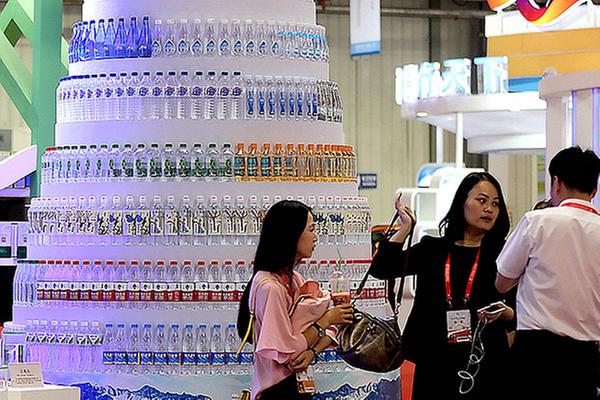 |
| A tower of bottled water on display at the opening of the 11th China-Northeast Asia Expo in Changchun, capital of Jilin province earlier this month. [Wang Zhengdong/for China Daily] |
Shoppers snap up upmarket labels with the industry projected to reach 86.5 billion yuan in 2021
Drinking upmarket bottled water has become chic for China's sophisticated shoppers.
The thirst for the right brands is growing despite rising prices as consumers go for the healthy option and leave fizzy, sugary soft drinks on the shelves.
Tang Min is a typical example of this new wave of conscientious customers.
She is a marketing manager at a Chinese boutique furniture store in Shanghai and buys an array of different kinds of bottled water.
"I choose mineral water of a specific brand for boiling tea and not just because it is healthier," she said. "The taste will be impaired if I use distilled water.
"When my four-year-old son cries for carbonated beverages, I will give him a bottle of sparkling water instead," Tang, 33, added. "I don't want him to grow into a humpty-dumpty with a mouthful of decaying teeth."
Consumers are increasingly going for this healthy option, a survey by market research company Mintel Group Ltd highlighted.
Between 2011 and 2016, China's bottled water sector increased more than 12 percent annually on average.
Last year, the industry was worth 60.7 billion yuan ($9.1 billion) and is expected to hit 86.5 billion yuan by 2021, Mintel reported.
In 2016, 25,906 million liters of bottled water were consumed. The number will continue to grow to 30,699 million liters by 2021.
"Premiumization, or the increase in high-end brands which are considered healthier, is the major driver of increased consumption of bottled water in China," said Li Lei, a research analyst at Mintel.
But then shoppers are not only buying more, they are going upmarket.
In the 400- to 800-milliliter sector, which is the leading category, mid- to high-end brands are taking an increasingly bigger share, Kantar Worldpanel revealed.
The consumer trends company reported that upmarket bottled water sales grew 27 percent from mid-2015 to mid-2016.
This was much higher than the 5 percent posted in the low-end market during the same period.
Naturally, companies are scrambling to get a larger slice of the high-end sector.
In March, Shenzhen Ganten Food and Beverage released its Blairquhan series upmarket label. This included mineral and sparkling water priced at around 15 yuan a bottle, which was sold in hotels, cinemas, cafes, bars and luxury department stores.
The Blairquhan series was launched after the success of Nongfu Spring.
Based in Hangzhou in East China's Zhejiang province, the company rolled out a high-end brand of mineral water in a glass bottle for 35 yuan in 2015.
International businesses have been quick to follow by dipping into this lucrative market.
In July, Reignwood Group, which distributes energy drink Red Bull in China, introduced Norwegian high-end bottled water brand Voss here.
A month later, Aoraki, the upmarket label marketed by French food producer Danone, made its debut in Shanghai and on e-commerce platforms.
"High-quality water sources are 'premium' among consumers," Li at Mintel said.
Indeed, this was evident in a poll conducted by the market research group about the retail habits of 2,965 shoppers aged between 20 and 41.
Mintel found that up to 71 percent of those surveyed last year were more concerned about where the water was sourced, compared to 68 percent in 2015.
Another 45 percent felt high-end bottled water helped provide additional health benefits, up from 42 percent in 2015.
"Consumers nowadays have become increasingly sophisticated and therefore look for value before paying a premium price," Li said.
"While high-quality water sources are strongly associated with 'premium bottled water', different age groups have different interpretations of 'premium'. This suggests companies and brands should target them accordingly," he added.
Sparkling water attracts mainly high-income consumers, while "black water", which contains additional minerals, is popular with younger shoppers, Li pointed out.
Even so, the overall beverage sector here has contracted for three consecutive years, consultancy firm Bain & Co confirmed.
Again, this is largely a result of the country's transition to services and the upgrading of traditional manufacturing industries.
"They are gradually moving from China to Vietnam and Bangladesh, where labor costs are lower," said Bruno Lannes, a partner at Bain & Co in China. "Products that usually target blue-collar workers, for example beverages, will see their sales decline accordingly."
The only exception will be the bottled water sector.
"People have accepted (rising) prices as they care more about their health," Lannes added. "It is not just about the wealthiest groups, it is about all consumers."