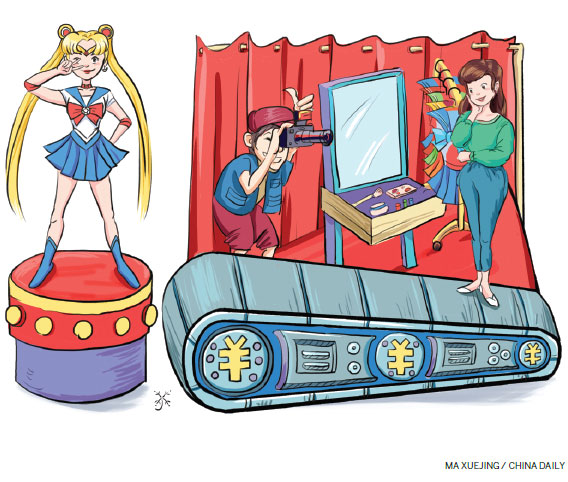
All dressed up for a new form of expression









Cosplay craze, inspired by cartoons and video games, is seen as offering another way for youngsters to express individuality
Editor's note: Many cosplay and ACG - anime, comics and games - events are being organized in China, making the subculture popular among some young people. Cosplay means costume play, in which participants wear costumes and fashion accessories to represent a specific character, real or fictitious. Two experts from the animation industry share their views on the issue with China Daily's Wu Zheyu. Excerpts follow:
It's an outlet for young people to show love for fictitious characters
By Deng Lili, director of the cartoon and game research center, Institute for Cultural Industries, Peking University
Cosplay participants often interact with each other to dress up as characters from animes, cartoons, comic books, films, TV programs and/or video games. Thanks to the rising number of cosplayers since the 1990s, a popular subculture has emerged in Japan, some other Asian countries and even in Western nations. The term "cosplay" was coined in Japan in 1984, inspired by fan costumes at science fiction conventions, which began with the first World Science Fiction Convention in New York City in 1939.
Cosplay contests on university campuses in China started increasing around 2008 and 2009. Initially, the students dressed up as Japanese animation and comic-book characters. But with the development of the Chinese animation industry, an increasing number of cosplayers started dressing up as characters from Chinese cartoons, comic books and video games.
Juveniles who enjoy cosplay are esoteric in nature and have their own sets of jokes, which "outsiders" rarely understand. Perhaps that's why people are prejudiced against them. But cosplay allows such young people to dress up as characters they like and express their love for fictitious characters.
Cosplayers are almost always young - most of them under 25 - and as they grow older they tend to give up the practice. So there's no need for parents to overreact to cosplay. Instead, they should treat such youngsters as normal, but at the same time warn them to never cross the social and moral boundaries. Once a cosplayer who wore a costume made from a Japanese military flag was barred from taking part in a contest. The incident reflected the distortions within the cosplay "community", some of which cross social and moral boundaries.
Additionally, many companies, especially online game providers, hire cosplayers or organize cosplay competitions in order to promote their new products. So regulators should strictly monitor such events to check if they also promoting inappropriate behavior.
Industry expected to witness more success
By Huang Guofeng, senior analyst at Analysis Corporate, a data analytics company for the entertainment industry
The cosplay subculture is a kind of performing art and is highly influenced by ACG derivative products. Usually, only zealous cosplay and ACG fans choose to participate.
Cosplayers usually obtain costumes in three ways.
First, through some companies that make and sell packaged outfits. Normally, such products are sold online, but they can also be purchased from dealers at cosplay conventions. Second, through some individuals who make customized costumes, props and/or wigs. And third, by making the costumes themselves using raw materials such as nonstyled wigs, hair dye, cloth, body paint, costume jewelry and toy weapons.
Based on our research, the development stages of China's ACG industry can be divided thus: the birth of the term ACG in 1995, and the emergence of campus communities in Chinese universities between 1995 and 2015, thanks to the influence of Japanese animation, along with the gradual growth of derivative products such as games and music-based animation.
With capital flowing into the ACG industry, 2015 proved to be a turning point, as several major content providers were shut down because of problems related to piracy and patent infringement. Since then, the domestic animation and game industry has been developing healthily with a stronger sense of using legal products. The 2016-18 period has been one of market stimulation, facilitating the segmentation of the market and helping build more specific, mature business models committed to developing the industry further.
China's ACG industry is likely to see higher growth in 2019, with major competitors leading the market, good branding driving leading companies' core competitiveness, and Chinese animation exercising greater influence on overseas markets.
(China Daily Africa Weekly 09/08/2017 page13)



Today's Top News
- Xi urges breaking new ground in advancing rule of law in China
- Dutch govt urged to mend chip dispute
- Macao's heritage sites hold special appeal for games
- China tackles N2O emissions, leading change
- AI should build a future where technology serves people
- Japan bears blame for worsening China ties