Making big fintech footprints









After UK success of crowdfunding index, Zhejiang University's Academy of Internet Finance looks to become a global research leader
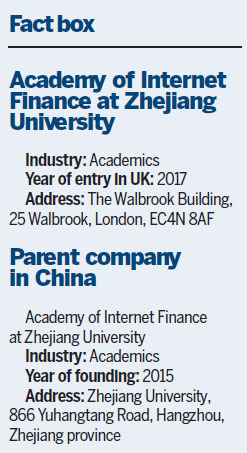
Just half a year after Zhejiang University's Academy of Internet Finance established a UK office to expand its overseas research capacity, the organization has launched several high-profile research bodies and formed a network of partnerships.
In June, the academy collaborated with the Cambridge-based technology company TAB to produce a comprehensive global crowdfunding index that was hailed as the first of its kind.
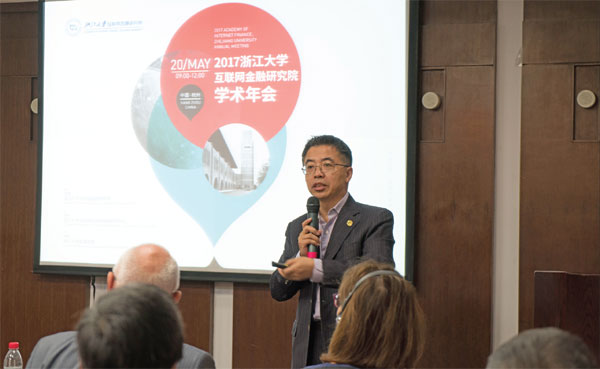
| Ben Shenglin, dean of Zhejiang University's Academy of Internet Finance, gives a talk at the AIF annual academic conference. Provided to China Daily |
During the G20 Global Leaders Meeting in Hamburg in July, the academy collaborated with a few German organizations to produce several studies on internet payment and infrastructure, and these were translated into proposals for G20 leaders. It is now working with the Cambridge Centre for Alternative Finance to jointly conduct a study on the Asian market's internet lending activities.
"Our vision is to be a global leader as a research institute in fintech, and maintain a positive and prominent presence in the global fintech community," says Ben Shenglin, a professor of banking and finance at Zhejiang University's School of Management and dean of the Academy of Internet Finance.
Following the academy's success in the UK, Ben's team is now preparing to launch new subsidiary offices in Singapore and the Silicon Valley in the United States to further develop its international influence. Meanwhile, Ben says the academy's strategy is to use London as its primary overseas hub to facilitate closer exchanges between China and Western countries in financial technology research and market development.

Ben says he feels that the academy's international development is very important, because the fintech industry itself is so international in nature, and also because China has an advantage because its fintech sector is rapidly developing and highly innovative.
"I feel that we as a China-based academic institution have the responsibility to translate the country's amazing fintech sector achievements into academic theory, and share these theories with other stakeholders across the world, so that China's experiences and expertise can be used to help more countries' fintech sectors grow," Ben says.
The Academy of Internet Finance was established in 2015 by drawing together Zhejiang University's resources in several of its existing departments and subject areas, including economics, law, management, mathematical sciences, computer science and technology, and public administration.
Its London expansion began when it set up a subsidiary in April, and its first product in the UK market is the crowdfunding index developed with TAB.
The index is designed to be used mainly by governments, regulators, investors and academics. It captures the sentiment of the whole crowdfunding market, Ben says, and serves as an industry benchmark.
"For example, if investors hope to understand the average return they can get from a crowdfunding platform, then looking at the industry norm from our index would help," he adds.
Ben says developing the index has been a challenging and rewarding experience, and he concedes that his team encountered many challenges along the way.
First, there was the challenge of data availability and consistency. "In China, there are about 6,000 crowdfunding platforms, but it is often difficult to be sure about the reliability of data from these platforms. Therefore, in the end we selected a collection of 2,800 platforms that we felt are relatively reliable in their data, and these platforms cover 65 percent of transaction volume in China," he says.
TAB collected data from 2,000 platforms, mostly from Europe, that amount to about 75 percent of transaction volume.
Second, there was the challenge of different countries' understanding of crowdfunding. "In China, crowdfunding platforms and P2P (peer-to-peer) lending platforms are slightly different concepts, whereas overseas they are seen as the same. So the two organizations had to agree on a definition that they are both happy with," he says.
"But because we're so committed to make it happen, and to ensure the index's launch is strictly following our agreed schedule, we worked very hard. We're glad that we achieved it, and that we were able to demonstrate to our UK partner that we stay committed to promises we make."
Ben says his team is already planning to develop crowdfunding indexes focusing on specific industries, such as crowdfunding relating to car loans, or geographical regions, such as China, the UK or Europe.
Riding on its success in the UK market, the Academy of Internet Finance has also conducted a few projects in collaboration with European governments and academic institutions.
One example is a comparative study on retail sector digital payment between China and Europe, in which the academy collaborated with Germany's central bank, Frankfurt University and German development agency Deutsche Gesellschaft fur Internationale Zusammenarbeit.
The idea of the study was related to Germany's hosting of this year's G20 Summit. The German government wanted to explore areas of continuity between China and Germany. The fact that retail-sector digital payment is a big trend and a sector of fast development in Hangzhou, Zhejiang province, prompted the German government to launch a study that identifies similarities and differences between how this sector is developing in China and Europe.
Putting the study together was another big challenge for Ben's team, he says, because a lot of the data in China was not readily available. Therefore, his students gathered an extensive amount of data in Beijing, Shanghai and Hangzhou. "They went to sample stores to gather information at the grassroots level, and together we compiled everything into a comprehensive data set," he says.
In addition, Ben's team conducted two studies relating to the G20 on digital literacy and digital infrastructure. Its proposal on digital literacy was selected as a part of the 20 proposals presented to the G20 leaders, Ben says.
Looking to the future, Ben says the academy will continue to expand internationally and stay committed to its footprint in the UK. "We see our UK expansion as an important step in our international growth strategy. London is an important financial hub and an important fintech market. We hope to use our London presence as a good hub to develop our activities across Europe," he says.
Such views mesh with the fast-growing fintech collaboration between China and the UK. Last year, during the UK-China economic and financial dialogue, an agreement between the two countries' finance regulators was signed to jointly strengthen the sector's growth.
Known as the UK-China Fintech Bridge, the agreement brings together the two countries' governments to exchange information and views so that they may better regulate fintech companies expanding into their markets.
Recognizing the huge opportunities within such regulatory frameworks, Ben's team at the Academy of Internet Finance is trying to participate in the bilateral fintech platform building. It is now joining hands with the Cambridge Centre for Alternative Finance to jointly bid to participate in the UK's Fintech Sandbox, a government framework to support fintech company growth, Ben says.
Ben sees a bright international future for the academy.
"We hope that we can play our part in the future of fintech development by facilitating the growth of a platform, allowing more players to exchange information and ideas, and sharing of thoughts and experiences across different countries, he says.
cecily.liu@chinadailyuk.com
(China Daily Africa Weekly 09/08/2017 page30)






Today's Top News
- Militarism revival efforts criticized
- Leadership highlights Party conduct
- Forging a human-centered future in era of smart machines
- Land-sea trade corridor key to regional progress
- Local rules to be reviewed to help disabled
- Stronger RMB points to resilience