unpolished, thanks~









15801182787
story for web, unpolished, thanks~
China has found workable solutions to desertification, as shown by successful projects like Saihanba Forest Farm, which is important for China and the rest of the world, according the UN’s top environmental protection expert.
Since 1962 when workers started planted trees, Saihanba Forest Farm, 150 kilometers from Beijing in Hebei province, has witnessed the forest coverage in the area soaring from 12 percent at that time to 80 percent in 2016, data from the forest farm showed.
Saihanba, the largest man-made forest in the world, has formed a natural barrier against sandstorm that protects the public health of millions of people living in the capital and its neighboring regions.
“The transformation of Saihanba is the result of more than 55 years of hard work by several generations of experts. ... That is a triumph of patience and determination,” Erik Solheim, executive director of the United Nations Environment Programme said in an exclusive interview.
He has personally witnessed the successful outcome of similar work like Saihanba recently in Kubuqi Desert in the Inner Mongolia autonomous region.
The total area of greenery in the desert, the seventh-largest in China, has expanded by more than 6,000 square kilometers in the past three decades, according to data from the region government.
“It’s a case of getting the science right, and being able to think big and take that vision forward with determined leadership,” Solheim said, adding that the patience to think long-term is also necessary, which has been proven in the 55-year efforts in Saihanba Forest Farm.
“Desertification is not just a major problem for China. Nations like Iran and Iraq face similar problems, as do countries in the Sahel region of Africa, and even parts of the United States. In parts of the Middle East, desertification is also a huge public health issue. We know that this kind of environmental degradation also drives instability and conflict.”
Thus it’s inspiring to see “the clear, workable examples of how these kinds of problems can be tackled,” he said, “This is not just important for China, but for the rest of the world, too.”
In addition to the efforts conducted in Saihanba and Kubuqi desert, China has taken comprehensive measures to reduce the desertification in decades, making the country’s total desert areas shrinking at a rate of 2,400 sq km a year, Vice-Premier Ma Kai said at a desert forum in July.
Solheim said in promoting the greening process, governments need to set up clear goals and necessary framework, and private sectors like companies, NGOs and local communities could nurture the innovative technologies and business opportunities.
“In the successful stories of Saihanba and Kubuqi Desert, they are really just well-rounded business plans, and they show the long-term economic benefits can outweigh the costs of the huge amount of work required,” he said.
Saihanba Forest Farm has developed in a sustainable way, with economic growth relying on tourism, tree seeding, wind power generation and logging — with the green sectors bringing in 100 million yuan ($15.1 million) last year, outweighing the revenue from past logging operations, data from the National Development and Reform Commission show.
“The success of projects like Saihanba and Kubuqi can form a component of China’s drive to build an ecological civilization and to take that message around the world, for example as part of the Belt and Road initiative,” he added.
“This work could also play a huge role in helping other nations meet their commitments, and indeed expand their commitments, under the Paris Agreement (on climate change).”





Today's Top News
- Xi meets IOC chief and its honorary president
- National Games an embodiment of China's strength, unity and progress: China Daily editorial
- Xi declares 15th National Games open
- Xi attends opening ceremony of 15th National Games
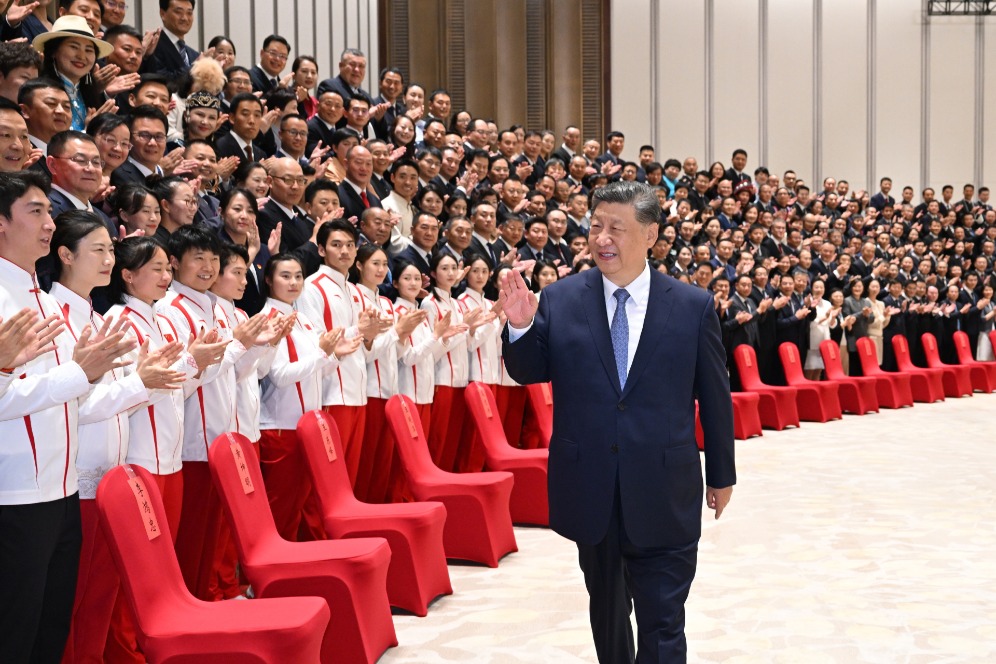
- Xi meets national honorees in sports
- Xi meets IOC president, honorary president