Spreading the sharing news









China's dockless bicycle business model is expanding to many international markets
It took 1,000 years for paper to reach Europe after it was invented in China around 150 AD. Fortunately, the rest of the world will not have to wait so long to use the dockless shared bicycle systems that are creating new transportation options in China's cities.
After starting at Peking University in 2014, ofo is already operating in eight countries - the United States, United Kingdom, Kazakhstan, Japan, Malaysia, Austria, Singapore and Thailand - and it plans to be in 20 by the end of the year.
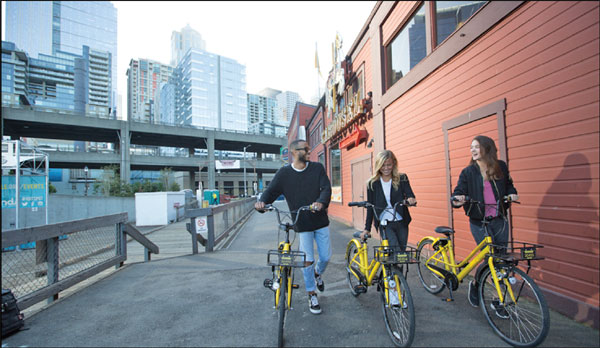
| People use ofo bikes in Seattle. Photos Provided to China Daily |
| Children ride donated ofo bikes to school in Salima district, in Salima City, Malawi in August. |

Zhang Yanqi, chief operating officer of ofo, says: "Going abroad has been ofo's vision from day one. Internationalization allows us to turn our brand from a China brand to a global brand. We also get a competitive advantage because we can attract global talent and see a lot of technologies around the world."
Asked why China was the first to develop dockless shared bikes, he replies: "In China, we have this huge problem of congestion and pollution. That is where the founding team at PKU started. China still has plenty of bike lanes, so city planners can save money by encouraging people to bike. Five or 10 years ago, China was still the kingdom of the bicycle, so we still have a culture of biking."
He added: "China has world-class bike manufacturers in terms of quantity and quality. Also, China's internet startups have been booming in the past five years. So, both manufacturing expertise and software innovation is available."
Ofo has partnered with singer Rihanna and the Clara Lionel Foundation in a program to give bikes to girls in poor rural areas of the central African country of Malawi, where only 8 percent of girls finish secondary school. For them, getting to school has been a long and sometimes dangerous trip. Now, ofo's donated bikes are changing their lives by giving them educational opportunities.
Joseph Seal-Driver, ofo's UK operations director, discusses how the system was adapted for local conditions in London's Hackney area, where ofo launched recently.
"We have been engaging with the relevant authorities in London, including the Mayor's office and the Greater London Assembly, as well as Transport for London," he says. "We have been encouraged by their openness to innovative ideas to help tackle some of London's perennial transport problems, like congestion and air pollution. We are always in full consultation with the local government wherever we go and constantly responding to the needs and concerns of local community."
How do people get from their home or office to mass transit stations or to nearby stores? Zhang stresses that the core capability of ofo is to solve this last mile problem, which exists everywhere in the world.
The problem can be expensive both for individuals and governments. Zhang notes that Brazilians on average spend 30 percent of their household income on transportation. In the US, lower-income households spend 16 percent and middle-income people spend 11 percent.
Ofo is attractive to planners because it costs the government nothing and it's cheap for users. The company is completely privately funded by investors.
Dai Wei, ofo's CEO, has said that the company will break even in 2017 and be profitable in 2018, with almost all of its revenue coming from the small fee people pay each time they use the bike. Most tech startups take much longer to become profitable.
Zhang says there's a lot more room to expand biking. He notes that in Amsterdam 30 percent of trips are taken by bike, but in nearby Paris only 3 percent are.
Obviously, the docked bike share system that Paris pioneered, called Velib, did not dramatically increase bike riding. But, because dockless shared bikes solve the last mile problem, they have the capability to transform cities.
The city of Manchester in northern England recently appointed former cycling world champion Chris Boardman as its "walking and cycling czar", aiming to improve the safety of the city and to move away from its car-dependent infrastructure. Boardman is often seen riding a bike from ofo's competitor Mobike, which launched there in August.
Seal-Driver says: "We are reshaping how we travel in cities. Bike sharing has the potential to make cycling more accessible for the whole community and make traveling in cities greener, quicker, and more fun. Ofo can help solve some of the perennial transport problems, such as congestion and pollution."
Zhang emphasizes that the product is "accessible, reliable, and affordable".
davidblair@chinadaily.com.cn
(China Daily European Weekly 09/15/2017 page7)






Today's Top News
- Drills demonstrate China's resolve to defend sovereignty against external interference
- Trump says 'a lot closer' to Ukraine peace deal following talks with Zelensky
- China pilots L3 vehicles on roads
- PLA conducts 'Justice Mission 2025' drills around Taiwan
- Partnership becomes pressure for Europe
- China bids to cement Cambodian-Thai truce