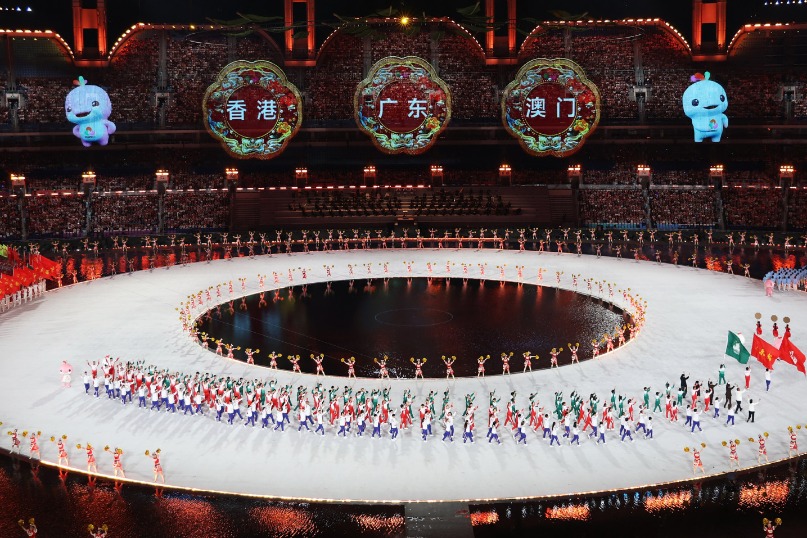
China concentrates on sci-tech innovation









BEIJING - Wang Junfeng and seven fellow Chinese researchers at Harvard Medical School gave up life in the United States to move to a small island on the outskirts of Hefei, capital of east China's Anhui Province.
"Science Island" is home to more than 10 research institutes and 1,000 top researchers - and an ideal place to focus on their research, they said.
In the 1990s and early 21st Century, many Chinese college students flocked to developed countries to pursue studies and professions with the help of more advanced research equipment.
In the past two decades, as its economy blossomed, China has attached greater importance to science and technology, making it an increasingly attractive base for researchers.
Wang said he came to the island because advanced experimental equipment on steady high magnetic fields was to be built there. It would make China the fifth country in the world to have such equipment.
Kuang Guangli, leader of the project, said the team has already made an impact in international academic circles and that the members have made greater academic achievements here than they did in Harvard.
SCI-TECH BOOM
Experience in China over almost a century has shown that it is necessary to mobilize efforts and resources to concentrate on major tasks. Now the experience is being applied to scientific and technological innovation.
Innovation is at the heart of China's 13th Five-Year Plan (2016-2020), which sets the aims to become an "innovation nation" by 2020, an international leader in innovation by 2030, and a world powerhouse in scientific and technological innovation by 2050.
At the forefront of fundamental research and strategic key technologies in fields such as space, deep sea, super computers and quantum communication, China has shown determination and speed, capturing world attention.
Over the past year, Chinese have been inspired by landmark achievements in science and technology.
Chinese scientists completed all the experiments designed for the world's first quantum satellite a year ahead of schedule, laying the foundation for a hack-proof global quantum communication network.
China's supercomputer, Sunway TaihuLight, was crowned the world's fastest computer at both the 2016 and 2017 International Supercomputing Conferences held in Frankfurt, Germany.
In early July, China made breakthroughs in the search for alternative clean energy sources by completing a 60-day trial of mining gas hydrates, commonly known as combustible ice, in the South China Sea.
"Combustible ice is considered a strategic alternative to oil and natural gas," China Geological Survey Bureau's deputy director Li Jinfa said. "The whole world is looking towards it."
In mid-June, China launched its first X-ray space telescope to observe black holes, pulsars and gamma-ray bursts.
"I am really impressed with how China is developing its scientific space program," said Arvind Parmar, head of the Scientific Support Office in the Science Directorate of European Space Agency (ESA). "The recent launches of the Dark Matter Particle Explorer and the Quantum Experiments at Space Scale missions highlight China's capabilities and commitment to science as does the range of missions under study for future launch opportunities."
China took a major step toward becoming a global aviation powerhouse as its homegrown large passenger plane, the C919, took to the sky on May 5. The flight makes China the fourth jumbo jet producer after the United States, Western Europe and Russia.
Last year, China launched its first space lab, Tiangong-2, and sent the Shenzhou-11 manned spaceship to dock with it. Two Chinese astronauts stayed in Tiangong-2 for a month, setting a new Chinese record for space residency.
In April this year, China launched its first cargo spacecraft, Tianzhou-1, to dock with Tiangong-2, to test space refueling technology, laying the foundation for building the country's space station.
This string of achievements shows the innovation-driven development strategy is paying dividends.
A report jointly issued by the National Center for Science and Technology Evaluation and Clarivate Analytics said China's expenditure on research and development accounted for 1.42 percent of GDP in 2006 and the ratio increased to 2.1 percent in 2016.
In 2016, China had over 1.1 million patents for inventions, ranking the third after the United States and Japan.
The latest Global Innovation Index showed China rose three places to 22nd on the list of the world's most innovative nations in 2017, the only middle-income country to join the top 25 innovative economies.



- China halts port fees on US vessels for one year
- China moves to cut teachers' administrative workload
- China launches group of internet satellites into orbit
- Former senior official expelled from CPC for serious violations
- Senior political adviser Yang Xiaowei expelled from Party, public office
- Former senior political adviser expelled, dismissed for legal violations