Prospects soften for overseas students









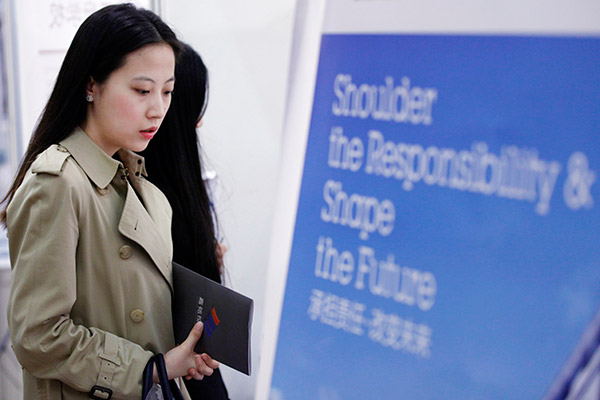 |
| Graduates returning home often have to attend job fairs to find work because the market is getting tight. [Photo provided to China Daily] |
Stronger universities at home, more competition dim job opportunities for some
Finding a job in China was once a breeze for graduates who returned home after studying at colleges abroad. Employers saw them as rare assets with an international flavor.
Now the game has changed.
The advantage returnees enjoyed in the domestic labor market has almost vanished in recent years due largely to two factors: a sharp rise in their number and the improving image of Chinese higher education.
As more head out, more are coming home. A record 666,000 overseas students are forecast this year to return home, where they will need to compete with 7.95 million fresh graduates from Chinese universities, according to recruiter Lockin China.
To help boost the chances of students in Australia finding work, Lockin China and the Australian embassy organized job fairs in Beijing and Shanghai in early July targeting that group.
More than 100 companies took part, while representatives from 17 universities Down Under were also there to learn more about the job market, promote the abilities of their Chinese students, and build relationships with local employers.
"We're really, really pushing for international students returning for jobs in China's two major cities," Rhett Miller of the Australian Trade and Investment Commission told reporters at the job fair. "And we want to make this national."
Michelle Maes, a senior adviser on employability at Monash University in Melbourne, said the information she gained will be used to coach Chinese students on what employers are looking for.
About 15 percent of the college's 70,000 students are from China, she said. "It's very competitive for them when they come back. Previously, there were few and they were special. It's wasn't hard for them to find work. Now, many more of them are studying overseas. They have to compete with more candidates. We want to support our Chinese students."
Working with employers
Speaking in August, Maes said some employers had contacted her after the job fair to discuss recruitment cooperation, while the college also will welcome representatives from Chinese companies this month during a tour organized by Lockin China.
Diane McLaren, manager of the careers center at the University of Western Australia, agreed that it is important universities with Chinese students make sure the students can get a job after graduation.
"It's a lot of investment," she said. "So we try to be here and make sure our students understand all the things they need to do to increase their employability."
More foreign universities are attending job fairs in China, especially since 2015, when more than half of all those who had left to study abroad returned home-a turning point, said Ge Wei, a manager with Lockin.
Tightened immigration policies in foreign countries also have contributed to the growing number of overseas-educated job seekers in China, she said.
According to the Ministry of Education, China sent 544,500 students in all abroad last year, while 4.6 million total left to study overseas from 1978 to the end of 2016.
The country saw about 432,500 people come back from overseas study last year, increasing the total number of returnees to almost 2.7 million.
Rankings can be affected
With this in mind, foreign universities have been paying more attention to employment of their Chinese students, as a low employment rate will not only affect a college's enrollment, but also its ranking, Ge said.
Yu Zhongqiu, vice-president of Vision Overseas, part of New Oriental Education and Technology Group, said overseas universities with a large number of Chinese students also have begun to employ Chinese or those who can speak Chinese in their career centers.
One task of those Chinese-speaking people is to seek employment information from Chinese enterprises to help their Chinese students secure jobs.
The number of overseas universities that come to join job fairs in China is still small compared with the total number of universities with Chinese students, but it will continue to increase, he said.
Returnees no longer have many advantages when competing with their domestically educated rivals for jobs. Not many employers would like to employ them with high salaries, as "many domestic graduates are also capable of doing what they can do", Ge, of Lockin China, said.
On average, overseas returnees make only about 500 yuan ($76) more a month than their peers who study at home. She said they do still enjoy more opportunities for promotion and salary increases.
Salaries 'open to discuss'
Crystal Kong, chief executive of Lockin China, said she has seen a big change in returnees' income expectation in recent years. "Previously, the minimum wage expectation of most students stood at 10,000 yuan a month. In recent years, many will say they are open to discuss their salary," she said.
Returnees also position themselves "more accurately" in the job market, as they realize they are no longer rare, she added.
There was a blowout in growth of Chinese overseas students in 2001, when China joined the World Trade Organization. Although the number continues to be on the rise, the growth rate has declined, according to a report on overseas returnees published in June by recruitment website Zhaopin.
Chinese students now can get quality education at home that is more cost-efficient in both time and money due to the country's improving higher education system, said Wang Yixin, a senior vocational counselor at Zhaopin. He explained that many universities have established cooperation projects with their overseas counterparts.
Some now hesitant
The low return has made some students hesitate to study abroad. The overseas experience, however, is still attractive for many, as that will help broaden horizons and experience alien cultures while studying.
Wang said about one in four international students at overseas universities is Chinese.
However, some are anxious about their job prospects.
Chen Dehao, 21, is halfway through a four-year engineering degree, yet he attended the job fair in Beijing in July to weigh his options.
There are too many returnees now, he said. "I don't know whether to come back or stay in Australia after I graduate. It's all I think about."