Wisdom in China's helping hand









Focused approach helps both the recipient country and the provider of project funds
While the ultimate effectiveness of the Western approach to foreign aid may be open to question, China's markedly different aid model might have some lessons for the world on how to develop a win-win situation for both aid recipients and benefactors.
Foreign aid, at least on the surface, has provided crucial resources to support the growth of poor and developing countries, as well as to enable the recovery of communities after natural and humanitarian disasters.
Angus Deaton, who won the 2015 Nobel Prize in economics, has said that "most overseas development aid is a waste and even a destructive use of money". His argument is that aid provided through conventional means can actually undermine the development of struggling economies and weaken their capacity to be self-sustaining.
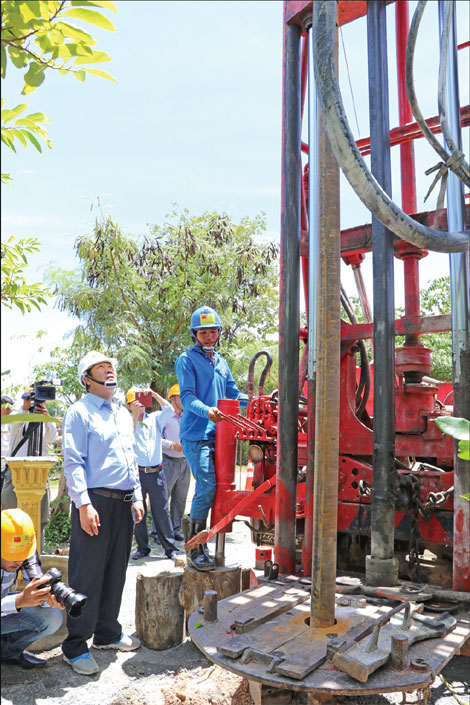
| Chinese workers dig a well in Cambodia's Kampong Speu province. Mao Pengfei / Xinhua |
Deaton's view is not new - critics of Western foreign aid often say that any assistance toward the development of poor countries must promote self-sustainability through policies that boost economic growth and improve education, healthcare access, infrastructure and trade.
"Evidence shows that the Western practice of dispersing aid through multilateral organizations is often ineffective," says Chen Qi, a foreign policy researcher at Tsinghua University. "The money often misses the target."
UNESCO, for example, has been criticized for spending 50 percent of its annual budget of around $735 million on staff salaries.
A 2015 study by the European Parliament's committee on budget control found that each year more than 900 aid projects worth a combined $15 billion failed to achieve their objectives or were delayed. Half of the European Union's annual $30 billion development aid budget seemed to have missed the target. And the chairwoman of the report described such aid as money "thrown down the toilet".
By contrast, China's apolitical, "no strings attached" aid model - which is conspicuously different from the Western approach - adopts a framework that promotes the development of struggling countries while contributing to China's trade and economic growth.
"The result is that money doesn't end up in nondevelopment activities as much. The strategy is much more direct in targeting poverty reduction and other developmental difficulties," Chen says.
China mainly distributes its foreign aid as grants, interest-free loans and concessional loans. Grants and interest-free loans come from China's State coffers. Interest-free loans usually have a tenure of 20 years, including five years of use, five years of grace and 10 years of repayment. Concessional loans are provided by the Export-Import Bank of China, and the interest rate is lower than the benchmark rate of the People's Bank of China.
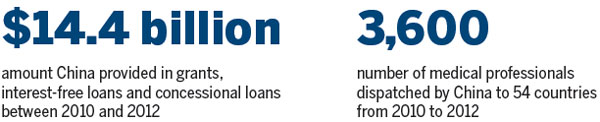
According to a 2014 government white paper outlining China's efforts on foreign assistance, the country provided $14.4 billion (12 billion euros; £10.6 billion) in grants, interest-free loans and concessional loans between 2010 and 2012. A little more than a third of the total was given out in grants, 8 percent was in interest-free loans and almost 56 percent was concessional loans.
"Grants are mainly offered to help build small or medium-sized social welfare projects and to fund human resources development cooperation, technical cooperation, material assistance and emergency humanitarian aid," says Neil Wang, Greater China president at the consultancy Frost & Sullivan.
"Interest-free loans are mainly used to help construct public facilities and launch projects to improve people's livelihoods," he says. "Concessional loans are mainly used to help undertake manufacturing projects and large and medium-sized infrastructure projects with economic and social benefits, or for complete plants, machinery and electronic products."
Of the concessional loans, about two-thirds have traditionally been used to assist in the construction of transportation, communications and electricity infrastructure in developing countries, while 8.9 percent have been used to support the development of energy and resources, such as oil, according to the white paper.
Through these three methods of grants and loans, China's foreign aid expenditure aims to improve agriculture, education, healthcare, infrastructure and welfare facilities, thereby boosting job creation and reducing poverty.
And the management of this expenditure is mature. China's foreign aid is managed by the Ministry of Finance under its budgets and final accounts system. It is also handled by the Ministry of Commerce and other departments under the State Council, China's cabinet.
Every year, each of these departments presents a budget for foreign aid projects, which is then examined by the Ministry of Finance and approved by the State Council and the National People's Congress. The departments control their own funds for foreign aid, while the Ministry of Finance and the National Audit Office supervise and audit the implementation of the projects.
"China's foreign aid model has several unique attributes," says Tsinghua's Chen. "The way China allocates aid has a strong philanthropic element, which can be seen in the country's Five Principles of Peaceful Coexistence."
Those principles - initially drawn up to define relations between India and China - include a foreign policy of nonintervention, which is a foundation of China's approach to foreign aid.
In other words, China's approach respects the political landscape of other nations. This is in stark contrast to the Western approach to foreign aid, which takes into consideration the recipient countries' adherence to free market principles, governance, democratic values and human rights.
Another attribute is the emphasis on common development - the vision for win-win outcomes for both China and its aid recipients. Through deals that involve aid, trade and investment, China's development aid model creates synergy and mutual benefits with the recipient nations.
In this way, not only does aid from China foster self-sustainability in struggling economies but it also ensures there is no unfair burden placed on Chinese citizens.
In addition, China has strong control over how its aid money is spent because the model is almost entirely bilateral. There is an emphasis on using the aid through Chinese companies and supply chains that are operating in the recipient nations.
However, this national interest is counterbalanced by an insistence that the aid directly contribute to the development of the recipient nations through improvements in agriculture, mineral extraction, transport infrastructure or manufacturing.
The government white paper refers to these operations as "complete projects", which are "constructed in recipient countries with the help of financial resources provided by China as grants or interest-free loans".
"The Chinese side is responsible for the whole or part of the process, from study and survey to design and construction, and it provides all or part of the equipment and building materials and sends engineers and technical personnel to organize and guide the construction, installation and trial production of these projects. After a project is completed, China hands it over to the recipient country," the white paper said.
Aside from grants, interest-free loans and concessional loans, other official funding under economic development initiatives is also provided by various government departments.
For example, from 2010 to 2012 China provided technical training to almost 50,000 people from poorer countries and around 300 training programs for around 7,000 agricultural officials. Currently, about 10,000 people from developing countries receive training in China each year.
"Technical cooperation is an important means by which China helps recipient countries strengthen their self-development capacity," the white paper said. "Technical cooperation projects usually last one to two years and can be extended at the recipient country's request."
Such training covers a wide range of fields, including industrial production and management, farming and agricultural technology, handicrafts (such as weaving), sports and physical training, healthcare, education, clean energy development and economic planning.
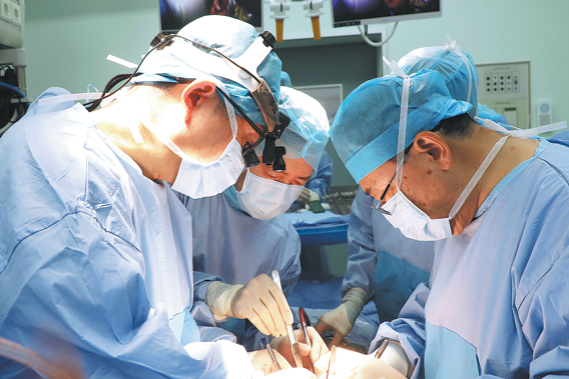
According to the white paper, China dispatched more than 3,600 medical professionals to 54 countries from 2010 to 2012. Also, as part of its efforts in international disaster prevention and relief, China has sent more than 30,000 peacekeepers and rescue teams to such countries as Nepal, Afghanistan, Haiti and South Sudan.
For China Daily
(China Daily European Weekly 09/22/2017 page7)



Today's Top News
- Wang to meet foreign ministers of Cambodia, Thailand in Yunnan
- China's top legislature concludes standing committee session
- Thailand and Cambodia agree to temporary ceasefire
- NPC's 4th annual session slated for early March
- Civilizational links for a fairer world
- Manufacturing in China spurs global growth