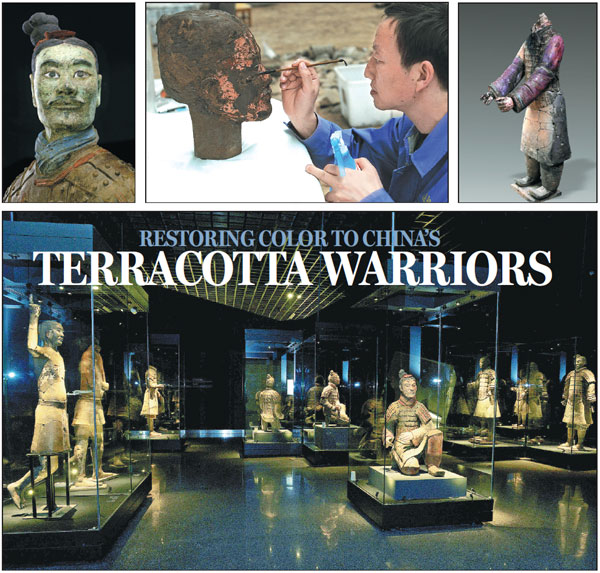
Restoring color to China's Terracotta Warriors









Ongoing exhibition shows how researchers are repairing precious relics
XI'AN - Four minutes. Just four minutes is all it takes for the rarest colors on Earth to fade in front of a pair of human eyes. Han blue and Han purple, also called Chinese blue and Chinese purple, are made of synthetic barium copper silicate.
The pigments were first used in paint in the Qin Dynasty (221-206 BC), and in large quantities in the Terracotta Warriors unearthed from the tomb of Emperor Qinshihuang, China's first emperor, who lived between 259-210 BC.
"Almost every warrior and horse was painted, but after more than 2,200 years the pigments were so old they began to change just 15 seconds after they were unearthed, and within four minutes the lacquer layers that were bound with the pigments broke from the surface," says Xia Yin, director of relics protection department at Emperor Qinshihuang's Mausoleum Site Museum.
| The life-size Terracotta Warriors were first discovered in 1974 from the tomb of Emperor Qinshihuang, China's first emperor. Photos by Shao Rui / Xinhua |
"Before the artifacts were unearthed, they were protected by a cooler and more humid underground environment," says Xia, who has spent more than 20 years researching the artifacts.
The life-size clay figures were first discovered in 1974 in the underground mausoleum, the world's largest. But there were no advanced techniques to properly protect the warriors, Xia says.
"Photographers did not have the time to take a picture before the paints began to disappear," he said.
For the last 20 years, Chinese researchers have collaborated with German scholars on preserving colors on pottery.
An exhibition is on in Xi'an, capital of Shaanxi province, where the mausoleum is located, to show the progress researchers have made in retaining the colors of the excavated artifacts. The exhibition started on Aug. 30 and will last three months.
Rare paints
No written records have been found on the production of Han purple and Han blue. The rare paints were used on pottery, murals and tomb artifacts during the Western Zhou period (1046-771 BC) until the end of the Han dynasty (AD 220). However, since then they have disappeared.
"Synthetic barium copper silicate is made from azurite, barite, quartz and other minerals heated together in temperature around 1,000 degrees Celsius. We can try to make the pigments in labs, but it is a very difficult technique, even for today," Xia says.
The paints were bound to the surface with lacquer, symbolizing luxury and status. They were used by emperors and noble families.
Overall, in the Qinshihuang mausoleum, there are more than ten colors for the Terracottas, including scarlet, pink, green, jujube red, azure, pink-purple and reddish brown.
"The colors on the surface of Terracotta Warriors show vibrancy and liveliness in the emotions of the Qin people. It is definitely not one of sadness or low spirit," says Yuan Zhongyi, a senior archaeologist and retired curator of the museum.
Better protection
The first excavation began on Pit No 2 in 1994. Nearly 8,000 life-size warriors and horses along with tens of thousands of pieces of weaponry have been uncovered in three pits.
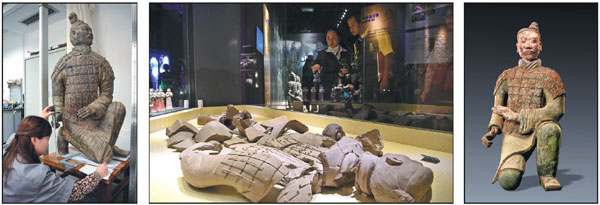
"We sprayed an antiseptic substance to the layers once the warriors were unearthed, wrapped them with plastic membranes to keep them humid and had skilled workers to clean the surface and work on them in labs," says Hou Ningbin, curator of the museum.
The new techniques can keep the paint stable for over ten years, he said.
The technology has been used on repairing unearthed artifacts from other parts of China.
"Now visitors can see for themselves the scarlet hair bands, pink faces, scarlet lips, purple robes and pants of the warriors. They can also visit our digital museum to explore the vividness of colors on the warriors," Hou says.
"The excavated part of the mausoleum is about 1 percent of the total. What we know is the tip of an iceberg. Many more things remain buried underground, but we'd rather things remain as they are now, because we may not be technically ready to protect them yet," Hou says. "The world of colors down below is still a mystery, and we need to be patient."
Xinhua
| Now visitors can see for themselves the scarlet hair bands, pink faces, scarlet lips, purple robes and pants of the warriors. |
(China Daily 09/23/2017 page16)