China model suits nation most









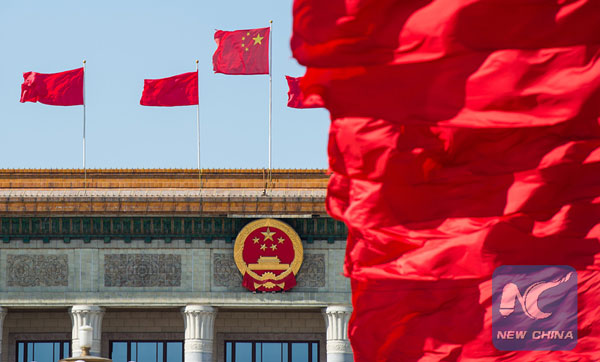 |
| Red flags on the Tian'anmen Square and atop the Great Hall of the People in Beijing. [Photo/Xinhua] |
The year 2016 might go down in history as a watershed moment for the global economy. Not only did the United Kingdom decide to leave the European Union, but also a globalization skeptic was elected president of the United States. And, in stark contrast to these inwardly looking events, China stepped forward as the champion of globalization and improved global governance.
Shortly after he assumed power, Donald Trump overruled major legacies of his predecessor by pulling the US out of the Trans-Pacific Partnership agreement, and seeking to repeal the Paris Climate Agreement and the Affordable Care Act, known as Obamacare. He is not alone in putting short-term personal influence before long-term national interests, which explains why a slew of economies in the West are either heavily indebted or suffer from waning competitiveness.
What makes China stand apart is its institutional efficiency, which has evolved from its political and cultural traditions, as President Xi Jinping concluded three years ago. At the macro level, the system allows China to make long-term plans and carry them through, an unlikely scenario in Western politics due to the constant reversal of policies whenever there is a change of government.
As a result of the wide solicitation of public opinions and thorough consultation with representatives from all walks of life, China's five-year plans ensure the country remains on the right track without being subject to its changes in leadership.
Western general elections, meanwhile, which are designed to enshrine the principle of "one person, one vote", have also led to notable wastes of talent. Political leaders are supposed to be chosen primarily based on their capability, yet the outcomes of general elections in Western countries are often determined by other factors including race, gender, appearance, religious belief, even eloquence.
Poor choices of political leaders aside, partisanship in many Western economies means talented members of the opposition do not have the opportunity to contribute to the ruling administration. The shortage and waste of political talent, coupled with increasing political scandals, have wrought havoc on the efficacy and consistency of Western politics.
China's success in electing eligible leaders has a lot to do with its capability-oriented recruitment system, in which all candidates have to go through decades of service in different local governments. These down-to-earth posts not only offer political talents firsthand experience of social governance but also help them promulgate targeted policies when in office.
Unlike China's democratic centralism, the Western political systems subject political power to voters and capital, which leads to inefficient governance and political shortsightedness.
Former US president Barack Obama was known as an enthusiastic advocate of high speed rail before he took up residence in the White House in 2008. His administration's 2009 stimulus bill allotted billions for high-speed rail projects, which were rejected or stalled after domestic airlines, expressway companies and citizens refusing relocation opposed them. Most of the federal funds have been used for upgrades to existing services such as Amtrak.
China, now a pioneer in high speed rail construction, has managed to press ahead with similar projects, which has actually prompted airlines and expressway companies to improve their services and lower their prices.
China also dwarfs many Western nations in its ability to mobilize and coordinate public participation in the face of emergencies and natural disasters, further evidence that China's development path should not be scorned.
The author is a researcher at the China Institute of Fudan University in Shanghai.