Everything under the sun









In just five years, China's solar industry went from 'life support' to global industry superpower
In late 2012, China's solar industry was on "life support". The warning came from Li Junfeng, deputy director of the energy research institute of the National Development and Reform Commission, which manages China's renewable energy policy.
So many solar panels were being produced that their value was plummeting; Li indicated that a crisis was on the horizon unless the world, including China, dramatically slashed production.
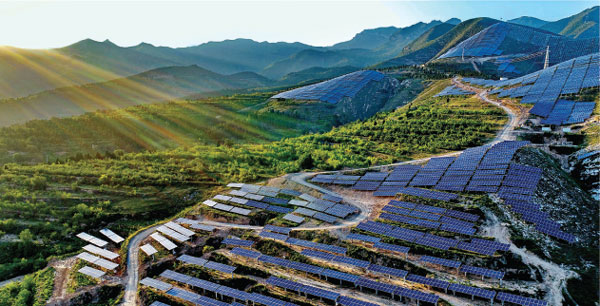
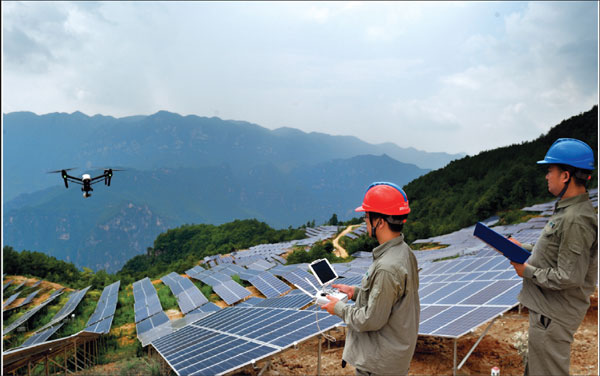
| A drone surveys a solar power station for impoverished areas near the Three Gorges Reservoir in Hubei province. Photos Provided to China Daily |
The European Union first imposed tariffs on Chinese solar products - which make up one-third of sales in the EU - in 2013. They were allegedly retailing at below production cost. It extended the trade measures to the end of 2015.
In September, the EU issued its final announcement that it will limit China's solar panel exports by setting a minimum import price. The regulation would be implemented from Oct 1, and the minimum import price will be set step-by-step. The Ministry of Commerce said on Sept 18 that the European Union's decisions regarding tariffs on Chinese solar panels were a positive step toward market normalization, and it hopes the EU will completely scrap such measures.
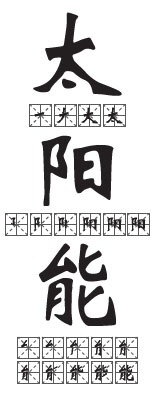
The EU tariffs are one of the few stumbling blocks still left for a resurgent Chinese solar industry, which, just five years after being at death's door, is now regarded as a superpower in an industry worth $100 billion (85.1 billion euros; £75.8 billion) globally, and expected to expand by an estimated 13 percent annually. In 2016 alone, China was responsible for half the world's solar capacity, doubling the size of the domestic industry.
In 2008, China set a goal of 1.8 gigawatts for its solar capacity by 2020; in 2014, that was dramatically revised upward to 100 gW. The target was met this year, when China installed 10 gW in July alone. Reuters recently reported that the country industry was expected to produce 60 gW worth of solar panels in 2017 alone, a 25 percent increase on the previous year.
China recently unveiled the world's largest floating solar farm, in a flooded coal-mining region in Anhui province, an experimental project that aims to see whether still bodies of water can be used for power generation.
That's far from the only large-scale project recently completed. A farm in the shape of a panda was recently unveiled, along with plans for another 100 panda-shaped solar-panel farms across Asia. Even this massive project seems minor compared with the proposal presented to the United Nations by China's State Grid Corp in late 2016, suggesting the creation of a global grid by 2050. Under this ambitious plan, solar, wind and hydroelectric power would be generated in areas with abundant resources and sold across borders to population centers that need power.
It's a plan that would have been unthinkable five years ago. Industry publication Scientific American, citing the US Department of Energy, points to Germany, which launched a program to promote rooftop solar panels in the late 1990s. The policy proved so popular that domestic production was overwhelmed by demand. The deficit was met by China, with the aid of German capital, technology and expertise. After Italy and Spain launched their own renewable-energy incentive programs, Chinese manufacturers realized there was ongoing EU demand to be met and began to seek more overseas solar investment - expertise and the materials, such as polysilicon supplies, needed to fuel its industry.
The process took decades, as it required building huge, often automated, factories and acquiring multiple technologies, during which China's solar future was uncertain. Renewable energy demand has come in booms and busts, but one constant was that China's solar expertise and manufacturing capacity were making steady improvements.
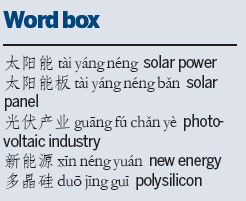
As global prices plummeted, China's domestic demand started to ramp up. Partly as a consequence of the low prices and ready availability of the technology, local governments began offering their own variants of the original German program, and China was suddenly in an enviable position.
The risks associated with razorthin margins are just as acute today, if not more so. But there are other potential problems lurking on the horizon for Chinese solar. While the future of solar power may still be under a cloud, one aspect is not: China will be at the center of the storm, for better or worse.
Courtesy of The World of Chinese; www.theworldofchinese.com
The World of Chinese
(China Daily European Weekly 10/27/2017 page13)




Today's Top News
- Spanish king on first state visit to China
- Japan must stop playing with fire on the Taiwan question: China Daily editorial
- The one who tied knot must untie it: China Daily editorial
- Xi congratulates Ouattara on re-election as president of Cote d'Ivoire
- Supercarrier to be put through paces
- Game changers for China's sports industry