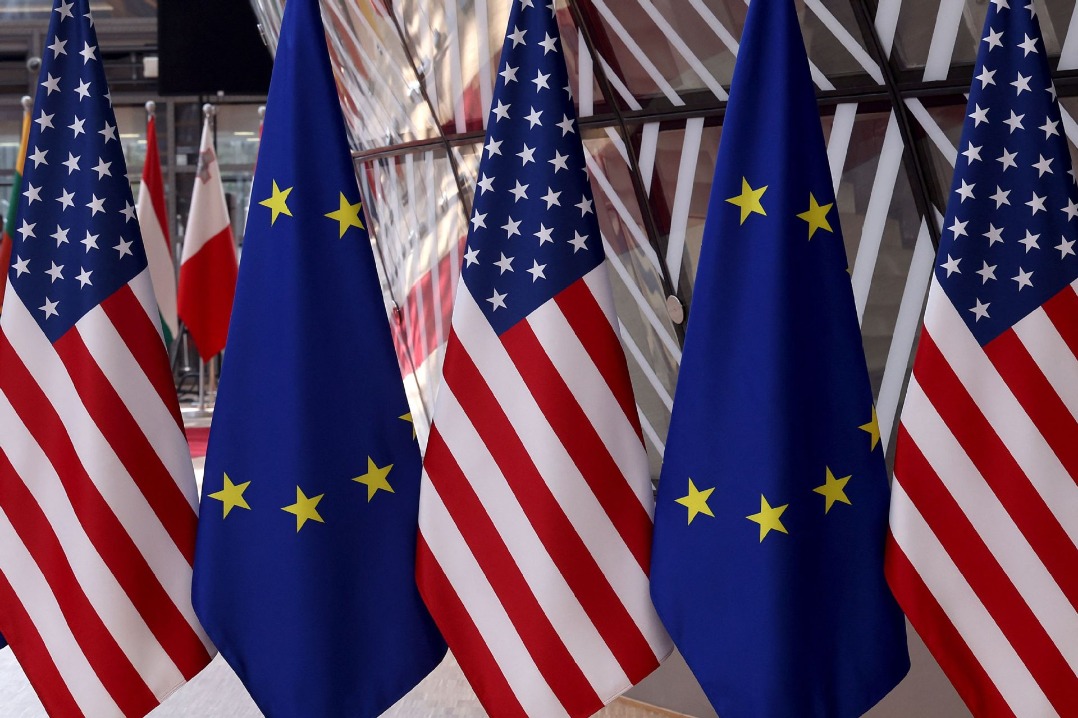
Aligned stars point the way forward









As the global recovery accelerates, now is the time for ambitious policies that will support growth and raise economic resilience
The International Monetary Fund's recent World Economic Outlook and China's strong economic performance suggest that now is the time to advance reforms.
The World Economic Outlook highlights that global recovery is gaining momentum, with growth now projected to reach 3.6 percent this year and 3.7 percent in 2018. This is well above the 3.2 percent of 2016, when global growth was still faltering and financial markets were turbulent, and calls for policy action to secure the recovery.
The good news is that global acceleration is more broad-based than at any time since the start of this decade, as cyclical upswings accelerate in Europe, China, Japan and the rest of emerging Asia. The United States is also growing above trend. This synchronized recovery offers a global window of opportunity for ambitious policies that will support growth and raise economic resilience.
Head winds exist nonetheless, and the recovery remains incomplete. Inflation and wage growth remain low in many countries, while some, especially commodity exporters and those beset by civil or political unrest, still face more complex challenges. In addition, the medium-term outlook in the advanced economies remains subdued, reflecting long-term productivity and demographic trends.
Closing the gaps in the recovery, therefore, requires policy action now. Policies will differ across countries, yet all have ample room for structural reforms that can raise economic resilience and potential output.
Fiscally, for countries that have returned to full employment, it is time to think about gradual consolidation and building buffers. In countries with fiscal space, higher infrastructure and educational spending can boost future productivity and offset fiscal consolidation elsewhere. And all countries will benefit significantly from investment in human capital, especially for youth, which is crucial to sustaining economic development.
Global challenges require global solutions. And the synchronized global recovery likewise opens a new window for multilateral cooperation. Yet existing multilateral systems need to adapt to the changing global environment and promote mutually beneficial cooperation. Priorities include strengthening the global trading system, improving financial regulation, enhancing the global financial safety net, reducing international tax avoidance and fighting famine, infectious diseases and climate change.
Against this favorable backdrop, China's economy is looking stronger in 2017. In particular, industrial growth, after continued deceleration, has stabilized, while the service sector remains robust. Strong, near-term growth arises in part out of recovering exports, as well as domestic policy support and supply-side reform. Producer price inflation has surged after years of deflation, boosting corporate profits and improving companies' capacity to service debt.
Strong economic growth and tighter enforcement of capital controls have also dampened capital outflow pressures, which had been mounting over the past two years. Reflecting the strong momentum, the IMF has raised its projection of China's growth to 6.8 percent in 2017 and to 6.5 percent in 2018.
The medium-term growth projection has also been revised upward to an average of 6.4 percent until 2020, mostly reflecting the government's target of doubling the 2010 GDP by 2020. However, this comes at the cost of higher medium-term debt levels and increasing vulnerabilities. China truly has the potential to sustain strong growth over the medium term, but to do so safely requires reforms to make growth less reliant on debt and investment.
China has made substantial progress in rebalancing its economy in recent years. The current account surplus has come down from a peak of 10 percent in 2007 to below 2 percent now. And consumption and services are gaining a larger share of the economy.
Yet rapid credit expansion and debt overhang remain risks to the sustainability of the economy. Recent strong growth provides a good environment to intensify deleveraging, particularly to speed up the exit of "zombie" companies and the cleanup of associated nonperforming debt. Such reforms, unavoidably, will entail short-term costs. But this can be mitigated by on-budget fiscal support for labor reallocation and settlement, and the best time to do so is when growth is strong and the overall labor market remains resilient.
To facilitate economic rebalancing, China has room to boost consumption by increasing social spending and making the tax system more progressive. Increasing the role of market forces, meanwhile, by reducing implicit subsidies to State-owned enterprises and opening up to the private sector will improve allocation of resources. And deleveraging the private sector by maintaining the recent regulatory tightening and focusing more on quality of growth and less on quantitative targets will reduce vulnerabilities.
The Chinese government has already taken important initial steps to facilitate private sector deleveraging, and credit growth is slowing. Financial deleveraging, by curbing interbank borrowing and shadow banking, has also made significant progress. In addition, the government has made efforts to curb borrowing by local government financing vehicles. These efforts should be maintained.
By pursuing its reforms, China can look forward to a bright future with sustainable, greener and more inclusive growth, as General Secretary Xi Jinping said in his report to the 19th National Congress of the Communist Party of China.
Alfred Schipke is IMF senior resident representative of China, and Zhang Longmei is IMF deputy resident representative of China. The views do not necessarily reflect those of China Daily.
(China Daily Africa Weekly 10/27/2017 page22)






Today's Top News
- Judicial reform critical for modernizing governance
- Effective use of investment emphasized
- China's shuttle diplomacy strives to reach ceasefire
- Nanjing Museum's handling of donated art, relics being probed
- Key role of central SOEs emphasized
- New travel program hailed as 'milestone'