1840: Why the 19th-century opium wars between imperial China and Britain are still relevant in modern China









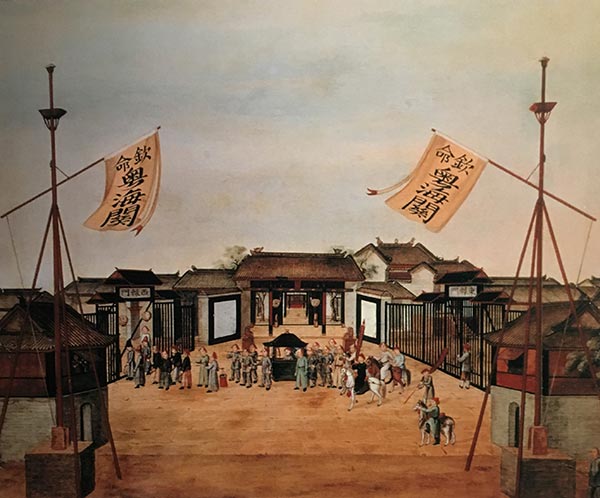 |
| An artwork depicting Canton Customs, the official channel through which foreign traders could do business in China during Qing rule, at the Thirteen Hongs Museum in Guangzhou. [Photo by Satarupa Bhattacharjya/China Daily] |
Once opium was outlawed by the Qing government in 1800, the so-called free traders, with ties to the British East India Company, started smuggling it by mixing businesses. They would hide the opium in ships and boats that sailed with commodities that they were allowed to legally sell in China and hand the substance to Chinese dealers at Huangpu harbor in Canton.
An anti-opium drive was launched after 1820, the smuggling's heyday, which made the harbor off-limits for both traders and dealers. That was when a warehouse on the waters near an estuary of the Pearl River was set up, serving as the new center of the illegal business and later as a site of battle.
The Chinese dealers would pick up the opium from there, according to the museum exhibits.
Wu calls it the "dirty trade".
The opium wars also exposed the frailties of the Canton System in operation then. It was a monopoly run by the Hong merchants with whom alone foreign traders could liaise for their business in China. Other than British presence in the Thirteen Hongs area, there were Danish, Spanish, French, American, Swedish and Dutch company representatives.
The Canton System later collapsed from within mainly because of the lack of financial support.
Liang Fengxin contributed to this story.