Elderly deserve better care and services









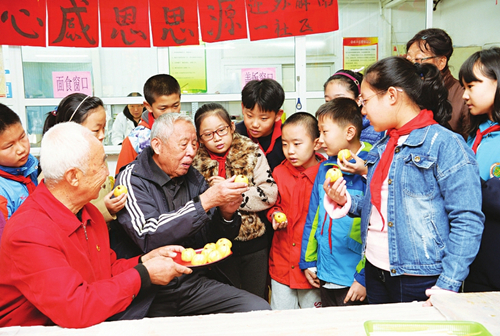 |
Senior residents celebrate Chongyang Festival with students of Dananguan Primary School in Taiyuan, Shanxi province, Oct 27. The visitors told various stories to educate and entertain the children during the celebration. Chongyang Festival, which falls on the ninth day of the ninth lunar month each year, is a traditional Chinese festival to pay respect and gratitude to seniors. [Photo/Shanxi Daily] |
In his report to the 19th National Congress of the Communist Party of China on Oct 18, General Secretary Xi Jinping said China will adopt policies that will help foster a social environment in which senior citizens are respected, cared for and live happily. As part of that effort, senior citizens will receive integrated care and medical service, and the programs to provide better elderly care will be expedited.
Building a foolproof elderly care system is a huge and complicated project, which should take many factors into consideration such as the Chinese tradition of filial piety, socialized old-age care, and the various types of care needed by senior citizens of different age groups.
Studies show that "empty nest" senior citizens account for at least 50 percent of China's total elderly population, and the percentage is increasing. With an overwhelming majority of families having one child and the flow of migrant workers into cities, family and home-based old-age care is no longer possible for many.
Healthy and active senior citizens want to spend their later years in the place they are familiar with, and prefer home-based care. But the elderly living alone in "empty nests" face many inconveniences and risks. For such senior citizens, the authorities should provide necessary help and take measures to improve community support for them.
According to the Ministry of Civil Affairs, community support for the elderly covers all the urban communities and more than a half of the rural communities. This means there is plenty of room in rural areas to develop community support for the aged.
In the given circumstances, an ideal arrangement would be the elderly and their grown-up children living separately but nearby, so that they can visit each other occasionally, if not frequently. But in reality, even some people living with their elderly parents cannot always take proper care of them, considering the typical"4-2-1" (four grandparents, two parents and one child) family structure in China.
A socialized old-age support mechanism is, therefore, called for. The Law on the Protection of the Rights and Interests of the Elderly advanced a comprehensive old-age support mechanism that is based on family-based old-age support, and relies on community and institutional support for elderly care.
Socialized old-age support reflects the division of family and society in the old-age care system, in which the family and society share the responsibility of providing care for the elderly. So developing a community-based old-age support mechanism and institutional elderly care is the need of the hour.
But the development of institutions for elderly care faces some problems, the foremost being the imbalance in supply and demand. The Ministry of Civil Affairs says China has more than 28,000 registered institutions for old-age care with about 7 million beds. However, public elderly care institutions enjoy better reputation and their services are much in demand, whereas private institutions are generally found wanting when it comes to taking proper care of the elderly.
The authorities should therefore deepen supply-side structural reform of public old-age support resources to both guarantee social security for elderly support and promote elderly care institutions, as well as to improve the management and service quality of such institutions.
Considering China's growing elderly population, institutions providing elderly care should not only fulfill their social responsibilities but also ensure quality and fair services, in order to safeguard senior citizens' rights and interests.
In particular, the old-age support problem can be attributed to China's special condition. For more than three decades, many of the Chinese families followed the family planning policy, leading to the"4-2-1" family structure, which in turn weakened the traditional old-age support system. So it is the obligation of the authorities now to take measures to improve the social welfare system and support mechanism for the elderly who, by following the strict family planning policy, helped restrict the population growth, which was necessary for China's fast-paced economic development and prosperity.
The author is a professor at the Population Research Institute of Peking University.