Belt and Road - reaching far and wide









The success of such a massive and wide-ranging project depends of the kind of expertise and pragmatism UK and Europe can provide
China and the European Union reached out to each other after the 1970s: Once there was the Silk Road that developed joint trade. ... Could there be a new road?
It was thought that strong economic benefits might accrue to both sides. China's grand reopening began in 1978, and the EU was strongly redeveloping and looking for new markets.
The World Bank and the Asian Development Bank discussed the rollout of roads and railways from the Pacific coast along northern, middle and southern routes to reach toward Europe. And the EU attempted to link to Asia from the Atlantic coast by extending its existing multination Trans-European Transport Network via routes in Central Asia and onward to China via the Black Sea and the Caspian Sea. Its program, like that of the ADB, was to promote regional economic development and be a catalyst to attract international institutional and private investors. In both cases, partial agreements were achieved, but there was little local perception of the economic benefits that might accrue. Indeed, containerization that would aid transportation systems did not advance until ISO standards were created in 1970; afterward, modern globalization slowly matured.
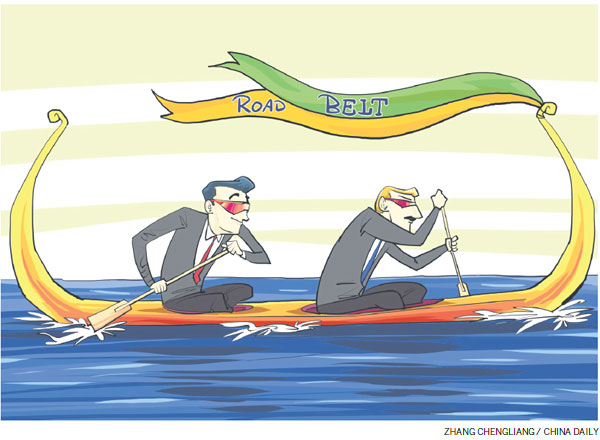
President Xi Jinping's official announcement of the Belt and Road Initiative in November 2013, to initiate a far-reaching and coherent set of routes overland as well as by sea to link China to nations in Asia, Africa and the Middle East to Europe, came as a surprise - to connect 65 countries with a combined population of 4.5 billion to boost long-term growth.
Xi showcased his Belt and Road Initiative to the world in a two-day forum in Beijing in May to review progress and to consolidate formal accords between nations. For instance, he noted that the first freight train directly from China to the United Kingdom arrived in London on Jan 3, taking only 18 days - much faster than shipping and cheaper than air freight. It was the president's overarching plan that ignited the initial but smoldering efforts of the ADB and the EU.
At the Belt and Road Forum for International Cooperation in May, Fitch reported $900 billion of projects were planned or underway, and McKinsey said the initiative connected 65 percent of the world's population, covering one-third of its GDP and moving a quarter of all its goods and services. The United Kingdom Chancellor of the Exchequer at the Forum, Philip Hammond, said the UK "can be a natural partner in delivering this infrastructure by supporting the finance, the design and the delivery needed to make the vision a reality".
To promote the Belt and Road Initiative, Chinese policy banks will be the main source of finance through the Asian Infrastructure Investment Bank and the Silk Road Fund.
Hammond's confidence stems not only from the freedom that separating from the ties of the EU might bring, but also the appointment in 2014 of the Chinese Construction Bank in London as a Chinese renminbi clearance hub.
The fast implementation by China of its modern transportation infrastructure cannot rely on the same technical and political backgrounds across the rest of Asia. A degree of standardization of projects is needed to ensure interoperability, with rules published for the financial, physical and governance specification of new projects. Within Europe, there are observable management and political styles, with the UK being seen as "pragmatic". If its finance and project skills were engaged across the Belt and Road, all would find that standardization would develop faster economic and social gains for the regions.
One example might be the adoption of the Bombardier TRAXX - Transnational Railway Applications with Extreme Flexibility - railway engine. This is designed to adapt to different track gauges and multiple rail electrification configurations and, if used from the Atlantic to the Pacific coast, would simplify the workload of railway engineers and maintenance crews. This idea is simply pragmatic - of extending an existing product into wider markets. We need to be mindful of the long lead times to be expected from truly new products.
The UK Energy Research Centre wrote in December 2015 that the average time for successful commercialization of products in the energy field was 39 years. Some products, like the lithium ion battery, took only 19 years, but the car took 70 years. Along the Belt and Road, we expect innovation hubs to provide new growth for their nations, this cannot be expected in the short term. The ERC research noted that successful development passes through two slightly overlapping stages. The first comprises invention, development and demonstration, and the second is market deployment and commercialization. In reality, few innovations reach the second stage.
There are goals along the Belt and Road that are readily achievable for companies in the UK. Better and faster payback will be achieved by investing in project management and teaching good innovation management. In other words, apply the undisputed global finance expertise available in the City of London to harness the full norms of ethical governance, anti-corruption practices and sustainability while rapidly developing the infrastructure needed in the hubs, including the eGovernment norms recently agreed upon across the EU and European Free Trade Association. Investors could quickly interleave training plans to support new product development, minimizing the personnel required for training (by using as much IT as possible) to train local entrepreneurs to innovate products enhanced by AI and robotization.
In other words, raise local skills in the hubs of the Belt and Road quickly in the supportive environments made possible by really good project management based on the global expertise already available at the "ends of the line" in the UK and the EU as well as in China.
The world too often has seen good ideas nullified by poor development. The Belt and Road will not blossom if it is not supported positively, notwithstanding Xi's continued belief. Given the uncertainty created by the United States' unwillingness to define any policy, the global economic lead must be taken by the two powerhouses - Asia and Europe, in particular China, with its financial strength and its technical positioning, and the City of London, with its pragmatic global expertise in financial and project management. The time is ripe to pave the way for the success of the Belt and Road.
Nigel Knowles is chairman of the Sheffield City Region. Frank-Jürgen Richter is founder and chairman of Horasis, a global visions community. Horasis and the Sheffield City Region hosted the Horasis China Meeting in Sheffield on Nov 5 and 6. The views do not necessarily reflect those of China Daily.
(China Daily Africa Weekly 11/17/2017 page12)




Today's Top News
- Supercarrier to be put through paces
- Game changers for China's sports industry
- Nation drives global energy transition
- Tariff-troubled US fears not-so-happy holidays
- 'Looking China' brings American youth closer to Chinese culture
- National Games start new chapter