


Revealing history of Chinese lingerie









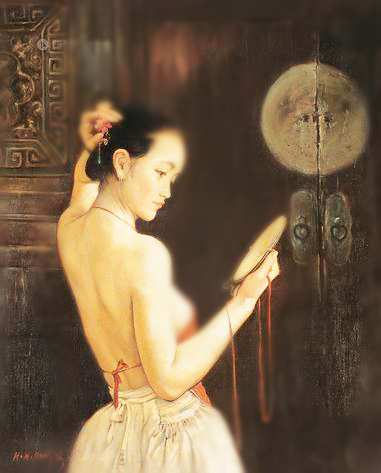 |
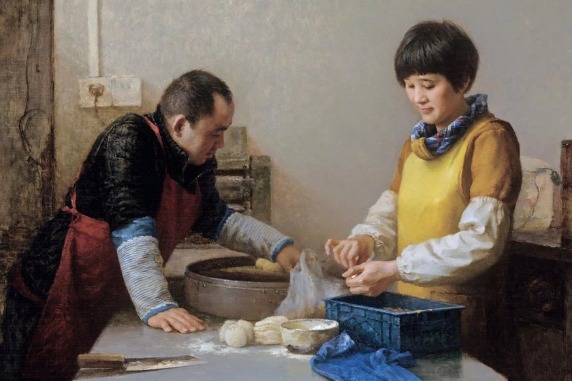
A woman wears a red du dou in artist Pan Honghai's oil painting. [Photo/artron.net] |
Du dou: a hidden beauty
In traditional Chinese culture, being decent and noble is hiding one's talent and beauty, rather than exposing or showing off. Exposing one's body was indecent behavior for both men and women.
And to ancient Chinese people, clothes were more like a symbol of social status, rather than simple fashion.
Underwear was originally called xie yi. The character xie means "frivolous", which implies that it should not be shown to the public.
People's underwear, which was first called du dou in the Qing Dynasty (1644-1911), was a piece of cloth that covered the front of one's chest. It often had four strings, being fastened behind one's neck and back. Men, women and children could all wear it.
Often shaped like a rhombus and red in color, du dou was made from cotton or silk. It was embroidered with various patterns, including children, auspicious animals, flowers and plants. Some patterns also featured folk tales and stories, bearing people's wishes for fortune or romance.
The strings could be made from cotton and silk as well, yet some ancient rich Chinese people preferred gold or silver strings.
Some du dou had pockets for people to store small valuable things, such as rings and necklaces. People also put spices and herbs in the layers of their du dou to stay healthy.
Thus, women's breasts were hidden under this piece of cloth for a long time in ancient China, except during a certain period of the Tang Dynasty (618-907) when people were more open-minded.