Creating new opportunities









Alibaba's expansion in UK is helping to boost British brands, and analysts are seeing tremendous potential for growth
In the weeks leading up to China's Singles Day shopping spree on Nov 11 this year, logistics companies began noticing increased e-commerce logistics traffic delivering products from British producers to bonded warehouses in China.
Singles Day is a shopping festival initiated by e-commerce giant Alibaba, using discounts to attract millions of shoppers. Alibaba's impact in the United Kingdom's e-commerce market is a reflection of its reach in the UK, where it started operations in 2009 with a small office in London.
| On Nov 12, audience members take a snapshot of a giant screen showing the record 168.2 billion yuan ($25.3 billion; 21.5 billion euros; £19 billion) in online sales on Nov 11, this year's Singles Day, the world's largest daylong discount gala. Xinhua |

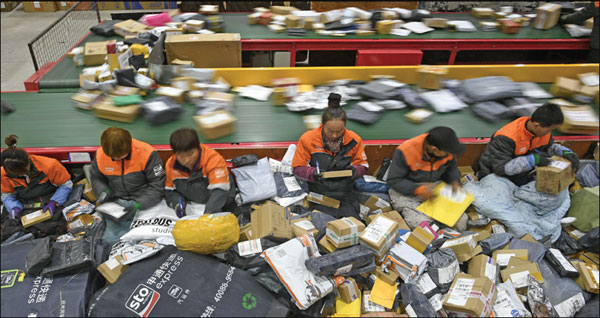
| Workers deal with packages at a courier company in Yinchuan, capital of northwest China's Ningxia Hui autonomous region on Nov 14. At least 331 million packages were handled by Chinese postal and courier companies on the Singles' Day online shopping spree. Xinhua |
Since then, Alibaba has helped many British retailers reach Chinese consumers. Alibaba Vice-President Brian Wong says the company continues to do this, which is especially useful when UK businesses are looking for new markets amid Brexit uncertainties.
"The adoption of e-commerce improves options for businesses. What the UK needs to think about is how it can continue to reinvent itself in light of the changes happening in the world," Wong says in Alibaba's office in central London's Covent Garden.
Chinese tourists' growing familiarity with British brands has helped create the growth of British brands selling in China. Alibaba, as China's largest e-commerce platform, became a natural choice for these brands to set up online shops targeting Chinese buyers.

This year, sales on Alibaba's platforms on Single's Day hit 168.2 billion yuan ($25.3 billion; 21.5 billion euros; £19 billion). In comparison, the UK's entire 2016 e-commerce volume was £133 billion ($177.7 billion).
Seeing such tremendous market opportunity, the UK's Royal Mail established a store in 2015 on Alibaba's overseas brands platform Tmall Global, managing the sales of British heritage brands.
"Breaking into this market has been made much more straightforward, thanks to Chinese third-party platforms, such as Alibaba's Tmall," says Nick Landon, managing director of Royal Mail Parcels.
Although no official statistics totaling Alibaba's e-commerce volume in the UK market are available, anecdotal evidence suggests Alibaba's market share in UK-China cross-border e-commerce is significant. For example, the Chinese courier STO Express says 90 percent of its UK customers are retail brands with shops on Tmall Global.
Perhaps what helped Alibaba establish itself in the UK market is the company's solid establishment at home and its focus on global growth in more recent years. Established in Hangzhou in 1999, Alibaba started as an e-commerce company at a time when China's e-commerce sector was at a very early stage of growth.
What helped Alibaba make a breakthrough in helping China's e-commerce volume grow was its launch in 2004 of Alipay, a service that enables withholding payment from suppliers until goods are delivered. This system helped to instill trust into China's e-commerce market, and consequently also helped Alibaba grow its customer base.
After Alibaba's successful addition of a payment business on top of its more traditional e-commerce activities, it began branching into new areas, including lending cloud technology and logistics.
Its lending business targets small companies in China that do not have an established credit history and therefore find it difficult to secure bank financing. To help small companies overcome this challenge, Alibaba's financing arm, Ant Financial, created credit scores for its clients, based on its own set of criteria such as how fast the business delivers products to buyers or the level of rating it has received for its sales.
Meanwhile, it started to grow Alibaba Cloud, offering cloud infrastructure services similar to those offered by Amazon and Microsoft. Its logistics arm, Cainiao, uses information and data analytics to help customers find the best logistics for domestic and international e-commerce.
Wong says this ecosystem that Alibaba has created is a unique selling point that gives the company an edge in the e-commerce sector. "Today we are a data company, no longer an e-commerce company," he adds.
"The realization that we've become a data company happened a few years ago, at a time when the whole world has evolved. Internet of things, big data and machine learning became popular. We have the data so we can analyze," he says.
Some of its larger subsidiaries have subsequently separated from the Alibaba Group, although Alibaba still holds significant shares in them. One example is Ant Financial, which looks after Alipay. Alipay has in recent years expanded in the UK and is now facilitating Chinese shoppers' purchases in UK shopping venues including Harrods and Selfridges.

But some industry insiders warn that Alibaba's existing model of fast expansion in new industries is stretching itself and distracting it from its core business. For example, Alibaba's media division includes the YouTube-like video site Youku Tudou; Alibaba Music, a streaming service; and Tmall TV, a smart TV and streaming business. Alibaba Pictures Group is a film and television company. It also includes Ali Sports, which promotes and markets sports.
But Wong says that while Alibaba is expanding into many sectors, it is using its resources as many such investments are made alongside local partner organizations. One example is the way Alipay partners with India's Paytm, leveraging on Paytm's existing local market reputation and customer base.
Over the past decade, Alibaba has grown rapidly in China and overseas, and in 2014, it received another boost of international confidence with its $21.77 billion initial public offering on the New York Stock Exchange, the biggest IPO on the NYSE at the time.
From there, Alibaba's globalization pace grew. One market it has made is in the United States, where it opened an office in 2000, just one year after its establishment. Keen to join the US technology scene, Alibaba's cloud business has invested in a data center in Silicon Valley, which puts it in direct competition with rivals such as Amazon, eBay and Google.
Such early investment in the US has allowed Alibaba to build a relatively solid foundation, so that when Alibaba Group's chairman, Jack Ma, met with US President Donald Trump in January, he pledged to create 1 million new US jobs by 2021.
Globally, Alibaba's revenue reached 158.27 billion yuan in the fiscal year ending in March 2017, an increase of 56 percent year-on-year, the fastest growth since its IPO.
In the UK, Alibaba's influence is much smaller, but industry insiders forecast that it will grow, particularly given British products' increasing popularity among Chinese buyers. When Royal Mail conducted a survey of 1,500 Chinese online shoppers earlier this year, 55 percent of respondents said they had bought UK brands, spending an average of £104 a month on items from British retailers.
Meanwhile, Alibaba's contribution toward UK-China trade volumes also helped to create new opportunities for players in the UK-China logistics industry.
"The growing UK-China cross-border e-commerce has helped us to grow in the UK. We have observed that over the past two years, an increasing number of British retail brands are expanding into China by setting up their own online stores within Alibaba's Tmall," says Tina Zhang, marketing manager of STO Express UK.
Zhang says this trend may reflect British retail brands' increasing understanding of the Chinese market, as well as reflecting Alibaba's ability to help them reach a huge consumer base in China.
In addition, the increasing number of Western brands setting up stores on the Alibaba platform has helped to create new market opportunities for the so-called Tmall Partner industry, in which e-commerce consultancy companies look to help brands become more successful on the Tmall platform.
"Alibaba's expansion in the UK and Europe in recent years has been successful, but its expansion in the UK still has a long way to go, because British companies tend to be conservative when it comes to new markets," says Joyce Hu, vice-president of Dolphin Supply Chain, which established an office in Manchester in 2014, providing logistics, procurement and consultancy services.
cecily.liu@mail.chinadailyuk.com
(China Daily European Weekly 12/01/2017 page30)




Today's Top News
- Supercarrier to be put through paces
- Game changers for China's sports industry
- Nation drives global energy transition
- Tariff-troubled US fears not-so-happy holidays
- 'Looking China' brings American youth closer to Chinese culture
- National Games start new chapter