Inspired by Chinese ink









An installation by artist Ma Wen on display in Beijing pays tribute to what has been the main medium of expression and communication for centuries in China
Handcrafted pieces of glass of various sizes, in the shape of clouds, hang above a reflecting pool filled with Chinese ink. The flickering lights create shadows in the high-ceiling gallery. This is the latest installation work, titled Seeing Mountain a Mountain, by artist Ma Wen, which is being exhibited at the Ink Studio in Beijing.
The exhibition - Luminous Shadows - by eight Chinese artists curated by Alan Yeung, featuring paintings, sculptures and installations, began on Nov 18 and runs till Jan 19.
The space of the gallery is used like a cave.
| Top: An installation work, titled Seeing Mountain a Mountain, by artist Ma Wen at the Ink Studio in Beijing. Above: Ma's first opera production, Paradise Interrupted, premiered at the 39th annual Spoleto Festival USA in May 2015. Photos Provided to China Daily |
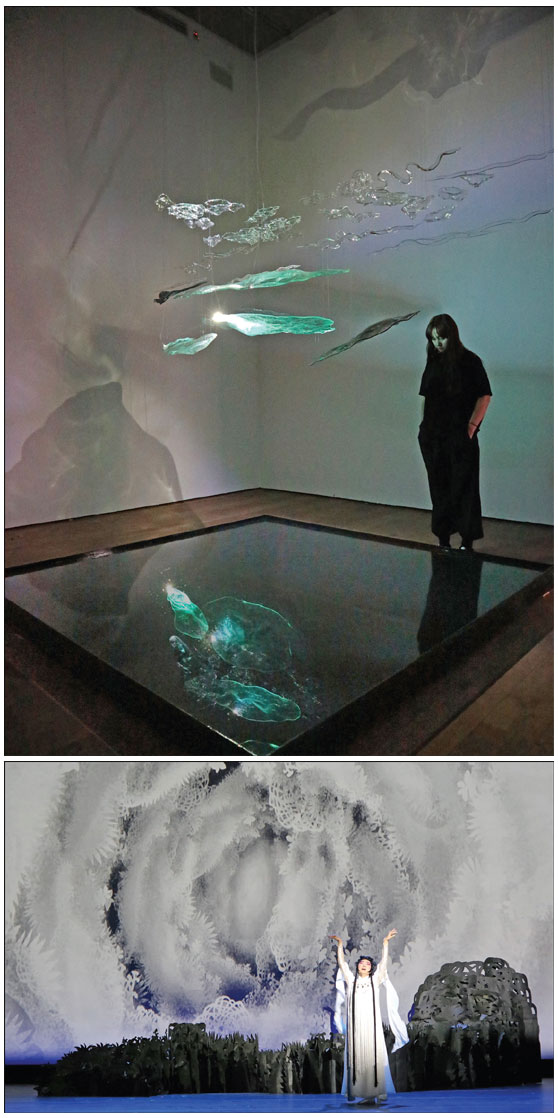
"The lights dim rhythmically like breathing. When a drop of ink falls from the ceiling, it disrupts the pieces of glass and conjures up ripples," says Ma, standing next to her installation.
The artist, who draws her inspiration from Zen Buddhism, explores the contemporary use of Chinese ink, which has been the main medium of expression and communication for centuries in China.
Ma, who was born in Beijing in 1973, now divides her time between Beijing and New York.
The artist, who moved to the United States in 1986, started learning traditional Chinese painting and oil painting at the age of 6 and gained her master of fine art degree in 1999 from the Pratt Institute in New York.
Ma has been obsessed with Chinese ink ever since she worked as one of the seven members of the core creative team for the opening and closing ceremonies of the 2008 Beijing Olympics, where she was the chief designer for visual and special effects.
She won an Emmy as an associate producer for the NBC broadcast of the Beijing Olympics opening ceremony.
In 2013, for a short while she used interactive technology to light up the Water Cube, or the National Aquatic Center - the main venue for the Olympic swimming events in 2008-every night in different colors, reflecting the mood of the people in Beijing.
In 2012, she exhibited her installation Hanging Garden in Ink at the Ullens Center for Contemporary Art in Beijing, which she envisioned as her conversation with the plants and ink. The 20-meter-long, 3-meter-wide and 8-meter-high piece was a tableau of 1,400 live plants painted in black Chinese ink, leaving only the flowers in vibrant colors. The lower half of the tableau consisted of real plants that mirrored the top half of the installation, creating the effect of a garden's reflection on water.
"Every artist tries to find their personal style. For me, it is Chinese ink," says Ma. "I've been working and living abroad for decades but, after all the artistic experiments I have done, I returned to Chinese ink, an important element of traditional Chinese culture."
Her exhibition at UCCA in 2012 also inspired Ma to create her first opera production, Paradise Interrupted, which premiered at the 39th annual Spoleto Festival USA in Charleston, South Carolina, in May 2015.
In 2016, it was performed at both the Lincoln Center Festival in New York and at the Singapore International Festival of the Arts.
Next year, the opera will be staged in Taiwan.
The 80-minute production, with Ma as director and visual designer, is an installation opera that weaves the myths of the Garden of Eden and the Peony Pavilion together. It also mixes the 600-year-old Kunqu Opera with contemporary Western opera.
The opera was composed by New York-based musician Huang Rong, while the libretto was by Beijing-based playwright Ji Chao.
The story is about a woman seeking an unattainable ideal in a world activated by her singing voice as she attempts to return to the garden.
Explaining how she came up with the production, Ma points to a Kunqu Opera, The Peony Pavilion by Ming Dynasty (1368-1644) playwright Tang Xianzu, which was staged at UCCA in 2012 as part of her exhibition.
"The dream sequence (in the performance) showed the main character, Du Liniang, dreaming of her fantasy lover. I thought a dream garden could be black and white, and it could be upside down, too - very surreal. So from there, I had this idea of creating a paradise, a mystical garden," Ma says.
Later, she was introduced to Qian Yi, a Kunqu Opera actress, who plays the leading role in Ma's opera.
They met in a noodle restaurant in New York in 2013 and, to Ma's surprise, they had much in common.
Like Ma, who received training in traditional Chinese culture, Qian was trained as a Kunqu Opera performer from the age of 10. And, as a member of the Shanghai Opera Company, she became known for her leading roles in The Legend of the White Snake, The Water Margin and other classical Chinese Kunqu Opera repertoires.
In 1998, Qian was cast in the lead role of the Lincoln Center Festival's epic 19-hour production of The Peony Pavilion. The production toured internationally.
Since she moved to New York in 1999, Qian has been exploring Western theater, working with directors such as Meredith Monk and Karin Coonrad.
"Qian told me that after various kinds of artistic experiments, especially her attempts to do Western art forms, such as contemporary dance and music, she returned to her roots as a Kunqu Opera actress, which is so much like my artistic path," says Ma.
Speaking of her role, Qian says: "Singing is the most challenging part. Paradise Interrupted is an opera, not a Kunqu opera. So either the way to present it or the aesthetic direction is different."
Qian also says that she was only 24 years old when she performed in the 19-hour production of The Peony Pavilion.
"My understanding of Kunqu Opera and myself was totally different from today.
"Actually, I knew nothing about myself. I was just carefully presenting what my teacher had taught me. Now I look at myself from different angles, and I am trying to understand myself," says Qian.
According to Ma, the opera, which took her three years to finish, is also a process of knowing herself.
At the end of Ma's opera, the woman ultimately breaks free from all her desires in a pool of Chinese ink, which enables her to freely paint any world she imagines.
"It's a paradise we've been pursuing. Only you can decide what you want to paint," says Ma.
chennan@chinadaily.com.cn
(China Daily Africa Weekly 12/01/2017 page22)


Today's Top News
- Japan must stop playing with fire on the Taiwan question: China Daily editorial
- The one who tied knot must untie it: China Daily editorial
- Xi congratulates Ouattara on re-election as president of Cote d'Ivoire
- Supercarrier to be put through paces
- Game changers for China's sports industry
- EU should not give platform to 'Taiwan independence' separatists