Endangered tiger faces uncertain future









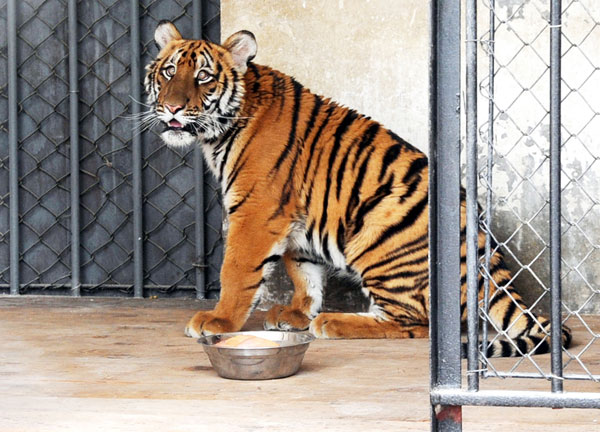
According to a 1995 survey made by the Chinese Association of Zoological Gardens and the International Union for Conservation of Nature, the 50 captive-bred South China tigers kept only 78 percent of the genetic diversity of their six wild ancestors.
This small population causes a lack of genetic diversity and a declining genetic quality, threatening the propagation of the species, said Sun Quanhui, chief scientist with World Animal Protection, in an interview with Science and Technology Daily.
“Wild animals can preserve the functions and diversity of the ecosystem. Once extinct in the wild, a species is no longer able to play this role,” Sun said.
To preserve the genetic diversity of the species, China launched an initiative in 1995 to chart a pedigree map of the tigers, and pair those with distant genetic relations for mating.
Degrees of mating fitness for the tigers are divided into seven levels, with level one indicating a perfect match of two individuals with no close blood relations and level five indicating mating would be harmful to the population.
Yin Yu said the average matching fitness for extant South China tigers stands at level four, which means it is not advisable to mate the two individuals.
Speaking of the possibility of reintroducing the tigers to nature, Sun Quanhui said the tigers have lost their original instincts after generations of artificial breeding and they are no longer be able to survive in the wild.
“There is no precedent for large felines like tigers to be released back to nature and for the wild population to recover,” said Sun.
He said humans cannot teach captive cubs skills they would learn from their mothers in the wild, and consequently a reintroduction is not likely to succeed.
Sun said the best approach to protect wildlife is to invest limited human and financial resources into the protection of habitats, anti-poaching efforts and the recovery of ecosystems, instead of artificial breeding of the species.
Since 2003, five South China tigers were sent to reserves in South Africa to learn how to hunt prey under a program initiated by the environmental NGO Save China’s Tigers and the State Forestry Administration.
By 2013, the population of South China tigers in South Africa had grown to 15, but none of them have been returned back to China as scheduled, according to Science and Technology Daily.






- Connecting cities, changing lives
- World's longest expressway tunnel opens to traffic
- Taiwan lawmakers vote to pass motion to impeach Lai
- Xi: Steadfastly implement conduct rules
- Beijing community leads the way in grassroots governance
- HKSAR govt extends thanks to various units for supporting people affected by residential complex fire