New work lifts cultural confidence









Traditional Chinese culture is as extensive as it is profound, but it has often proved a difficult subject matter to encapsulate in print.
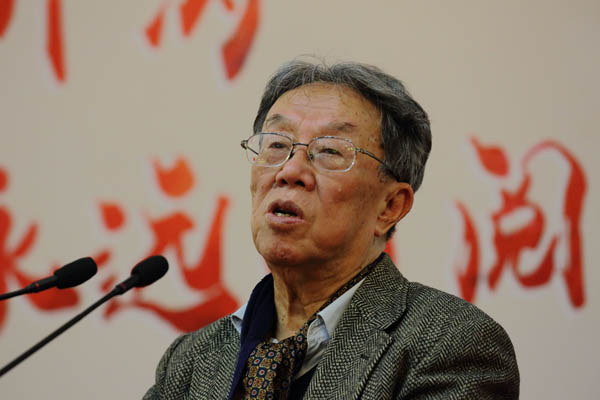
Chinese author Wang Meng uses vivid stories drawn from his understanding of traditional Chinese culture to help interpret its essence for younger generations.
Born in 1934, Wang is a former culture minister who also worked as editor-in-chief of People's Literature and as vice-executive-chairman of the Chinese Writers' Association. He is also a prolific author of literary works, including novels, essays and poems.
Wang's book Zhongguo Tianji (God Knows China) was published five years ago. The work demonstrated his profound understanding of Chinese history.
Now Wang is bringing his audience a companion piece - Zhonghua Xuanji ("Chinese recondite principle") - which provides a deeper insight into Chinese philosophy and traditional culture.
"Six years ago, I wrote about the role of predictability and unpredictability in modern and contemporary Chinese history, where tianji referred to the rule of inevitability," says Wang.
"But this time, xuanji can have many different meanings."
The Chinese character xuan can mean black or mysterious.
The book is a collection of Wang's 36 lectures and articles about traditional Chinese culture, which are divided into five sections - "personality", "soul", "social environment", "the world" and "people's feelings".
The fewer words used in a philosopher's texts, the more open to interpretation it can be - that's Wang's understanding of Chinese philosophy.
"Tao Te Ching, or Dao De Jing, a text written by Chinese sage Laozi around the sixth century BC, only has 6,000 characters, but it's one of the most influential philosophy books in the world," Wang says.
With a limited number of words, the principles set out are open to a variety of interpretations, and researchers can always find ways to dig deeper.
"So, it could take you more than a lifetime to finish studying Chinese culture," says Wang.
"Unlike more straightforward foreign tracts, Chinese philosophy tends to view things dialectically.
"We have a Chinese saying - One step back today for two steps forward tomorrow - which doesn't mean we will always have to take a step back, but rather that we are seeking a way to zigzag forward."