


It's all for one and one for all









Film companies join forces to take on the foreign competition
As more Chinese film companies look to expand overseas, an alliance that brings together some of the top players for a larger-scale foray has been founded in Beijing.
The Alliance of Companies Exporting and Importing Movies and Television Shows was initiated by the China International Television Corporation and brings together 43 domestic firms, all leaders in their fields. The pact was formalized at a ceremony on Nov 24.
Industry insiders see the alliance as a chance for individual firms who would otherwise have to go it alone or in small groups as they court foreign broadcasters to pool resources.
A source close to the alliance says members can share information about exports, including the highest price a foreign buyer is likely to offer, and distribution in countries in which Chinese content has hardly been broadcast.
"We'll establish strategic relationships with organizations to set up more exchange programs and a system to share information," says Shen Jianing, assistant president of China International Television Corporation.
The corporation, founded in 1984, was a pioneer in introducing Chinese television programs to overseas markets and has since sold more than 20,000 hours of TV dramas, documentaries, variety shows and animated titles overseas a year on average.
One of its main goals is to localize Chinese content.
"When Chinese movies and TV shows are shown overseas the aim is not just to get people in those places to watch them, but for them also to make a deep impression on those people," Shen says.
It is easy to find people to translate content from Chinese into the world's most popular languages, but minority languages are another matter, and often the difficulties faced in translating into those languages hinders Chinese films from reaching a wider audience.
The corporation has a broad base of linguists and has translated more than 5,000 hours of television shows into more than 30 languages, including Cambodian, Hausa, Hungarian, Kyrgyz, Swahili, Thai and Vietnamese, Shen says.
"Usually, most companies can handle projects with English subtitles. But they cannot afford to set up an overseas sales department catering to minority language-speaking markets," says Wei Lili, vice-president of the television program maker Ciwen Media Group of Beijing, which is an alliance member.
"They also have contacts with distributors in countries and areas that are hard for Chinese companies to get into. It would be very useful to rely on their resources. China International Television Corporation has many experts in diverse languages, securing the quality of translated content."
The experts' rich knowledge of foreign culture and customs can also help the makers of Chinese TV shows avoid unintentional offense, Wei says.
For example, a husband's romance with a woman who is not his wife would be regarded as morally unaccepted in some countries, thus requiring cuts or other changes before distribution, he says.
Because cultural differences are often a major barrier to film makers distributors and others in the industry, coproductions are seen as a clever strategy that can help Chinese companies get into overseas markets and to handle the difficulties they may encounter in such unfamiliar territory.
There is a broadly held view in television circles that animated titles and documentaries travel more easily across borders and languages, making such titles the frontrunners in coproduction.
Qian Feng, president of the Suzhou company Ori Animation, is well versed in working with foreign partners. Over the past decade the company has worked with more than 600 companies and organizations in 70 countries and regions.
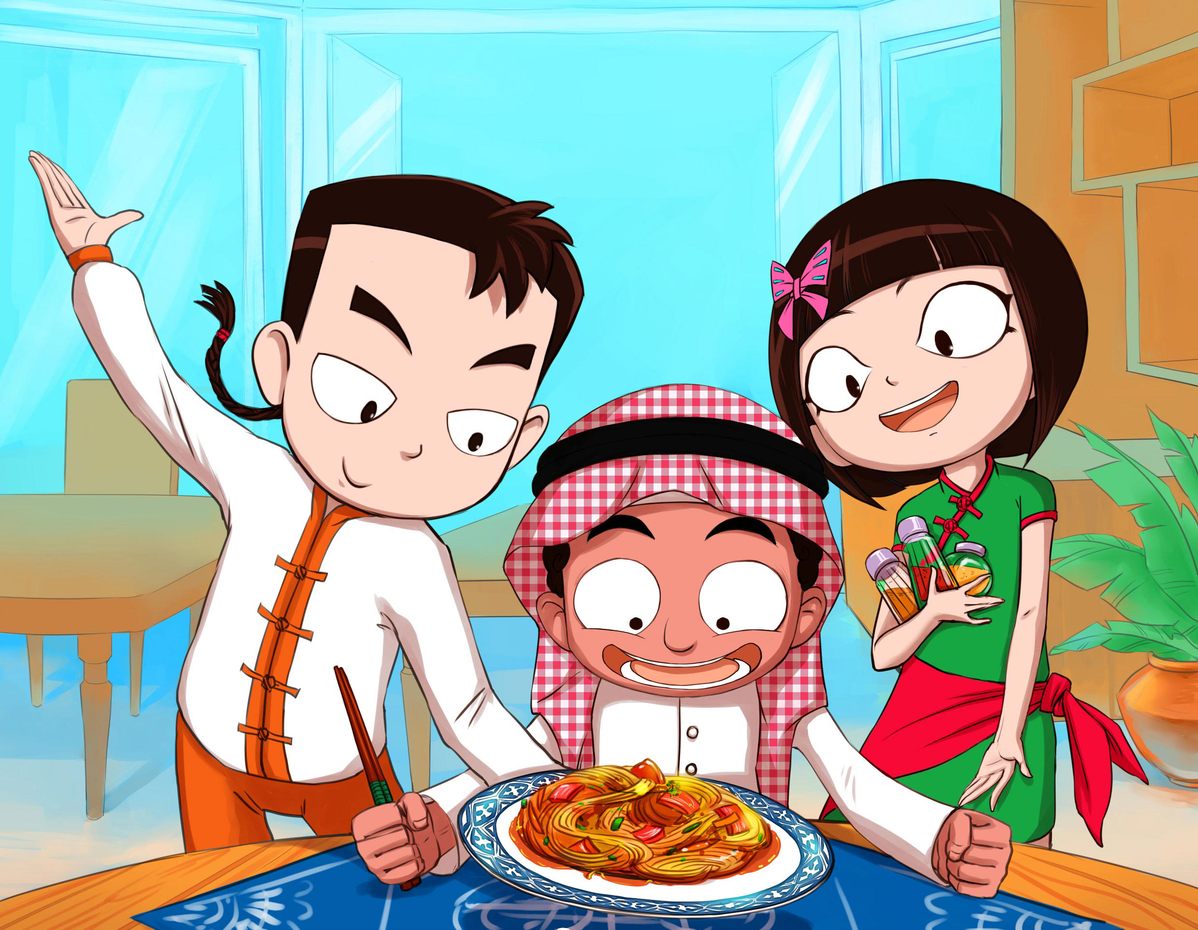
Its 26-episode animated series Hakim & Kong Xiaoxi, the first animated coproduction between China and Saudi Arabia, became one of the highest-rated shows in the kingdom.
Yet Ori's switch to focus on overseas markets is relatively recent, undertaken about four years ago as the animation industry in China began to experience a slowdown.
Qian has been to a number of foreign countries seeking opportunities. When deciding to shoot Hakim & Kong, the biggest challenge was to make a production that addressed the cultural sensitivities of both countries, he says.
Discovering that food could be a shared interest for both countries helped to set the tone. The story centers on a Chinese teenager, Kong, helping her Saudi friend Hakim defeat local Western competitors by using traditional Chinese cooking methods.
In a series of short sections, the program presents a panoramic scroll of Chinese cuisine, clothing, martial arts and Saudi Arabian culture and food.
"Shooting of the sequel will begin soon," Qian says. "The key to winning multiple markets is to find a perspective that we are all interested in."
China International Television Corporation remains the master par excellence of purchasing channels or hours set aside for Chinese television shows in foreign countries, and has managed to get two channels in Indonesia and Cambodia to run Chinese content 24 hours a day, seven days a week.
In this case "hours" refers to a foreign channel signing with a Chinese company to set aside one hour or more for Chinese content a couple of days a week.
This kind of broadcasting, which the corporation calls China Hour, has been introduced in about 10 countries, including the UK, the Czech Republic, Nepal, Serbia, South Africa and the United Arab Emirates.
Weza Matomane, a presenter of China Hour in South Africa, says the Chinese shows are very popular in his country.
The stories featuring Chinese lifestyle are entertaining and amusing to locals.
"Sometimes there can be culture shocks here and there with things that we are not used to in South Africa, but that usually adds to the humor and learning."