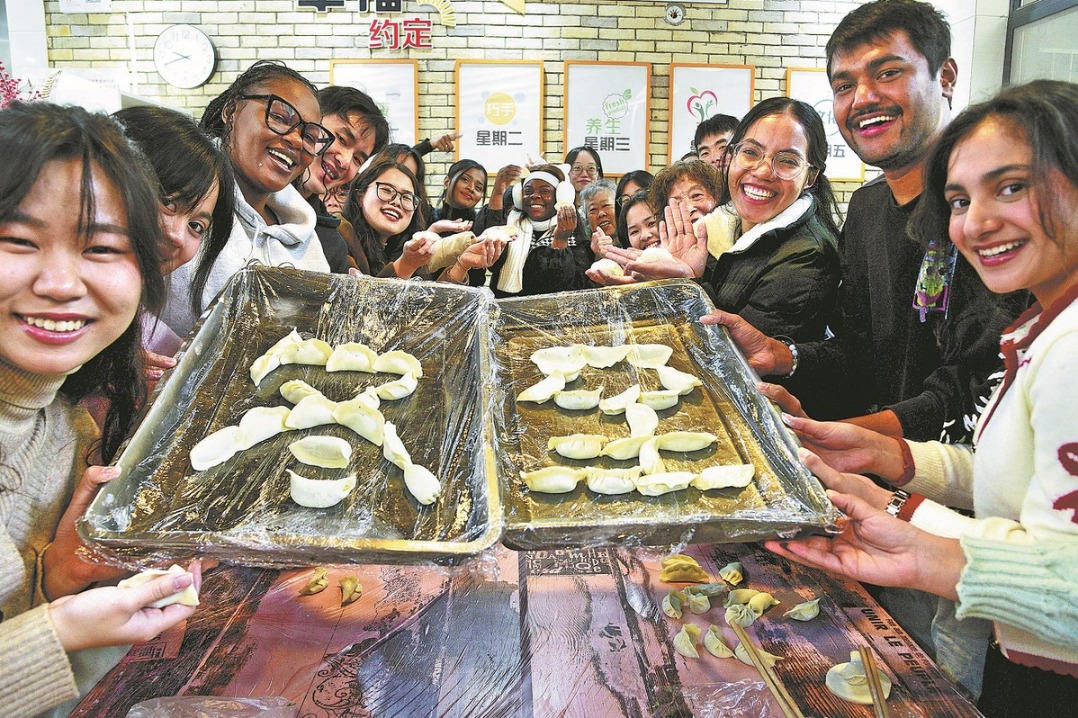
'Buddha-like' youth go calmly about their lives









Life's tough for China's younger generation. Finding jobs or spouses and settling down in a sometimes tough and cruel world often lend themselves to either giving up outright or detached ironic posturing.
Many of the youth of today have opted for the latter and refer to themselves as the "Buddha-like" generation.
Zhang Min, 23, is among them. He is just about to graduate and was informed recently he had failed yet another job interview - he has already sent out over 60 applications and attended 20 job fairs, but they all came to nothing, and he has no choice but to be philosophical.
"Failure does not bother me as much as before," Zhang said. "Whatever will be, will be."
The phrase "Buddha-like youth" went viral after a popular WeChat article used the term to describe the generation born in the 1990s.
"Having seen everything and keeping a casual and calm mindset toward life and career under mounting social pressure, it's fine to have something or not," according to the article.
Young Chinese, perhaps ironically, have been quick to label themselves as Buddha-like youth. A Buddha-like relationship is, apparently, one of forgiveness, never forcing your better half to make changes, and accepting things as they are.
A Buddha-like career means employees no longer concern themselves with promotions or office politics, but simply get on with the job at hand.
But there has been a backlash against the mindset, particularly among the older generation. They argue that such an approach is defined by pessimism, indolence and sloth, leading to a reduced work ethic, lack of self-motivation, and an apathetic demeanor.
"A rapidly developing China brings about many reforms and changes, which inevitably create challenges and great pressure for its younger generations, notably in career and life," said Tian Feng, a research fellow at the Chinese Academy of Social Sciences.
Far away from her hometown, Li Xiao, 22, works in an architectural design company in Guangzhou, Guangdong province. Last year, she failed the postgraduate admission exam.
Li had intended to prepare for the exam in her spare time after work, but a lot of overtime caught her unguarded. She often gets off work at 11 pm and is invariably burned out.
After taking this year's exam, Li said she has little expectation about the result.
"I've tried and participated, that's what counts," she said.
The difficulties faced by this generation lead them to describe themselves in mocking tones as "prematurely balding", "monks or nuns", or the "middle-aged obese". They are nowhere near these things, but they certainly feel like they are.
"Saying 'It's OK' or 'It doesn't matter' is just a disguise we put on in the face of the rigors of life," said Zhang Li, who works as a product manager for a Beijing internet company.
Xinhua



- Beijing community leads the way in grassroots governance
- HKSAR govt extends thanks to various units for supporting people affected by residential complex fire
- Influencers barred from vulgar, false, or harmful content
- Hangzhou–Quzhou High-Speed Railway begins operations
- China records rise in survival prospects for child and adolescent cancer patients
- Ministry unveils draft revision of the national air quality standards