Mobility services to put an end to private auto ownership?









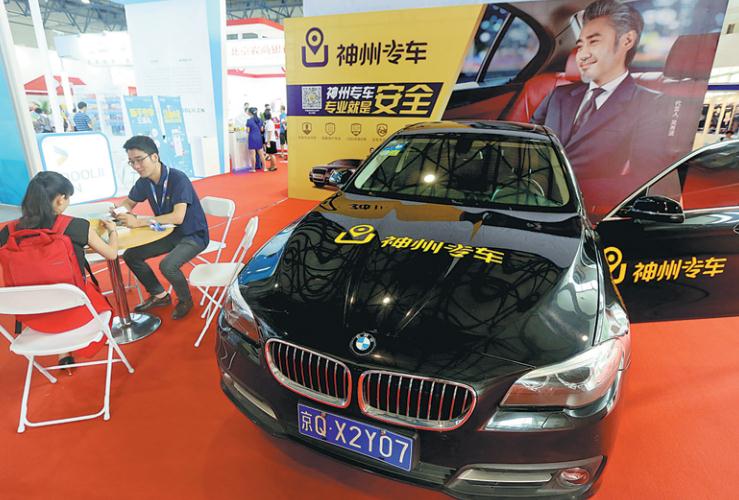
Chang, a 37-year-old from Beijing is looking at selling his compact sedan, a vehicle with 30,000 km mileage, that he has owned for the past eight years.
The young Beijinger is one of many people in China who are reconsidering their vehicle ownership in favor of cheaper and more convenient mobility service options.
Currently, Chang's car just sits idle in his community because it is cheaper for him to use mobility services to get to and from work and go out, than it is to drive himself.
"These services cost less than driving my own car. The parking lots around our office building charge me about 80 yuan ($12.3) for eight working hours, and there's also fuel cost to pay," Chang said.
With the rise of shared mobility, including short-time car rental, namely car sharing, and chauffeured car hailing, an irreversible trend is being revealed-owning a car is no longer a must for many individuals in major cities.
United States management consulting company Boston Consulting Group surveyed 3,528 car owners from 18 Chinese cities throughout 2016, and found only 84 percent of existing car owners are still willing to buy and own a car if the shared mobility options are well-established.
"Mobility services give more economic choice when it comes to the overall expenditures," Xu Gang, Shanghai-based partner of BCG and managing director of BCG's Automotive Practice Greater China, told China Daily.
To take a 20-km journey lasting approximately 1 hour as an example, Didi Chuxing's Kuaiche ride sharing service charges less than 30 yuan, but the trip could be rerouted to pick up another passenger. A similar trip costs about 45 yuan when using Shanghai-based EVCard.
Last week, Beijing headquartered CAR Inc challenged the market with an even keener budget pricing strategy expecting to create a benchmark in the market. CAR Inc's vehicle sharing, set to be available from Mar 28, will charge just 31 yuan for 20 km driving in 1 hour.
Shared mobility's low costs will make an impact on weaker brands and low-end models, as they meet the customers' fundamental needs that also could be fulfilled without owning a car, according to Xu.
"The brand is key to attracting the future purchase. Customers will attach more emotions and feelings to a strong brand, and will be more willing to own a car carrying that brand," Xu said.
For those customers who still choose to buy and own a car, they would like their future vehicles bigger and better-branded to better meet their specific needs-something that shared mobility services have no way to fulfill, according to BCG's report. When comparing across the automobile industry, many local volume brands are perceived as weaker than those international brands from Europe, the United States, Japan, and South Korea.
Chinese volume brands have taken the majority market share for basic and economy products priced lower than 80,000 yuan.
In the meantime, many shared mobility services are offering similar vehicles and sometimes even better. EVCard has Roewe, Chery, Chang'an, and BMW in its fleet at varied costs, while CAR will offer major international brands at unified prices, and will add Land Rover to the list later.
Lu Zhengyao, chairman and CEO of CAR Inc, said: "Imagine you experience a Land Rover luxury SUV for a cost of 0.19 yuan a minute and 0.99 yuan each kilometer."
He also said that the low-price strategy in car-sharing won't make huge profit for the company, and that services do not have a business model that proved to be effective and profitable, so many of the players couldn't survive in the market.
"CAR is building a service platform targeting the future 10-year development and tackling the current issues on a big-data basis to better match our supplies and the customers' demands," Lu said.
Cui Dongshu, secretary-general of the China Passenger Car Association, agreed that the price advantages of mobility services have weakened the customers' purchase willingness, but significant influence won't come to fruition in the near future. He said: "Despite younger Chinese customers' preference for mobility services, there are a large amount of elderly people who would like to own a car. They see the car as a possession or an icon of wealth, instead of merely transportation."