Demonstration zones to harvest new crop of agricultural expertise









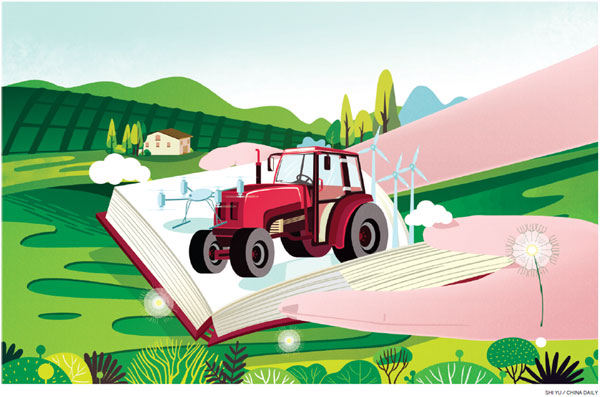
High-tech approach will give sector the seeds of growth and opportunities
Zhu Junqiang, general manager of Shaanxi Zhongxin Technological Co, was exhilarated to hear about the central government's decision to further promote agricultural high-tech industry demonstration zones nationwide.
His company is located in the Yangling Agricultural High-tech Industry Demonstration Zone in Shaanxi province, established in 1997 as China's first such zone.
New technologies developed by local researchers brought expanded business opportunities and Zhu was one of the young pioneers to start his own business in Yangling, focusing on rubber-sap trees.
Even though his company has registered 13 patents in this field, Zhu said his company is still in desperate need of new technologies to expand business, like many other agricultural companies.
The move means more technologies will be created to help the key business and many initiatives have been developed in agricultural high-tech demonstration zones, Zhu said. "Therefore, the news is exciting for me," he said.
The manager's excitement was due to a guideline released by the State Council, China's Cabinet, to establish no more than 30 national agricultural high-tech industry demonstration zones by 2025, to create a world-leading sector focusing on innovation, talent and industry development.
So far, China has only two agricultural high-tech industry demonstration zones, including the one in Yangling and the Agricultural High-tech Industry Demonstration Area of the Yellow River Delta, which was approved in 2015 to be built in Dongying, Shandong province.
The guideline called to examine innovation-driven development for the sector by significantly raising output and productivity in the demonstration zones. It sets eight key tasks for the zones, including expanding research and development input to improve technology and efficiency.
More high technology will be further used to boost innovation for key agricultural categories, such as fertilizer. Research and education resources, including universities and research institutes will be present in these zones and farmers will be trained to prioritize labor structure. An integrated development of the first, secondary and tertiary industries will be promoted to coordinate rural and urban development.
Meanwhile, green development will be enhanced to develop recyclable agriculture, and information services will be strengthened to develop smart agriculture. International cooperation will be boosted to align the sector with the Belt and Road Initiative, the document added.
In addition, preferential policies such as fiscal, financial support and land will be granted to the demonstration zones.
The guideline was the first such document on agricultural high-tech industries by the central government, which will be beneficial to efforts to revitalize rural areas, upgrade the agriculture and promote all-round development for farmers, said Xu Nanping, vice-minister of science and technology, at a news conference last week.
Xu said that agricultural productivity is only one eighth of the secondary industry and one fourth of the tertiary industry, and the key solution is technological innovation. Establishing these demonstration zones will substantially improve the agricultural productivity, output of farmland and green development, he said.
High-level research and development is needed to provide a steady supply of technologies, and what's more important is that demonstration zones should be promoted to lead farmers and show them how it works, the vice-minister said.
In China, agriculture is a less competitive sector compared to developed countries in terms of agricultural technologies, but labor costs are rising in the world's second-largest economy, said Li Guoxiang, a researcher of rural development at the Chinese Academy of Social Sciences.
Li was echoed by Zhu, who said the application of new technologies can compensate for the rising costs and shortage of labor as many of the younger generation flock to cities looking for better-paid jobs.
For example, the Yangling Agricultural High-tech Industry Demonstration Zone has made about 400 science and technological achievements at the provincial-level, and 48 national ones. Hundreds of young people have started their own enterprises based on what they have researched, including remote sensing, soil repair and drip irrigation.
The Yangling demonstration zone focuses on the development of modern agriculture in arid and semi-arid areas and has made enormous contributions, Xu said. Technologies developed in Yangling earn about 17 billion yuan ($2.7 billion) each year and other demonstration zones will follow this model to focus on one particular area, he added.

- Countdown to 15th National Games: On-site warm-up entertains audience
- Eight missing after cargo ship collides with fishing vessel near Shandong
- Investing in people: a worthwhile investment
- Exhibition commemorating the epic relocation of universities opens in Fujian
- Twelve punished for scaffold collapse that killed 7 in Shandong
- Slovenian official visits whole-process people's democracy practice site of CPPCC committees