


Chinese collector decodes the Renaissance with new book









More Chinese now travel around Europe and see Renaissance masterpieces. Yet, they do not necessarily understand them-composition, colors, light and shadow, strokes-indeed, why they stand out.
For most Chinese, school education gave them a limited knowledge about fine arts. "It's a pity that we lack an art education to understand aesthetics better," says Yang Hao, a collector of old masters and an art history lecturer at the Central Academy of Fine Arts in Beijing.
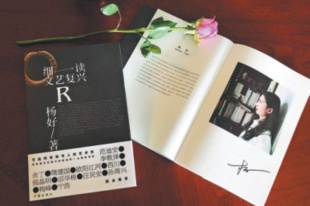
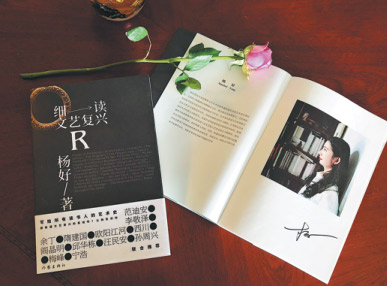
Based on her lecture notes for the Renaissance art history classes for CAFA freshmen's visual foundation course, her new book Annabel's Short Renaissance Art History is a practical guide to the art world.
The Renaissance marks a social and cultural revolution in Europe between the 14th to the early 17th centuries.
Thanks to the economic and technological developments, there was a flourishing of cities and a revival of ancient Greek and Roman philosophy.
That trend led to and was reflected in a burst of literature and art creation.
Yang's book, which focuses on Renaissance art, gives a systematic introduction to the artistic achievements of the era.
It describes the three main styles divided by regions-the Florence School, the Venetian School and Northern Renaissance.
In her book, Yang showcases the features of each school through representative figures, not only giants as da Vinci, Michelangelo and Raffaello, but also Botticelli, Tiziano, the Bruegels and some 30 others.
Besides the artists' life experiences, Yang also examines the art pieces, the techniques used and the metaphors in the images.
In the chapter on Jan van Eyck, one of the most distinguished painters from the Netherlands, and who was seen as the pioneer of the Northern Renaissance, details of his painting The Arnolfini Portrait are interpreted by the author, who says the two subjects' clothes, the Middle Eastern carpet on the floor and the imported oranges-a luxury at the time-all show immense wealth.
The characters, she says, also don't have much jewelry on, indicating that they were from a business family rather than nobility.
Two more people are reflected in the curved mirror on the wall, with one of them believed to be the painter himself. The 10 circular patterns on the wooden frame around the mirror-so small that are often neglected-are filled with 10 scenes of the crucifixion of Jesus Christ.
Also, Yang uses historical documents and the 10 circular patterns, to unveil the characters' identity.
The painting was commissioned by the man in it in memory of his wife.
Interpretations like this provide the readers with practical methods of appreciating the artworks' appeal and connotations.
Wang Min'an, a philosopher and professor at Capital Normal University, says: "The Renaissance laid the foundation of 400 years' of European artistic tradition. The challenge to the Renaissance tradition did not arise until the later half of the 19th century, and it became the prelude to modern art. This book is a proper description to the foundation."
Yang, in her 30s, who got her master's degrees in art history from the University of St Andrews and art business from the Sotheby's Institute of Art, partly attributes her understanding of the Renaissance to her old masters collection that includes works by artists like Giovanni Bellini, the Bruegels and David Teniers the Younger.
In November, the German embassy in China held an exhibition of 11 woodcuts of Albrecht Durer, a leading figure of the German Renaissance, and they all came from Yang's private collection.
"I can feel the real textures of the old masters through touching the paintings. The elimination of mystery and worship keeps me sensible and objective," Yang says.
In her book, Yang shows her preferences.
She likes Donatello's David sculpture more than Michelangelo's. And she also devotes much enthusiasm to the chapter on Tiziano.
Defending her preferences, she says: "Since Chinese and Western viewers are seeing the Renaissance based on the same evidence, we should be brave and more confident to put forward our viewpoints.
"I see the Renaissance as neither sacred nor secular. I can find myself in the Renaissance, like a mirror image. I hope readers can also find themselves somewhere in its history," she says.