The most traditional not always the most practical










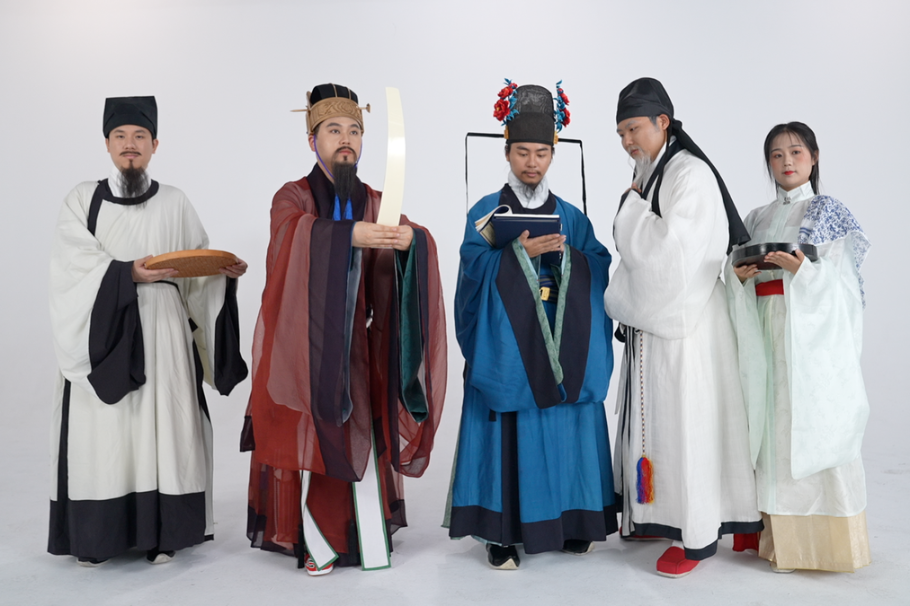
For at least three connoisseurs of Han attire, wearing hanyuansu, a kind of modern dress featuring hanfu style, is an acceptable choice for daily life.
The hanyuansu dress was designed to adapt the traditional hanfu to modern living by applying the main characteristics of hanfu in the design of vogue clothes, which has raised the profile of hanfu and expanded its influence.
"For me dressing up in a traditional hanfu outfit with wide sleeves is not that practical or comfortable," says Liu Yinhong, founder of the website hanfuhui.cn. However, he says he insists on wearing standard hanfu on formal occasions, such as the celebration of traditional festivals and weddings.
"Hanyuansu is a more practical and fashionable choice for casual wear."
Wang Tianjiao of Shandong province, who is an aficionado of hanfu, and Chen Suyue, who has produced comic book that has its characters dressed in hanfu, largely share Liu's view.
Xu Hui, founder of the hanfu brand Han Ke Si Lu, is well known among hanfu lovers for making exquisite clothes that were prevalent during the Ming Dynasty.
Choosing hanfu as wedding garb has become popular among hanfu lovers, so the best-sellers in his shop on Taobao.com are red.
Xu, 41, graduated from Zhejiang Institute of Silk Textile, now known as Zhejiang Sci-Tech University, and has run his own business in the textile industry for nearly 20 years.
His love for hanfu comes from his passion for analyzing traditional textile techniques, he says.
When he studied he specialized in textile materials and design, he became engrossed in archaeological reports of the tombs of emperors and nobles in ancient China, especially the Ming Tombs.
"I was captivated by the fineness of the brocade in the Ming Dynasty. What I wanted to do was to try to get closer to the beauty of our national dress."
As he had jacquard making machines in his workshop, he tried to restore Ming Dynasty hanfu, and started his own brand.
The pattern designs on the fabrics of hanfu during the Ming Dynasty varied among different social classes, he says, and he strictly follows the pattern designs in the replicas he makes.
"However, it's hard to weave a garment exactly the same as the relics, because the machines we use today are different to the ancient ones."
His business is both a driver and beneficiary of the increasing of hanfu fashion.
Chu Yan, chief costume designer for leaders at the Asia-Pacific Economic Cooperation forum leaders' meeting in Beijing in 2014, studied traditional culture for many years and has created stylish clothes with a fusion of characteristics of traditional Chinese costume.
"Costume is one of the carriers of our culture, especially on some international occasions," she says.
In the context of consolidating Chinese people's cultural confidence, Han people are seeking an identity for their culture, and the public is trying to find a visible cultural symbol to show the country's uniqueness, she says. That could partly explain the hanfu renaissance.
"The elegance and beauty embodied in the fabrics, pattern designs and colors of hanfu cannot be replaced by fast fashion. We should take advantage of it instead of just following Western fashion trends."