Pingtan legend sings praises of traditional opera









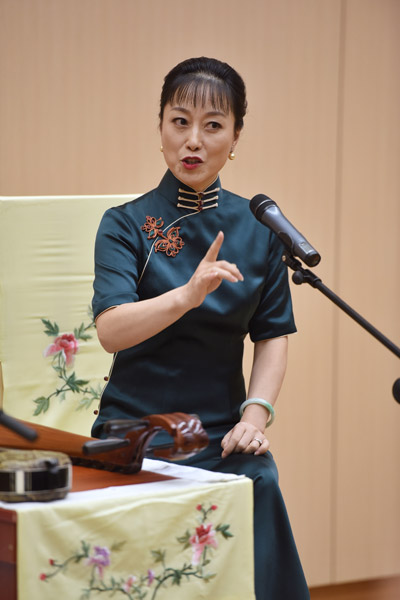
In 1998, when Sheng Xiaoyun debuted the first Suzhou Pingtan performance in Taiwan from a Chinese mainland troupe since 1949, she was dubbed by some local media as "the most beautiful voice in the country".
To date, that is the most frequent commendation not only for her, but also for her beloved art form.
Born in Suzhou, Jiangsu province, both of Sheng's parents were performers of Pingtan, a musical genre popular in southern Jiangsu and northern Zhejiang provinces, and Shanghai. Xiaoyun, a name she chose after first stepping onstage, has the aesthetic meaning "Little cloud"-small in size, but often extending across the horizon.
Being deputy head of the Suzhou Pingtan Art Troupe in her home city, she has built up a considerable reputation all over China and even overseas.
"I would sometimes accompany friends from other cities to visit popular tourist destinations in Suzhou and occasionally came across some Pingtan performances," Sheng recalled. "When they asked'Is this what you do?' I would feel a little bit embarrassed."
Many Pingtan shows in local teahouses are "not so great" in her eyes.
Pingtan became popularized during the Qing Dynasty (1644-1911) as Suzhou's economy flourished. It is admired for its exquisite and mesmerizing melodies, all being vocalized in a soft dialect. An entire show, usually themed around historical legends, can last more than 30 hours, and are performed in separate chapters lasting several days.
"However, most commercial performances are only rough shows featuring five-minute opening scenes," she said. "We need better guidance and education of new talent."
In the biggest Pingtan art school in Suzhou, more than 60 students graduate annually, but less than 20 percent are good enough for professional troupes. Relatively low income is another barrier to building up a critical mass of talent.
Sheng, 49, is dedicated not only to her own stage performances, but also to the bigger picture of the country's traditional performing arts.
Furthermore, as a member of the 13th Chinese People's Political Consultative Conference National Committee, Sheng has many concerns she wants heard.
Among her proposals to the CPPCC, she is urging China Central Television to restart a program promoting regional opera as a means of reviving traditional Chinese culture, and is calling for a reform of vocational education to nurture more young talent.
"Today people have many modes of entertainment," Sheng said. "Traditional regional operas are marginalized. However, they help maintain unique Chinese aesthetics and performing techniques, and play crucial roles in our culture."
A survey by the Ministry of Culture last year found there are 348 regional opera forms nationwide, including those featuring Pingtan. However, 107 forms have no publicly owned troupes, and 70 of them rely solely on the ability of artists to personally pass on their skills.
She has tried various measures to make traditional operas popular again among the younger generation, including sometimes mixing pop music and other genres with Pingtan, and has developed new themes favored by young people.
"New channels of promotion are a must," she said. "But the display of classic repertoires is always a priority, and such creativity will usher in bigger audiences."
Different regional operas can also create unexpected chemistry.
During the recent Lantern Festival gala on CCTV, 15 female Pingtan performers stood on the same stage with 15 male storytelling art performers from Shaanxi province. The show was warmly welcomed by audiences.
Many traditional rituals and ceremonies in the countryside-which are the foundations of regional operas-are fading away. Sheng often worries that such a trend will leave less room for regional operas to survive.
However, she has also found that many young rural performers increasingly use digital channels like livestream platforms and social media to promote themselves.
"We'd better keep pace with the digital era if we want to see traditions revived," she said.


- China launches Lijian 1 Y9 carrier rocket
- First cross-border event debuts at the National Games
- China Focus: National Games enhances coordination under 'one country, two systems'
- China's Fujian aircraft carrier to make regular appearances on high seas: spokesperson
- A decade of dialogues
- HK: a stage for art and cultural dialogue