Autonomous driving moves ahead









Chinese experts predict earliest commercial uses of vehicles to be made in very technical fields
Fully autonomous driving technologies might be unlikely to arrive in the near future, but partially self-driving capabilities are expected to be applied soon in sectors using commercial vehicles.
Wan Gang, minister of science and technology, said earlier that the Chinese automobile industry should focus more on lower-level automated technologies, including level 1 and 2, than higher-level automation, according to a blog by Dong Yang, executive vice-director of China Association of Automobile Manufacturers.
Wan noted that the intelligent emergency brakes in the level 2 technologies will significantly reduce the possibility of accidents, dramatically reducing fatalities, and drastically reducing property and financial loss.
Level 1 automated driving involves driver assistant systems already in use in many automobiles including lane departure warnings, vehicle following in safe distance, collision warnings, and driver alert systems, while level 2 automated technologies consist of a series of advanced driver assistant systems which apply artificial intelligence to correct and rectify human errors.
The minister also called on the Chinese automakers to concentrate on implementing and promoting realistic technologies and applications, instead of demonstrating higher-level autonomous driving.
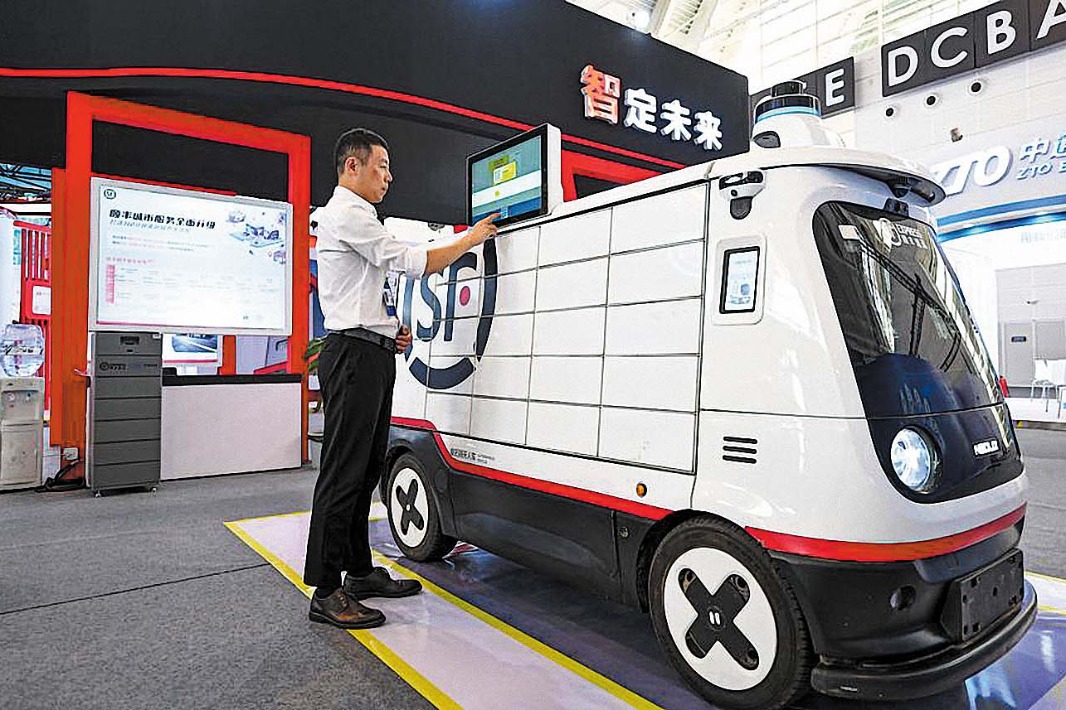
According to industrial experts' expectations for autonomous driving, such business scenarios and technical fields include commercial vehicles on highways and passenger vehicles traveling at slow speeds.
Yang Diange, head of the automotive engineering department at Tsinghua University, predicted that the earliest uses of industrialized autonomous vehicles will be in very technical fields.
"Intelligent and connected vehicle industrialization will make critical progress from 2020 and 2025, and high-level autonomous driving will be realized by 2040," Yang said.
At first, commercial vehicles including trucks and special purpose vehicles will mainly apply low-level autonomous driving capabilities, such as emergency braking, lane keeping and cruise control on highways. Automated Vehicles Index for the fourth quarter of 2017, jointly released by Roland Berger and German research institute Fka, found the level 2 automated functions' popularity in the Chinese market tied for second place with Germany among the world's major markets, only behind the United States.
When it comes to level 3, the hands-off stage, trucks will run in convoy on highways by applying partial autonomous driving, according to German consulting firm Roland Berger.
Truck fleets have been involved in autonomous driving tests for about six years in Europe, the US and Japan.
Wang Xiaojing, chief scientist at the National Intelligent Transport Systems Center of Engineering and Technology, explained, "A truck driven by a human driver takes the lead, and the rest of the fleet follow, driven by autonomous driving functions.
International truck-makers have vowed to realize this on public roads very soon."
Zhang Yichao, a Shanghai-based project manager at Roland Berger, told China Daily, "Automated convoy-capable truck fleets are going to save an estimated 10 percent of fuel expenditure, while high-level autonomous driving will help to reduce labor costs and at least 30 percent in insurance costs.
"Commercial vehicle users are largely vehicle fleets, companies and governments. The immediate benefits for them from applying autonomous driving to commercial vehicles are lowered costs, risks, emissions and traffic accidents."
Wang Binggang, an expert leading the National New Energy Vehicle Innovative Engineering Projects, told a group of reporters that Chinese passenger carmakers need to realize autonomous driving step by step, starting from low-speed implementation.
He used the example, "When I need a car, it will be able to autonomously drive from the parking lot to where I am."
However, US management consulting firm Strategy& anticipates a more aggressive realization of autonomous driving around the world in the coming decade, with about 12 million self-driving vehicles in use, mainly scattered across China, Europe and the US.
"Eyes-off and minds-off higher-level autonomous driving will be in large scale commercial use by 2027 or 2028," said Peng Bo, partner and practice leader of automotive at Strategy&.
Southwest China's Chongqing released its trial guidelines on March 11 regulating autonomous driving car testing on public roads. Chongqing is the third city allowing such tests after Beijing passed such norms in December, and Shanghai on Mar 1.