Chinese expertise helps fight malaria in Comoros









A drug derived from TCM has almost eradicated the illness in the African island nation, as David Blair reports.
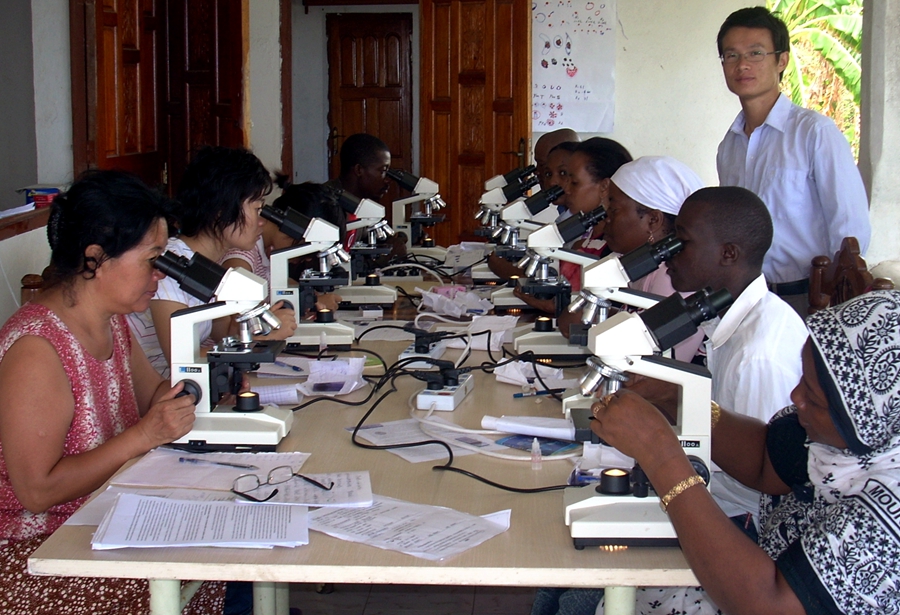
Until recently, malaria not only destroyed lives in the East African island nation of Comoros, but also devastated the economy. However, a team of Chinese doctors from Guangzhou University of Chinese Medicine, cooperating with the Comoran government, has almost eradicated the disease.
"In 2010, more than 103,000 people got malaria - one out of every eight people - and 54 died," said Affane Bacar, director of the National Anti-Malaria Project of the Ministry of Health of the Union of Comoros.
"Every year, more than 90 percent of families had someone who got malaria. If a family member gets the disease, they have to go directly to a health clinic at the hospital. Families had to pay around 40 percent of their annual income for this healthcare. It was a fortune," he said.
The team from Guangzhou University of Chinese Medicine in Guangdong province gave doses of Artequick, an artemisinin combination therapy, to a large portion of the population simultaneously, a technique known as mass drug administration. Artemisinin is a drug derived from traditional Chinese medicine.
By 2014, seven years after the program was introduced and then gradually expanded in Comoros, there were fewer than 2,000 cases of the disease and no malaria-related deaths in the country.
"Using the Chinese strategy, this disease has been solved, eliminated. Every family has saved a lot of money. The economic level of the country is not very rich. They can use this saved money to do other very, very important things - to develop their family, to give the children an education," Bacar said.
In 2016, there were an estimated 216 million cases of malaria and 445,000 deaths worldwide. Ninety-one percent of those deaths were in Africa, according to the US Center for Disease Control and Prevention. Malaria is also a serious problem in South Asia and parts of Southeast Asia.
More than 90 percent of the deaths from malaria are children age 4 or younger. On average, a child dies of malaria every 30 seconds in Africa, according to the World Health Organization.
Mass treatment
Traditional methods of dealing with malaria focus on mosquitoes - either trying to eliminate them or stopping them from biting people by using indoor spraying or distributing insecticide-infused sleeping nets. Mass drug administration, on the other hand, aims to eliminate the malaria parasite directly from the human population. Since malaria does not affect animals, eliminating it from humans can eradicate the disease.
"Our method is to use two to three rounds of mass drug administration to clear the parasites from a large portion of the human population, thus cutting the transmission cycle. Even though the mosquitoes exist, if the parasite is not carried by the population, the biting of mosquitoes will not transmit the disease," said Deng Changsheng, who was in charge of the program's fieldwork for eight years on two of Comoros' three major islands.
"The second point is that MDA (mass drug administration) is given to all the population, whether infected or not. The infected patients with low parasite levels may not have symptoms, but they are a source of infections. A successful MDA can clear parasites from the human population."
In 1974, Li Guoqiao, now chief professor at the Guangzhou University of Chinese Medicine, led the first clinical trial of artemisinin to treat outbreaks of malaria in the provinces of Yunnan and Hainan. Artemisinin cleared the parasites from the blood of malaria patients more rapidly than any other antimalarial drug.
Before going to Comoros, the team attempted to use a mass drug administration approach to fight malaria in a trial area in Cambodia. In three years, the malaria rate fell by 95 percent. However, it later went back up because the program did not cover a large enough portion of the population and the disease was reintroduced from outside.
In 2005, Li received an unexpected phone call. Cui Wei, a Chinese woman, had moved to Africa and settled in Comoros to try to get over her grief at the death of her only child. She saw Comoran children dying of malaria and wanted to help. Having read about Li's work in Cambodia, she called and asked him and his team to visit Comoros. In response, the team traveled to the country and established good relations with the Comoran government.




- Jingdezhen a 'rare space' for creators, French ceramic artist says
- China revitalizes 88 key rivers, lakes in ecological restoration drive
- La Nina weather pattern could bring extreme cold, droughts, says NCC
- A march of faith: 74-year-old Hong Kong man retraces the Long March on foot
- Tianjin hosts events highlighting status as international destination
- Chinese startup Interphase takes top prize at Kering Generation Award