Spotlight focused on science, tech frontiers









Hypersonic craft, computer processor redefine fast
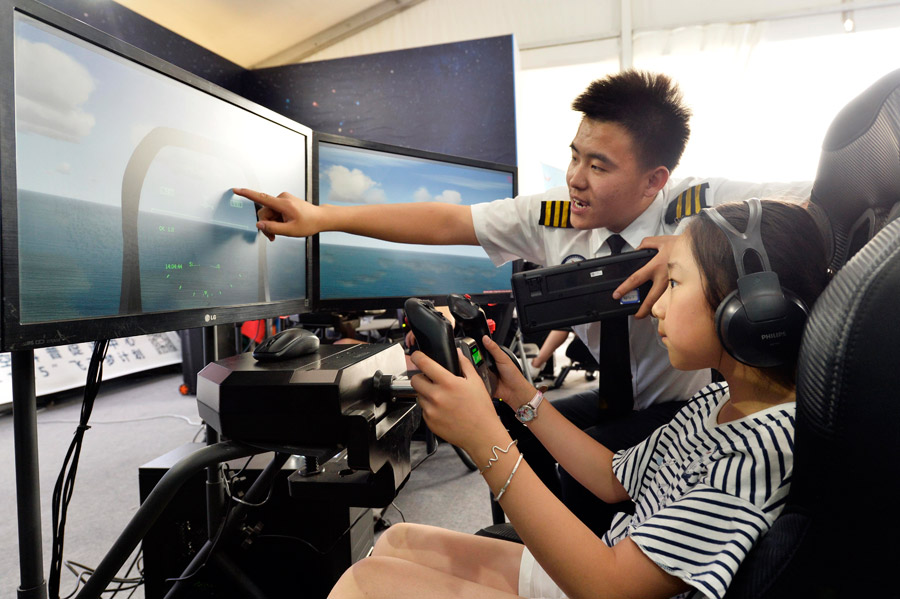
From hypersonic aircraft to supercomputer modules, science lovers were enthralled by China's newest and most advanced scientific hardware featured at Saturday's launch of the 18th National Science and Technology Week in Beijing.
The opening ceremony was held at the Military Museum of the Chinese People's Revolution with 460 exhibitions. The national science week, founded in 2001, is the largest, longest and most participated-in annual science event in China, said Minister of Science and Technology Wang Zhigang at the opening ceremony.
More than 300 million people are expected to participate in about 20,000 open days, exhibitions and other science-related events across China this week. The purpose of these events is to educate the public about recent Chinese scientific achievements and how they improved the national technological prowess and the lives of everyday people, Wang said.
Bai Chunli, president of the Chinese Academy of Sciences, said this year's science week features much new scientific hardware that is unfamiliar to the public yet crucial for groundbreaking scientific research.
"Letting the public see it firsthand will foster greater understand and appreciation for this cutting-edge hardware and China's overall scientific development in recent years," he said.
Lingyun 1, a hypersonic aircraft that can travel at more than five times the speed of sound, or 6,100 kilometer per hour, made its public debut at the museum on Saturday. It was developed by the College of Aerospace Science and Technology at the National University of Defense Technology.
The craft has a Chinese-designed supersonic combustion ramjet engine, also known as scramjet, the exhibition panel relates. The missile-shaped Lingyun made its maiden flight in 2015, making it the second low-cost, multipurpose hypersonic vehicle known to the public - the other is the HIFiRE vehicle jointly developed by the United States and Australia.
A scramjet engine can be used to make superfast cruise missiles that can penetrate anti-missile defenses. Technologies from the engine can also be applied to space shuttles able to make multiple trips and rendering space exploration and tourism cheaper and more viable.
Fitted on a passenger jet, the engine could propel the aircraft from Beijing to New York in about two hours. While civilian use of this technology is still in its infancy, Chinese scientists from the CAS have successfully tested a hypersonic plane in a wind tunnel at speeds up to 8,640 km/h, according to papers published in February in the journal Science China Physics, Mechanics& Astronomy.
Another new piece of technology that drew attention is the processing module for China's upcoming exascale supercomputer prototype developed by Sugon, a high-tech company affiliated with the CAS. An exascale supercomputer can make a quintillion - the number one followed by 18 zeros - calculations per second. That is 10 times faster than the current world champion, the Chinese Sunway TaihuLight super computer.
A major challenge for the design of such a computer is the cooling system. Sugon engineers have created a method in which the computer's processors are completely submerged in cooling liquid. This breakthrough has made possible the delivery of a prototype later this year, said Chen Jin, vice-general manager of Sugon's Engineering and Technology Center.
"It's common knowledge that fluid can damage electronics," Chen said. "The catch is, this is only true with liquid that conducts electricity, such as water. But we are using a special insulating liquid that does not harm the circuits and that can effectively remove the heat by pumping the material in and out of the system."
This technology is called Immersion Phase-Change Cooling. Because the liquid is recycled and reused within the machine, the engineers were able to stack processors with relative ease, thus increasing the computing power, Chen said.
Jay Siegel, a US chemist at Tianjin University, said it is encouraging that China puts so much effort into and attaches so much importance to educating the public about science on a national scale.
Foreign scientists tend to have trouble integrating into Chinese communities due to their work and cultural barriers," but events like these allow us to reach out to the community and teach them about the exciting new scientific achievements that have yet to enter the textbook," he said.





- Chinese researchers find new treatment path for high-risk breast cancer
- China cracks down on organized crime involving minors
- Two Taiwan suspects wanted in mainland smuggling case
- Lhasa promotes initiative to foster a skilled workforce
- Beijing makes it easier for families to buy property
- Authorities spotlight 10 landmark court cases to emphasize marital, family harmony