


In the steps of the enigmatic black dancers










Yet despite their wide popularity with their clientele, the Kunlun slaves were far from the only group of men who were traded along the ancient Silk Road, says Rong Xinjiang, a professor at Peking University and a Silk Road researcher.
Rong makes the comment as he points to a paper slave sales contract unearth ed in Xinjiang Uygur autonomous region, Northwest China. What was revealed by the contract, written in neat, inky Chinese calligraphy, was that a man named Zhang Zu had bought a slave from a Sogdian merchant. The contract was signed in a leap month in the year 447 and was executed in duplicate, the buyer and the seller each keeping a copy.
"For those familiar with the ancient burial traditions of the Chinese, the discovery is not surprising at all," Rong says. "People believed that they should take underground with them all the contracts signed during their lifetime, just in case of a dispute.
"Between the fourth and eighth centuries the Sogdian people from West Asia dominated the terrestrial Silk Road. The things they sold into China ranged from elaborately wrought metal wares and exotic-smelling spices to rare animals and even humans, and in many cases they traded their own people, especially young Sogdian boys and girls from poor families."
In fact the Sogdians were "the biggest slave traffickers of the Silk Road", Rong says.
The scale of sales can be glimpsed from a type of Tang Dynasty passport known as guosuo, he says.
"For any foreigner traveling on the vast territory of Tang, guosuo was required at all land and water passes. Some unearthed travel documents for Sogdians were marked clearly with the Chinese words nyu or bi, meaning male or female servant. Many were 8 to 10 years old."
In other cases, a couple of dozen Sogdian slaves shared a single guosuo, with their names appearing on a long list.
"During Tang, human trading was nothing unusual," Rong says. "Markets were available at almost all major stops of the ancient Silk Road, from Dunhuang, in present-day Gansu province, where some precious letters written in the now-extinct Sogdian language were discovered, all the way to Chang'an," Rong says, referring to present-day Xi'an.
However, Rong stresses that with Tang being an open feudal society, these men should not simply be depicted as slaves.
"Of course they could be bought and sold, and their freedom, consequently, was severely curtailed. Yet these Sogdian people, distinguishable by their high-bridged nose and deep-set eyes, were treated far better. Let's not forget that in a society where things foreign were not just tolerated but celebrated, their masters bought them not for manual labor but to showcase wealth and a trendy life-style."
In other words, they were not necessities but accessories.
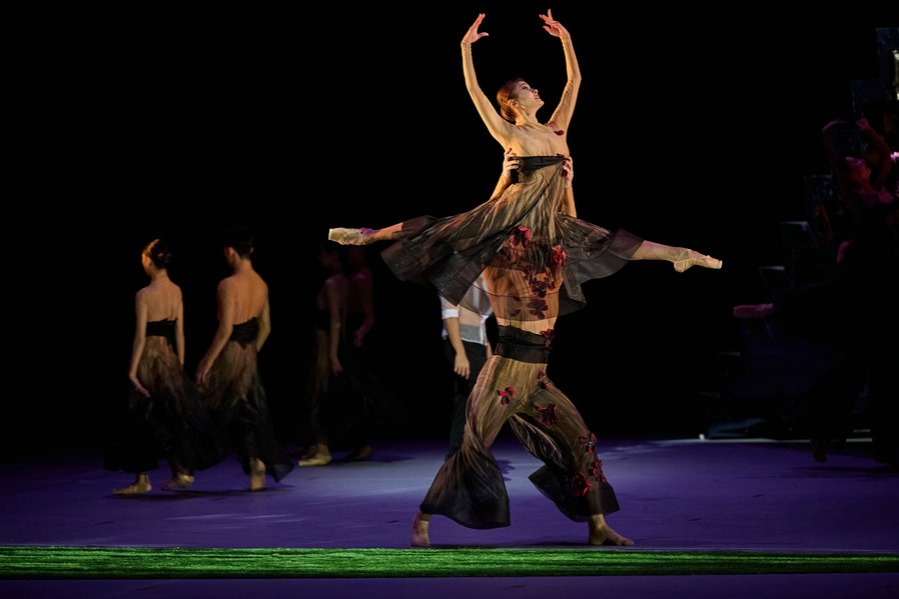
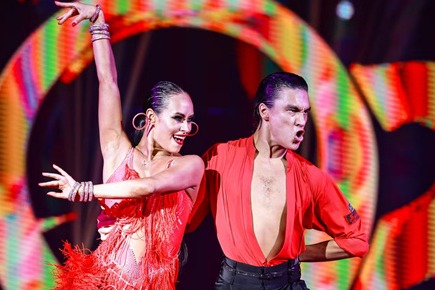
And the fact that many Sogdians were expert dancers must have certainly helped when their masters held a banquet to entertain guests. Their signature electrifying leaps and eye-bewildering twirls were expected to set everyone in a mood for carousal. The dance moves were known at the time as Hu-teng or Hu-xuan. Teng means leap and Xuan means twirl, while the word Hu was a concept subject to change throughout the history of ancient China.
"For the Han, China's ethnic majority, the term Hu was generally used to mean central Asian and non-Han people from beyond the country's northern and western frontiers," Rong says. "In other words, the Sogdians, who spoke Eastern Iranian and hailed from the Aral Sea Basin in around what is now Uzbekistan, were called the 'Hu people' by their Tang contemporaries."
This has differentiated them from other foreigners, including the aforementioned black Southeastern Asians and the broad-faced, flat-nosed men from the Eurasian steppes.
"Despite their different origins, all of these men were either involved in regular exchanges with ancient China, or became part of it, thanks to the Silk Road," Rong says. "And they collectively held up a giant mirror to the Chinese empire, extremely open and highly hierarchical at the same time."
Perhaps the best reflection of Tang rulers' attitudes toward these foreign people can be found in what is known as the Fanqiu Galleries, fanqiu being a term applicable to leaders of non-Han nations. It was a tradition for Tang emperors to install in their mausoleum such a gallery peopled by statues of all the foreign heads of state coming from afar to attend their funeral.
"The Tang emperors, who themselves are believed to have had some non-Han blood running in their veins, thought they ruled the world from its center," Rong says. "In a sense, for a large part of Tang, any of those who entered the constantly changing borders of the empire were considered its people."
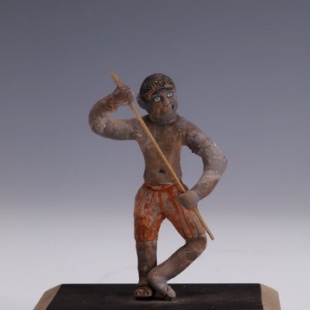
The boy, for his part, may have been a little too tired or homesick to reflect on such grave matters. He was discovered in the suburb of the city of Luoyang, about 400 kilometers east of Chang'an. (Luoyang was the capital for the Han Dynasty between 25 and 196. Later, during the reign of Tang, the city prospered once again, gaining for itself the title of the empire's "eastern capital" - as opposed to Chang'an as its western and official capital.
The boy came in between those two periods. The statue is dated to between the fourth and sixth centuries, a time in Chinese history marked by war, fragmentation and, surprisingly, art flourishing and rapid cultural development.
The sense of quietness he exudes contrasts with the color and cacophony of the time and place he found himself in. In the ensuing centuries it would be a color and cacophony added to by those who followed in his footsteps.
zhaoxu@chinadaily.com.cn