Quality drive puts brakes on IPOs









Only 51 applicants out of 96 receive regulator's green signal in the Jan-May period
The stock-market regulator's approval rate for initial public offering or IPO applications plunged in the January-May period as quality-oriented tighter regulations took effect, experts said.
Out of 96 IPO applications received from Jan 1 to May 17, only 51, or 52 percent, were approved by the China Securities Regulatory Commission.
In the same period last year, 178 of the 210 applications, or over 84 percent of the total, received regulatory approval.
Stricter eligibility criteria have kicked in to ensure only quality companies get to raise funds from investors, said Li Daxiao, chief economist at Shenzhen-based Yingda Securities.
"The tightened regulations and rules aim to choose IPO candidates with high quality, as part of the effort to protect investors' interests," said Li.
"An analogy might help to understand what's going on. Imagine a situation where all the Chinese people seek to study in the same university. They would have to wait for 1,000 years or longer in the queue. Not everyone would be admitted. Only a select few with top scores in the qualifying exam will make it."
Besides, the number of companies that are awaiting the IPO green signal has also plummeted to 287 by May 17 from a peak of 900 in 2016. Shorter queue could shorten the waiting time to less than 10 months from the peak of over 2 years in the past, market insiders said.
Li said companies generally seek to list to raise funds for research, development and business expansion. But some companies, once they get listed, don't perform very well, suggesting they may have furnished dubious or questionable information during the IPO application stage. If investors buy shares of such companies, they may lose their money.
According to a Xinhua report, the CSRC and stock exchanges have released draft rules in March that will force companies to exit the equity market for any serious violations of regulations, incomplete disclosures, and suppression of market-sensitive information.
The regulators and bourses will also step up efforts to delist "zombie companies" and those with long-term losses and severely poor financial condition, the report said.
CSRC data showed about 130 firms withdrew their IPO applications by mid-May. The corresponding number for 2017 was 146.
Withdrawals were due to some companies failing to meet the standards set for business operations and internal controls on basic accounting. Some firms did not disclose enough information or showed weaker capability to sustain profit, Gao Li, spokesperson of the CSRC, said at a news conference on May 18.
Li of Yingda Securities said if a company's IPO application is refused, it cannot opt for a backdoor listing in three years.
Backdoor listing is a strategy for companies to get listed by acquiring an already listed company.
"So if they realize that they won't pass the IPO test of the market regulator, withdrawal is an ideal way to avoid any risk to reputation and future prospects and also to access other financing channels later," Li said.
China's securities industry has developed rapidly since the 1990s. By now, China's stock market capitalization ranks second worldwide, contributing over 10 percent to the global market capitalization, Shao Yu, chief economist at Orient Securities, told China Securities Journal.
Similarly, China's bond market ranks third after those of the United States and Japan. However, there is still space for further expansion given the country's strong economic performance, Shao said.
Li said though it will become more and more difficult to get approval for IPOs, high-tech companies and unicorns - startups worth $1 billion or more - are still encouraged to list.
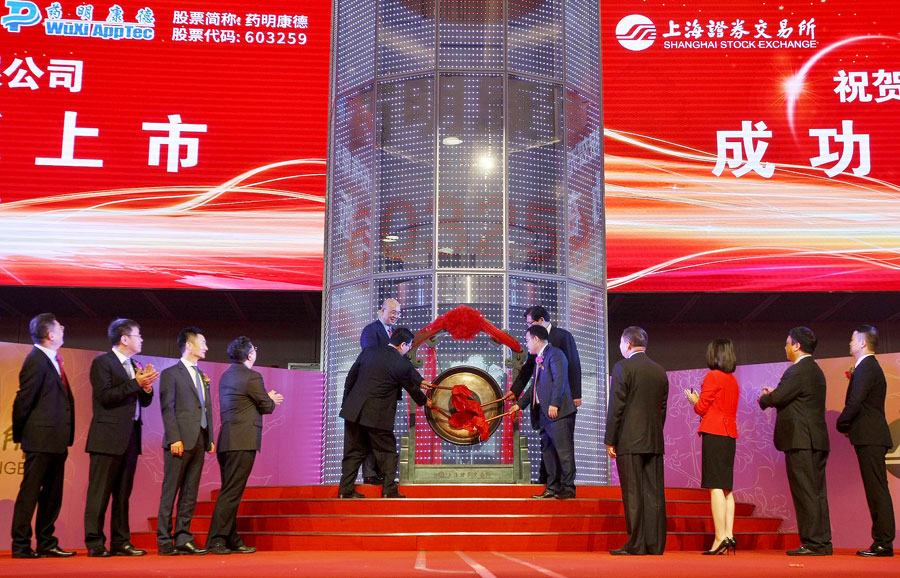
WuXi AppTec, China's contract research provider, got listed on the main board of the Shanghai Stock Exchange on May 8, marking the nation's first unicorn to get IPO approval on the A-share market.
The regulator welcomes companies in industries such as biosciences, cloud computing, artificial intelligence and advanced manufacturing, to promote the country's capital market and foster the new economy, market sources said.
Li Xiang contributed to this story.
Related story : Pay cuts sour staff mood at brokerages by CHEN MEILING, China Daily
Staff at some securities brokerages in China appear to be in for hard times as their employers are said to have cut salaries as well as human resources, after the business related to initial public offerings or IPOs began to shrink, industry sources said.
A monthly salary slip from an unidentified employee of Shenwan Hongyuan Securities, they said, went viral on the internet recently.
The stock analyst concerned apparently received only 4,783 yuan ($749.4) in monthly salary recently, down as much as 40 percent from the normal level.
Media reports said the brokerage adjusted its staff pay structure in late 2017. Key performance indicators or KPIs, which are linked to real sales, were given a weightage of 20 to 50 percent, it was said.
So, a plunge in the IPO business led to a decline in salaries-or so goes the market buzz.
Shenwan Hongyuan declined to comment for this story. It was not possible to identify its analyst concerned.
From January to May 17, the brokerage reportedly had no IPO-related work projects. In the same period last year, it had seven IPO projects on its books.
Pingan, Southwest and Minsheng Securities also reported nil IPOs in the same period this year. Typically, well-established brokerages employ 200-10,000 staff across different divisions, including 40 to 800 in investment banking, research and analyses.
An analyst working with a major Shanghai-based brokerage, speaking on conditions of anonymity, said, "We feel okay. It's just … no business or bonus. But who knows on which day the salary will decrease?"
He said a few days later he interviewed for a job in a different division of the brokerage.
China's securities brokerages were among the top pay masters in the private sector. This helped attract financial talent. However, since 2016, they have lost a bit of their sheen as IPO regulations tightened to avoid financial risk. This, in turn, affected the fortunes of brokerages, market insiders said.
According to information provider Eastmoney, average annual salary of stock market analysts decreased from 639,500 yuan in 2015 to 433,800 yuan in 2016 and about 411,100 yuan in 2017.
Yi Ping, senior partner of management consulting firm Roland Berger, said salaries at securities brokerages mainly contain basic wages and commission fee.
"For personnel who complete some big projects valued at 1 billion yuan, he or she may get millions of yuan in commission," Yi said. "But the workload is heavy and risk is high. It depends on whether you have projects and they go well."
From January to March, revenue of 131 securities brokerages decreased 7 percent to reach about 65.9 billion yuan while net profit dropped 17 percent to 23.5 billion yuan, data from the Securities Association of China showed.
For brokerages, revenue from their investment banking division dropped by over 31 percent, while underwriting fee plunged by about 32 percent, and income from financial advisory services shrunk by about 30 percent, the SAC said.
So, companies have to thrive by decreasing wages, downsizing or by hiring more interns to control the cost of human resources, industry insiders said.
But Yi said the current situation is not dismal, so no alarm bells need to be rung. For, a brokerage may have diverse business divisions dedicated to mergers and acquisitions and value assessment for clients. Such niche services are still in demand on the back of a strong Chinese economy.
"It's not a problem for the whole industry. If a company has other strong and profitable divisions to keep it running, it can still support sections that are weaker at the moment," she said.