




Documentary series looks at the lives of 6 Chinese authors









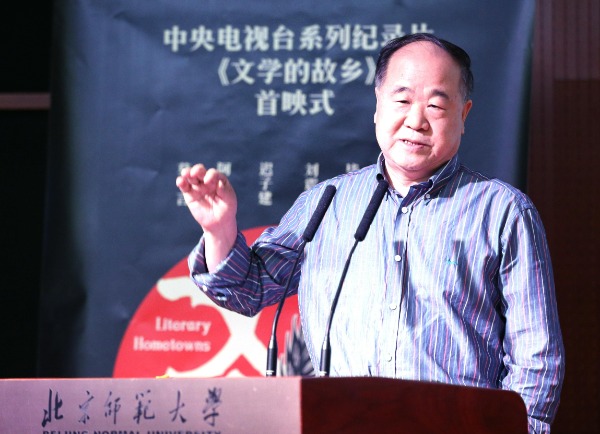
Nobel Literature Prize winner Mo Yan says he is the kind of person who dislikes to be on camera, but the novelist has agreed to "star" in an upcoming documentary series.
Literary Hometowns, a six-episode production that will air on China Central Television's documentary channel from June 8, features Mo and five other authors, Liu Zhenyun, Jia Pingwa, Alai, Chi Zijian and Bi Feiyu. One appears in each episode.
Mo, Liu and Alai, along with the documentary's creators, attended a ceremony to launch the series at Beijing Normal University on May 25.
The authors, who were all born in China's rural areas in the 1950s and 1960s, began to write after China launched its reform and opening-up policy.
The documentary series focuses on their birthplaces, old friends and relatives.
Also, viewers will get to see Gaomi, a small city in Shandong province that's the backdrop of Mo's 1986 epic novel Red Sorghum, and Shangluo in Shaanxi province, where Jia's award-winning novel Shaanxi Opera chronicles the villagers' lives.
The documentary series also focuses on ethnic Tibetan author Alai's climb up the 4,300-meter-high Balang Mountain in Sichuan province and travels with award-winning female writer Chi to China's northernmost village, Beiji, where the temperature can fall to as low as -42 C.
The series, produced by the CCTV documentary channel and made by Beijing Normal University's documentary center with support from the university's international writing center, took more than two years to complete.
Zhang Tongdao, the director and head of Beijing Normal University's documentary center, first got the idea for the series after watching the 2015 Sino-French documentary Once Upon A Time in Bussiere's Garden, which features an anecdote about French poet Saint-John Perse writing a poem in Beijing.
But the inspiration for Literary Hometowns came from the story of Lu Xun, arguably the greatest writer in 20th-century Chinese literature, who died in 1936.
"When Lu passed away, China's top film studios all wanted to shoot a production about him. But it was a pity. There were no video clips of him available," says Zhang.
So, Zhang, a Chinese language and literature graduate, wanted to avoid this situation in the future.
Also, Zhang had always wanted to see the places that had inspired the modern literary greats.
Citing the case of Alai's Mao Dun Literature Award-winning Red Poppies: A Novel of Tibet, which depicts the Tibet autonomous region's unique chieftain system, Zhang says: "I was very curious about how this great work was created.
"So, I told all the authors that we not only wanted interviews in Beijing but also wanted to travel with them back to the places where they were born and raised."
Though all the novelists made time to join the filming, their first reactions when approached were the same - they all refused to be part of the documentary.
Speaking about his initial response, Mo, who finally changed his mind thanks to Beijing Normal University literature professor Zhang Qinghua's persistence, says: "I had turned down the invitation many times. A writer is not an actor. I feel uncomfortable in front of a camera."
Mo, 63, who studied at the university in late 1980s, now heads the university's international writing center, of which Zhang Qinghua is the executive director.
For Mo, the series is an opportunity to again look at the relationship between a writer and his homeland.
And he explains this in the documentary when he says: "A writer's hometown means more than just where he was born. It is a place where he spent his childhood and grew into his youth, a place where his mother bled when giving birth, and a place where his forefathers were buried. Blood ties remain between him and his land."




















