


Crossroads of cultures









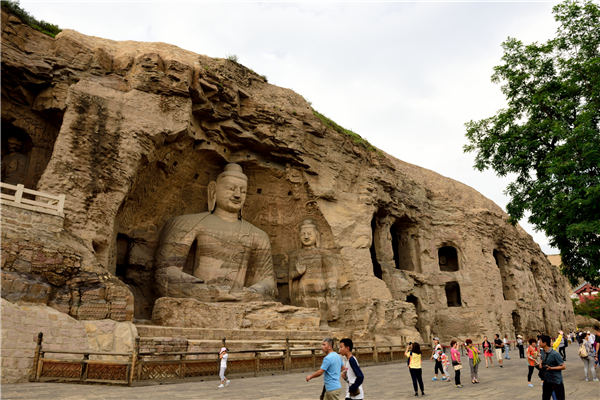
After the North Wei moved its capital from Datong to Luoyang, Central China's Henan province, in 494, the rich families living in Datong took up the mantle left by the departing royal families to continue the Yungang project, while the Xianbei royal families initiated the Longmen Grottoes in Luoyang. So as Yungang increasingly served as a turning point in the eastward spread of Buddhism, it helped Buddhism to continue onward to Central China.
The appearance of the statues, their clothes and posture vary between all the sites between Mogao to Longmen. The sculptures of Mogao and Maijishan grottoes look like people from South and Central Asia, while the statues at the Longmen Grottoes look more like the Han people of China. And just as the sculptures in Yungang represent the transition from foreign features to Chinese looks, Wuzhou Hill, a mountain range running from east to west, also marks the border between the nomadic and farming civilizations. And Datong, which is home to Wuzhou Hill, has always been a crossroad for exchanges among civilizations.
The climates to the north and south of Wuzhou Hill are very different. In the spring, when the north is still cold and windy, plants start to bud south of the mountain range.
The Northern Wei rulers deemed the hill as holy site and offered sacrifices to the heavens on the hill. That's why they chose it for the site of the grottoes, employing Buddhism as tool to comfort the war-torn nation, unite all the ethnic groups and consolidate their regime.
The geological makeup of the hill consists mainly of arkose, a type of sandstone that's ideal for excavation and carvings.
A monk named Tan Yao was assigned to take charge of the project in 460. The five most representative grottoes in the early stages of the project are called the Five Grottoes of Tan Yao, which are famous for the grandiose scale of their statues.
The middle stages of the project took place between 494 to 526 when Datong city fell to invaders, and the grottoes there are beautifully rich in bright colors, and the statues smaller than Tan Yao's works.
At that time, there were temples built leaning into the hill. During the following Han-dominated Sui Dynasty (581-618) and Tang Dynasty (618-907), the sites were repaired from time to time.
Over the following 1,000 years, the grottoes and temples were partially destroyed, rebuilt and expanded by the Qidan, Nvzhen and Manchurians - all nomadic peoples from Northeast Asia - and the founders of the Liao Dynasty (907-1125), Jin Dynasty (1115-1234) and Qing Dynasty (1644-1911) respectively, and constantly maintained by the Mongolian and Han Chinese founders of the Yuan Dynasty (1271-1368) and Ming Dynasty (1368-1644) thereafter.