US trade move bound to hit global growth









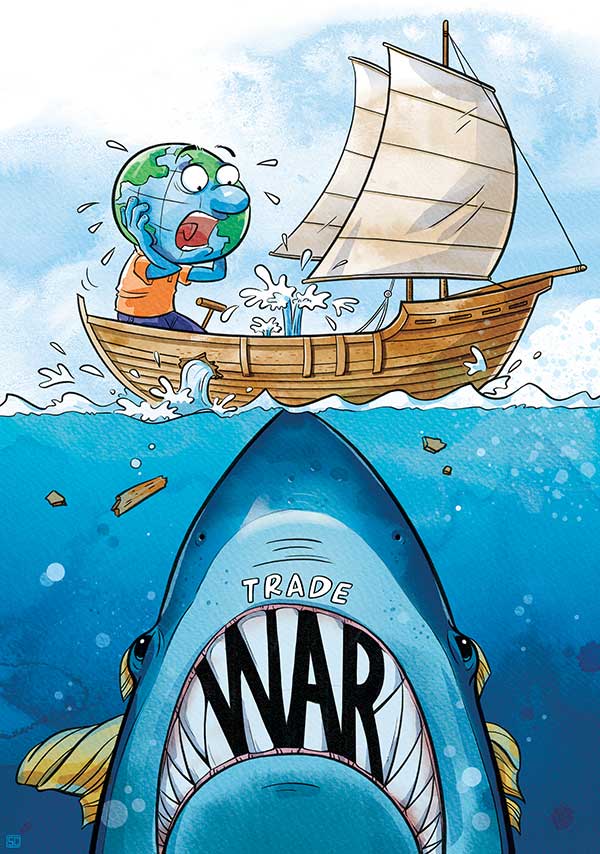
After threatening to ignite a trade war against China for months, the Donald Trump administration imposed additional tariffs on $34 billion worth of Chinese goods on July 6. To protect its core national interests, China was forced to take retaliatory action on the same day and levy tariffs on US imports based on the "equal scale and strength" principle.
Not satisfied with the July 6 tariffs, the US administration on July 10 proposed a 10 percent tariff on $200 billion of Chinese goods, which will be decided on Aug 31 following public hearings from Aug 20 to 23.
While the Trump administration is using his "America First" policy as an excuse to impose tariffs on Chinese goods, such protectionist tools were declared "outmoded" in the 1990s, because they were not only against the spirit and trend of globalization but also World Trade Organization rules. The US' beggar-thy-neighbor trade policy has invited condemnation from the international community and risks the trade conflicts spiraling out of hand. And increasing protectionism could fan the passions of nationalism and populism giving rise to more inward-looking policies across economies.
In the 1930s, the US used the Smoot-Hawley Tariff Act to levy tariffs as high as 50 percent on more than 20,000 types of imports in order to protect US farmers and businesses. The enormous retaliatory measures triggered by its trade partners resulted in a 66 percent decline in global trade from 1929 to 1934, exacerbating the Great Depression.
The current trade volume covered by US restrictive measures and countermeasures has already reached $100 billion, and could surge toward $1 trillion, or 6 percent of global trade. This is a large number and it means a lot to the global economy. Unfortunately, there seems little chance of a "cease-fire" in the short term, so the international community should not downplay the dangers they pose and instead prepare for the worst-case scenario.
Conceivably, tariffs on such a wide range of products will only result in losses on all sides and serve neither the US' nor China's interests, let alone the interests of the international community as a whole. All the other countries that are part of the global supply chains will also suffer as the impact of Sino-US economic and trade relations-negative or positive-extends far beyond the economies of China and the US. For example, about 59 percent of the $34 billion of Chinese goods subject to US tariffs from July 6 are produced by foreign-invested enterprises in China.
That the tariff war is imperiling the multilateral trading system is evident-and it will ultimately harm the fundamental and legitimate interests of many countries and their peoples. The US has put global companies and consumers on the edge, leaving them worried about the "real risks" posed by the rising trade barriers across economies. The increasing uncertainty over the US' economic policy has markedly eroded the confidence of enterprises that in turn could discourage them from investing at home and abroad. And the rage and anxiety over the economic outlook could overshadow political and economic activities.
The US' unilateral trade restrictions and incurred retaliations are adding to the chaos in the global economy and increasing the risks for it, including possible recession owing to the disorder in and decline of global markets. Although the world economy continues to maintain the momentum of recovery, its foundation remains anything but solid. In such a condition, the US' unilateral trade moves could trigger market turmoil, reverse the current trend of global growth and destroy the global economic foundation. Also, it could disrupt global trade flows, global supply chains and the functioning of the world economy.
As a crucial engine of global growth, trade plays the most important role in economic globalization, whose smooth progress is essential to ensure the implementation of the UN Sustainable Development Goals, especially in less-developed countries. In this sense, the US' unilateral moves deal a blow to global development which, to a certain extent, could lower the global living standards.
The international community should therefore uphold the spirit of win-win cooperation and common development, and strongly oppose all forms of unilateralism and protectionism, safeguard free trade, and help those countries in special situations to integrate into the multilateral trading system.
The author is a senior fellow at the International Cooperation Center of the National Development and Reform Commission of China.