Carrying Chinese goods on flights still popular with African traders









GUANGZHOU - It was 5 pm, and Saada Masood Ally Seif, a Tanzanian passenger in her 20s, was waiting in the departure hall of Guangzhou Baiyun International Airport, though her flight would not take off for seven hours.
"There will be a huge amount of baggage to be checked in, and I want to be the first in the queue," Saada said, eyeing three pieces of baggage beside her, dwarfed by piles of large baggage from other passengers.
Saada would take a midnight flight from the southern Chinese city of Guangzhou to Tanzania's biggest city Dar es Salaam, an air route she has taken many times over the past five years.
In Dar es Salaam, she runs a baby clothes shop in Kariakoo Market, the largest distribution center of Chinese goods in East Africa, and Guangzhou is her source of supply.
"Every time we come to Guangzhou, we take home as many goods as our check-in luggage can take," she said.
In recent years, the fast-growing Sino-African trade has become a vigorous part of global trade, with China being the largest trading partner of Africa for years. According to Chinese customs figures, the bilateral trade in the first half of 2018 reached $99.8 billion, a year-on-year increase of 17.3 percent. In this huge trade system, ordinary people like Saada play an important role.
When night falls, three check-in counters at Guangzhou airport brace for the peak check-in of passengers flying to Africa. Many are carrying baggage filled with Chinese goods.
For many African business people, Guangzhou is the most attractive place for buying goods. And for countries without ports, shipping back Chinese goods by air is still profitable, according to Vincent Ongas, a manager at Kenya Airways.
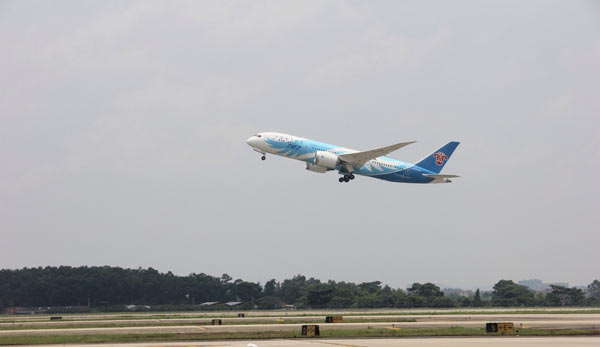
"A lot of African people like the trade environment in Guangzhou. Some travel between Guangzhou and Africa every week," Ongas said. "Kenya Airways uses Boeing 787s to fly the Guangzhou-Nairobi route. Usually among the more than 400 passengers on board, there are 60 to 100 business people."
"At the Guangzhou airport alone, there are more than 150 such traveling African traders shipping a large number of made-in-China goods back home daily," said Ma Jiangnan, a customs officer at Baiyun Airport.
"With Africa's increasing demand for Chinese goods, more African buyers in China have abandoned random small procurement and turned to bulk purchases," said Liu Jisen, executive vice-president of the Institute for African Studies of Guangdong University of Foreign Studies. "Yet for new traders, the channel of passenger-carried cargo still has a certain appeal."
For this trip, Saada ordered five large boxes of baby clothes, a majority of which had been shipped to Tanzania by sea before her departure. She took the rest home by air.
The Guangzhou airport has six air routes to Africa, including three direct routes and three transit routes. Every week, there are 34 flights between China and Africa, with an annual passenger throughput of 650,000.
Kenya Airways and Ethiopian Airlines offer excess baggage coupons for frequent passengers, which are priced between $80 and $200 for each piece. With both free and paid baggage, a passenger can carry up to 300 kg of check-in luggage.
"We are using widebody passenger aircraft. Our passengers who have made round trips a certain number of times can get free air tickets," Ongas said. "Since 2013, we have increased the number of flights from four round trips to seven round trips a week. But in the peak period, passengers still need to buy tickets at least one week in advance."
Easier customs clearance also facilitates trade. African traders can send information on carried cargo to a declaring agent through a mobile phone app and some clearance work can be done beforehand.
The customs use X-ray machines at baggage sorting lines to inspect goods. "The cargo can complete non-intrusive inspections before a passenger reaches the boarding gate," said Chen Xinyi, an airport customs officer.
According to Guangzhou Customs, more than 30,000 tons of goods have been exported this way since 2014. At the peak, more than 30 tons of goods are cleared daily.
"It's good to do business in Guangzhou. You have a lot of choices and can buy at a satisfactory price," said Saada, who lined up for boarding near midnight. "If business is good, I will be back six times like last year, maybe even more."
- China-Africa infrastructure cooperation seminar held in Kenya amid growing ties
- Fashion merges Sino-Kenyan culture
- China-Africa Economic and Cultural Week kicks off in Guangzhou
- Morocco, China vow to enhance cooperation between business communities
- South Africa and China celebrate 20 years of diplomatic relations