Large wildfires reshape US Western states









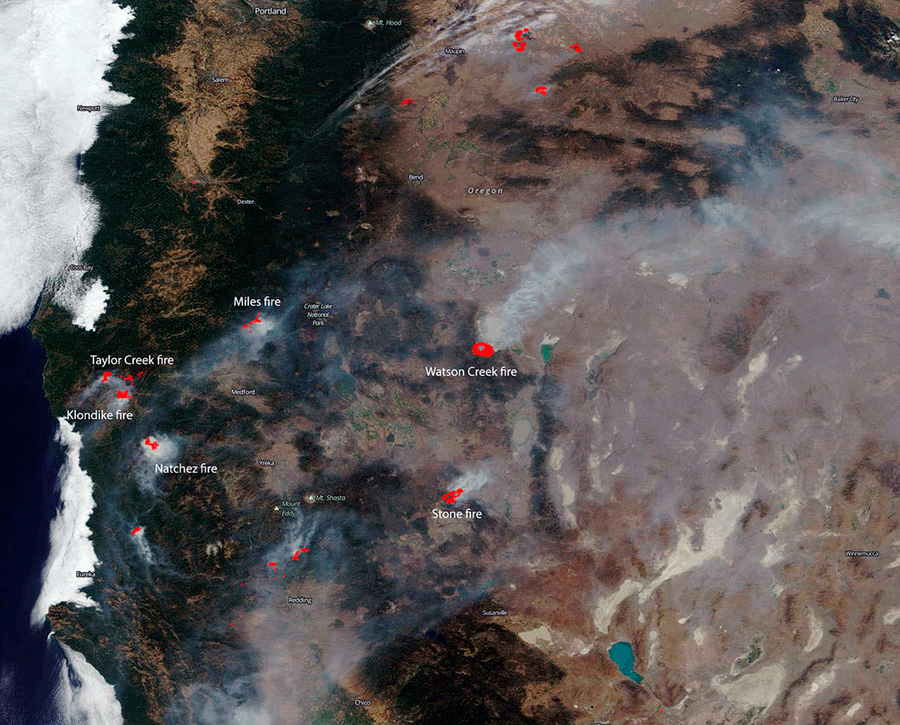
BILLINGS, Montana - Wildfires in the US have charred more than 25,900 square kilometers so far this year, an area larger than the state of Maryland, with large fires still burning in every Western state including many that are not fully contained.
Whether sparked by lightning or humans, fire has long been a force shaping the landscape of the US West.
Hot, dry winds can whip flames into firestorms that leave behind charred wastelands prone to erosion and mudslides. Other fires clear out underbrush, open the forest floor to sunlight and stimulate growth.
Those influences are magnified as development creeps ever deeper into forests and climate change brings hotter temperatures. Recent images of subdivisions ablaze thrust the power and ecological role of wildfires into the spotlight.
A look at the environmental effects of wildfires:
Smoke and ruin
Most immediately fire brings destruction.
Temperatures from extreme fires can top 1,093 C-hot enough to kill all plant life, incinerate seeds hidden beneath the surface and bake the soil until it becomes impervious to rain.
The lifeless landscape becomes prone to severe erosion, fouling streams and rivers with silt that kills fish and other aquatic life. Torrents of muddy debris following fires last year in Southern California killed 21 people and destroyed 129 homes.
Climate questions
Scientists broadly agree wildfires are getting bigger in North America and other parts of the world as the climate warms. But still emerging is how that change will alter the natural progression of fire and regrowth.
The time interval between wildfires in some locations is getting shorter, even as there's less moisture to help trees regrow. That means some forests burn, then never grow back, converting instead into shrub land more adapted to frequent fire, said Jonathan Thompson, a senior ecologist at Harvard University.
"They get stuck in this trap of repeated, high-severity fire," Thompson said. "Through time we'll see the California shrub land shifting north."
Similar shifts are being observed in Colorado, Wyoming's Yellowstone National Park and Glacier National Park in Montana, he said.
Bird in the balance
Life and property still top the list of priorities for firefighters, but in recent years another asset has been deemed worth extra protection in many Western states: a chicken-sized bird known as the greater sage grouse.
Fires burned an estimated 8,400 sq km of the bird's sage bush habitat in 2017 and have burned almost 6,200 sq km so far in 2018.
When sage brush burns, it's often replaced with a plant from Europe called cheat-grass, which crowds out native plants and is more prone to burning.
That's challenging government efforts to keep greater sage grouse off the endangered species list, which could restrict economic development.
Regeneration
A turning point in public understanding of the ecological importance of fire came in 1988, when 1,240 square miles of Yellowstone National Park burned.
The devastation, punctuated by images of wildlife fleeing flames, fed into the perception of wildfires as a menace to be battled.
The events drew criticism of the park's "let it burn" policy. Officials didn't immediately squelch lightning-caused fires that June because they did not pose an immediate threat to life or property, but eventually ended up deploying 10,000 firefighters.
By that fall, seedlings already were emerging in some burned out areas. Park biologist Roy Renkin recalls a visitor reacting with surprise a decade later when he told her a thick stand of young trees emerging from a burned area had come back on their own.
"It's isn't all death and destruction," Renkin said. "These forests have evolved with fire."
AP