More disabled students admitted to universities









Gaokao takers given reasonable help; tailored courses available
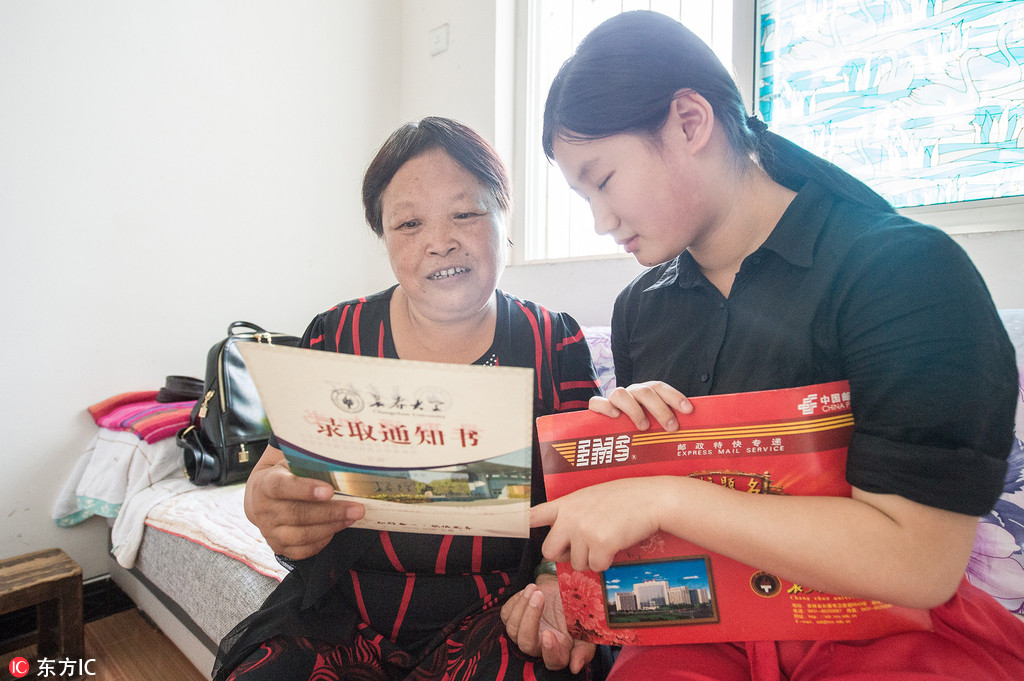
More students with disabilities have been admitted to colleges via gaokao, China's national college entrance exam, than through special exams, in the last few years, an official from China Disabled Persons' Federation said on Friday.
Between 2015 and 2017, more than 28,900 disabled candidates were admitted via gaokao to mainstream colleges, compared with 5,464 candidates admitted through special exams to colleges or majors that cater to the group, according to Li Dongmei, deputy director of the federation's education and employment department.
"The statistics show that an increasing number of disabled students are receiving higher education, and are being enrolled in mainstream colleges along with their able-bodied counterparts," she said, adding she expects the number to increase with economic and social development.
China has 85 million registered disabled people. According to the second national sample survey for the disabled - the latest available statistics released in 2007 - only 1.13 percent of the disabled aged above 6 have received higher education. The illiteracy rate is 43.9 percent.
China has a two-track education system from primary school through university; one track is standard, while the other caters to children with disabilities.
The special colleges targeting disabled candidates provide a relatively narrow range of curriculums, mainly for developing skills. For example, the majors available for the visually impaired are limited to massage and music in such institutions, whereas the mainstream colleges provide a wider range of choices, such as law and interpretation studies, but applicants need to take the gaokao first.
In 2015, the Ministry of Education and the China Disabled Persons' Federation issued a guideline that required examining bodies nationwide to offer "reasonable" assistance to students with disabilities taking the test.
For example, blind and visually impaired students should be provided with exam papers in Braille or bearing large-print characters, while those with hearing disabilities are allowed to use hearing aids and can be exempted from the aural section of English exams providing they obtain permission.
Those with physical disabilities can use wheelchairs and crutches, and the duration of the tests, which usually last two or two and a half hours, can be extended if students have difficulty writing.
In addition to better access at the test, Li said her federation also launched a two-year program in six universities last year in an effort to accumulate experience in inclusive higher education and provide reference for policy-making.
Universities included in the program would provide tailored courses for the disabled students that could substitute courses in their curriculum if they have difficulties attending, and set up volunteer groups to help with such students, she said.
The six forerunners include Beijing Union University in the capital, Sichuan University in Sichuan province, Wuhan University of Technology in Hubei, Changchun University in Jilin, Nanjing Normal University of Special Education in Jiangsu, and Zhengzhou Institute of Technology in Henan.
Song Muhan, a Chongqing student who lost an arm in an accident, was admitted to Beihang University this summer. He said the admission inspired him very much. "I hope I will be among the makers of China's space shuttles and spaceships in the future."



- National Games vibe is everywhere in Guangzhou
- Forum unites global experts to enhance city image communication
- Miao New Year celebrations get underway in Guizhou's Leishan county
- Mainland spokesman reiterates stand on Taiwan
- Fujian county's rural development becomes a big draw for Taiwan investors
- Nobel laureate in chemistry: Give young scientists more independence