Tollways, solar-powered roads boost transportation









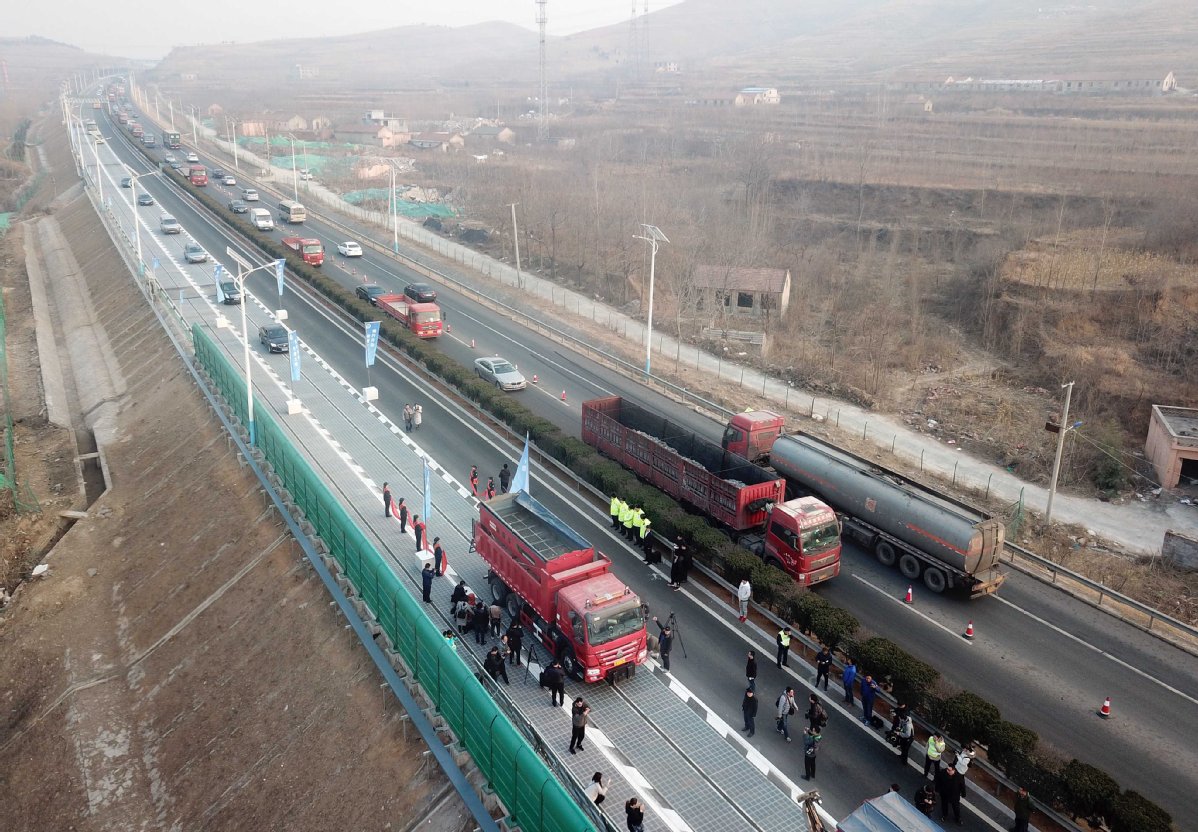
High-tech materials, new funding streams are paying dividends
"I still remember the hardship my peers and I experienced when building the Shanghai-Jiading Expressway," said Zhou Liang, chief engineer with the Shanghai Urban Construction Design and Research Institute.
The 20.4-kilometer-long expressway - known as the Hujia Highway for short-was built in 1984. It was the first national highway project built in the Chinese mainland, and connected Shanghai's Jiading district with the city's downtown.
Zhou, who was involved with the project from the beginning, said the work was incredibly challenging because of unregulated construction standards. Equipment, financial support and technologies were also lacking, making for inefficient infrastructure construction.
"Negative voices were raised against the proposal at the time, allowing for much higher costs but unpredictable economic returns," he said. "Objectors said the (low) number of private cars at the time could not satisfy the normal operations of such a highway."
Technology was the key problem, according to Zhou. "We didn't have any advanced equipment, such as drones for example, to help us conduct surveys, so we walked step by step from Jiading to the urban center to measure the road by hand," he said.
"In addition, expressway signs had not yet been standardized. We drove a car on an airfield runway at speeds reaching 120 km per hour to see how big the signs would have to be so drivers could read them clearly."
With an investment of 230 million yuan ($33.5 million) from the Shanghai government, the Expressway opened to traffic in October, 1988, marking the start of China's massive plan to upgrade the highway network.
Growing network
In the early 1980s, the length of China's highway network was no more than 900,000 km, according to the Ministry of Transport.
By the end of last year, the total length of highways open to traffic was about 4.8 million km, about 5.2 times the length in 1984 when highway construction work was in the early stage of development, the Ministry of Transport said.
Last year, expressways attaining modern transportation standards accounted for 136,500 kilometers of the total length of highways nationwide, the longest network in the world, the ministry said.
Expressway construction really began to take shape in 2005 when the ministry introduced the "7918" network, which included seven radial expressways from Beijing, nine north-to-south expressways, and 18 east-to-west expressways.
The network was upgraded with two more north-to-south expressways after the ministry released the National Highway Network Planning (2013-2030) program in 2013. The network was then renamed"71118".
Investment in highway construction was 2.1 trillion yuan last year, a rise of 18.2 percent from 2016, and funding for expressways exceeded 900 billion yuan, a rise of 12.4 percent from the year before, according to the ministry.
The rapid development of the highway network has greatly improved traffic capacity and efficiency.
Cheng Xinguang, a 50-year-old from Jixi county, Xuancheng city, Anhui province, has been impressed by the great changes highway construction work has brought for him.
Before the expressway connecting Jixi and Hangzhou city, Zhejiang province, opened in 2014, Cheng used to drive on winding mountain roads for more than three hours to reach his hometown in Zhejiang and visit his parents' house.
"The road I used to drive on has many curves which made it extremely dangerous when encountering large trucks and cars," he said.
"Now it is much safer and easier to get home, and it only takes about 90 minutes."



- 'Book of Songs' from Chinese imperial tomb proves oldest complete copy ever found
- Exhibition highlighting the 'Two Airlines Incident' opens in Tianjin
- Average life expectancy in Beijing rises to 83.93 years
- Energy drink overdose sends delivery worker to hospital
- GBA and Hainan deepening cooperation to boost innovation and sustainable growth
- Beijing mulls including the costs of embryo freezing and preservation in medical insurance