Brewing up a perfect recipe for success









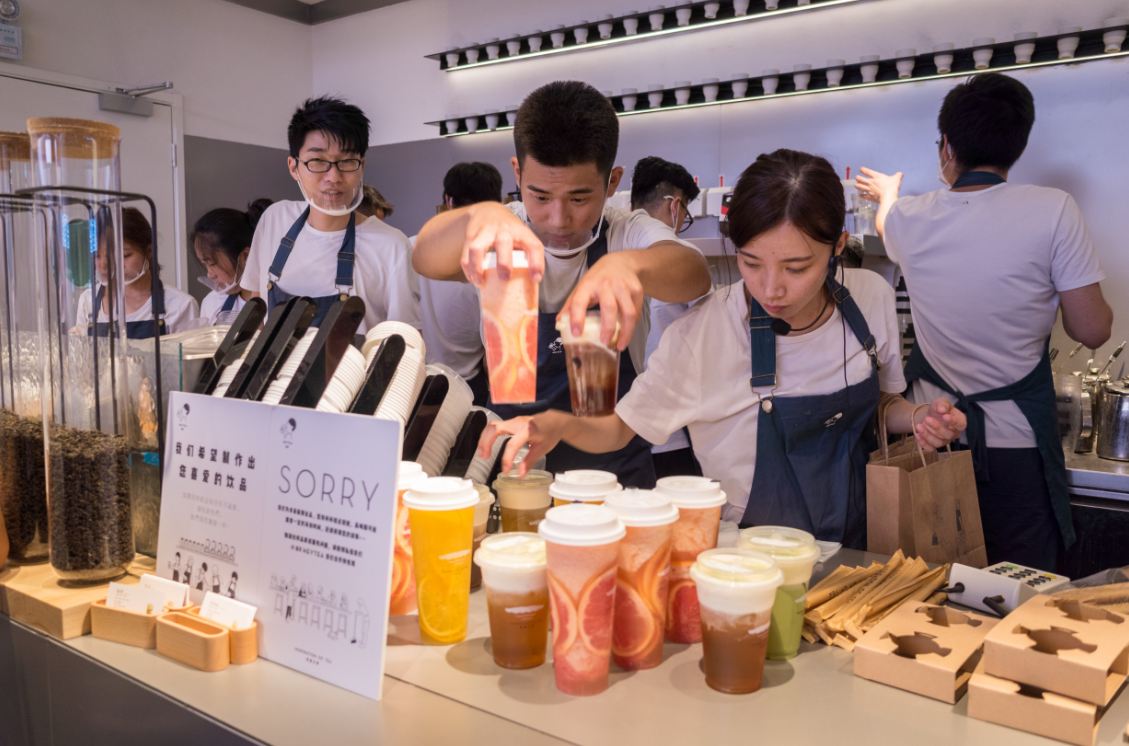
Chinese tea chain Heytea gets ready to challenge global rival Starbucks
Heytea, China's fast-growing tea chain, is looking to challenge its much-bigger global rival Starbucks, both at home and abroad.
The company, which had over 100 stores in 13 cities by September, is planning to double its presence to 200 locations across the country by the end of this year. More than that, it is also making its foray into markets like Singapore and Hong Kong, as part of its long-term international expansion.
"When we talk about international expansion, it also includes tapping the local market. It would be of little significance if the main consumers of our overseas outlets are Chinese living abroad," said Nie Yunchen, founder and CEO of the Guangdong-based brand.
"There is no doubt that a super brand will rise from the category of modern Chinese tea. And the influence of this super brand must be worldwide," said Nie to China Daily in Shanghai, ahead of the opening of its flagship store at the Disney resort.
Statistics provided by Shenzhen Meixixi Catering Management, which owns the Heytea brand, showed that in 2017, the company raked in 600 million yuan ($87.2 million), up 100 percent year-on-year. The growth rate is likely to sustain, if not become higher, over the next three to five years.
It is now the second largest player in China's rather fragmented milk tea market, after Yi Dian Dain from Taiwan, which boasts more than two decades of history, according to consultancy Euromonitor International.
Though Heytea accounts only for a fraction of Starbucks' multibillion-dollar business in China, its phenomenal success within six years of inception has stirred up a storm in both retail and investor world.
In April, Longzhu Capital, the venture-capital arm of Meituan-Dianping, an online-services and delivery giant, led a second funding round of Nie's company, raising 400 million yuan, the biggest in China's beverage industry to date.
When it pioneered into east China with the first store in Shanghai in last Feb, waiting lines outside the store stretched hundreds of meters, raising security concerns. A customer had to wait as long as seven hours to get a cup of the 25-yuan drink. Outside the store, scalpers sold the drink at three times higher than the original price and managed to make big fortunes from those who were too impatient yet too curious for a sip of the drink.
It signature product, cheese-foamed tea, has enjoyed such popularity that it has become a regular item not only on the menus of thousands of coffee and tea chains across the country, but also some well-established Chinese and western restaurants. Even Starbucks introduced something similar in April for China-a cold brew coffee topped with what it calls "cloud foam".
But Nie attributed the success of Heytea to "making China's most traditional, beverage relevant and young again", instead of to one certain product.
"Heytea has never been positioned as a brand of cheese-foamed tea, or any singular type of tea," said Nie.
"My confidence does not come from Heytea or myself, but the nation's tea tradition that has been around for thousands of years. Any certain type of tea can be outdated. But tea won't. It has found its root in the nation," he added.
A native of East China's Jiangxi province, Nie moved to Jiangmen, Guangdong province when he was young with his two geologist parents, who were laid off from their former academic jobs and decided to try their entrepreneurship in the business hub of Pearl River Delta.
Never interested in schoolwork, Nie took up administration management as his major at college and started to do business in his sophomore year with friends.
Two years later, he invested 150,000 yuan, made from selling smartphones, and opened a milk teashop in an alley, the size of "a shower room", he said.
"Making money is boring, and definitely not worth devoting my youth to. Selling doesn't create value. Instead I want to make things and ideally, leave an impact on the world with the things I make," said Nie.
And so he chose tea, to be "impactful".
"It's a quite polarized industry. On one end, there is the over thousand-yuan-per-kilo tea leaves that rich people invest and collect as trophies. On the other, it's the milk tea chains expanding from Taiwan that sell the drinks at less than $2 and use mostly powder," he noted.
Nie admitted that the idea of adding milk above tea instead of into it doesn't come from him. What he has done is to "make it better"-by replacing all types of powder with real ingredients, milk and cheese on top and brewed tea leaves, supplied by a tea plantation owned by Heytea.
"I think the biggest problem with some of the veteran milk tea brands is that they believe consumers can be easily fooled (with the powder). But I am one of the young people and I know lots of young people would rather drink mineral water than a cup of powders," he said.
China saw its first trend of milk tea at the beginning of the century, started mostly by business people from Taiwan, where the bubble tea is believed to have been invented. Shops, or more precisely kiosks, offering these drinks to go are mostly located near school with no seats and frequented by students for a snack after class.
Today, most of Heytea's stores, as well as those of its competitors', are situated in the bright and sleek shopping malls, next to fashion retailers like H&M and Zara, if not more luxury brands. Like their well-designed logos and teacups, the interiors of the stores are also suited to the taste of the millennial, or social media, generations.
"The idea of making tea cool again has to be applied everywhere," said Nie.
This has also added to the high cost in almost every part of the supply chain. What's more, he has also decided on a pricing policy wherein his products are 10 yuan cheaper than its equivalent on Starbucks.
As a result, the gross margin of the business is much lower than 50 percent, despite the fact that some of its popular stores could receive an average of 3,000 to 5,000 take-out orders every month.
But Chinese media reports noted that some shopping malls have been cutting rentals to lure Heytea to have a presence there, so as to attract more young people.
"Regardless of the taste of its products, Starbucks is a respectable and dominant player in the domestic beverage market. As a late comer, we can only compete with it by being more accessible," said Nie.
However, he added that if there were an entrepreneur that has inspired and motivated him over the past six years since he found Heytea, if not even before that, it should be Steve Jobs and his Apple, instead of Howard Shultz of Starbucks. "The significance Jobs and his iPhone has left on us could be more profound 50 years later than today. When he first introduced iPhone, there was no such thing as Alipay or WeChat or Uber. Everything we find so great and life-changing has been built on his invention," said Nie.
"And what I want to do is something similar," he added.
And the young man is assured he is half way there, as "even if the super brand of tea fails to be Heytea, it has shown the world the kind of storm tea can bring up."