


Remembering the changes through music









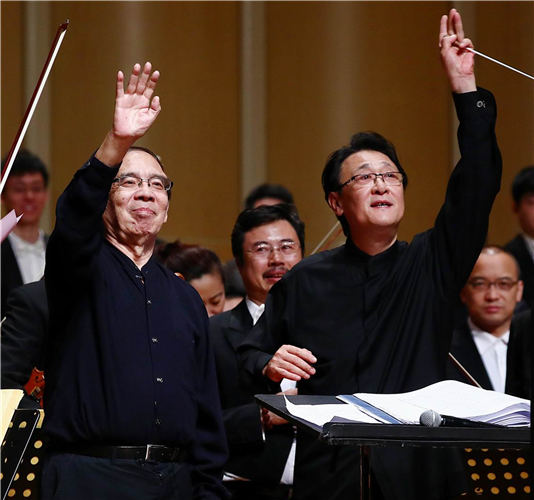
The Beijing Symphony Orchestra performs a concert to mark the 40th anniversary of China's reform and opening-up.
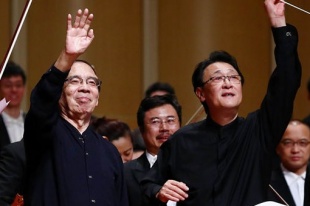
At the ongoing Beijing Music Festival-an annual event featuring world-class musicians and concerts, the Beijing Symphony Orchestra led by conductor Tan Lihua gave a performance called Embracing the New Era: Chinese Music Concert, to mark the 40th anniversary of China's reform and opening-up, at the Forbidden City Concert Hall in the capital.
The first half of the concert featured three pieces by Chinese composers: Yang Qing's Symphonic Poem: The Narration of Beijing; Chen Peixun's Aira of Snow and the fourth movement of Bao Yuankai's Peking Opera Symphony.
According to Tan, the artistic director and conductor of the orchestra and vice-president of the Chinese Musicians' Association, the repertory focused on massive changes in China since the reform and opening-up began.
"In the past 40 years we have not only performed Western classical music works, but also devoted ourselves to writing our own music," Tan says. "In the last four decades, a large amount of original Chinese music was created and we feel proud that these works have not only been performed in China, but have also been performed by international orchestras."
Symphonic Poem: The Narration of Beijing was written by Chinese composer Yang, a classmate of Tan at the Shanghai Conservatory of Music, for the Beijing Symphony Orchestra to mark the 2008 Beijing Olympic Games.
Tan, who premiered the work in 2008 with the Beijing Symphony Orchestra, says: "It uses local nursery rhymes and qinshu, a traditional art form that combines storytelling, singing and music instruments.
"The music unfolds bit by bit, and is a tribute to Beijing and its people."
As for Bao's symphony, it contains four movements: Jing-The Painted Face, A Solemn Andante; Chou-The Comedian, A Humorous Presto; Dan-The Lady, A Profound Largo and Sheng-The Man, A Brillante Allegro.
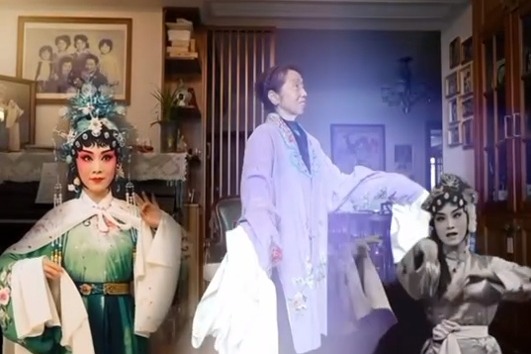
With the techniques of Western classical music composition, the work is based on four different role types in Peking Opera-the 200-year-old traditional Chinese art form that combines singing, dancing and martial arts.
The piece was also commissioned by the orchestra and premiered in 2006 by Tan in Beijing.
Speaking about his work, Bao, 74, who was born in Beijing and graduated from the Central Conservatory of Music in 1967, says: "I wanted to present the profound and rich spiritual world of Peking Opera through classical music."
Bao, who took almost a year to complete his Peking Opera Symphony, says he used to listen to Peking Opera as a child and was always interested in painting Peking Opera characters.
Commenting on Bao's work, Tan says: "Thanks to his (Bao's) interpretation, audiences from different cultures can enjoy the beauty and spirit of Peking Opera."
Bao says that despite the development of classical music in China in the past 40 years, he is concerned that Chinese traditional music has not been promoted as greatly as Western classical music.
"Music schools in China put a lot of effort into Western classical music rather than traditional Chinese music. It's harmful for our culture," says Bao.
The second half of the concert was Embracing the New Era Symphonic Suit, a special arrangement by Chinese composer Dong Yuexuan, who adapted popular Chinese songs, including On the Hopeful Field, Pearl of the East and I Love You, China.
The songs, Tan says, represent the big events in China over the past 40 years.
For example, On the Hopeful Field celebrates the start of the reform and opening-up and Pearl of the East marks the handover of Hong Kong in 1997.
Looking back over the past four decades, Tan says classical music has developed very quickly in China.
Before 1978, there were four symphony orchestras in China but now the number is more than 80 across the country.
"The reform and opening-up made China powerful and changed people's lives.
"The booming classical music scene means that the Chinese composers now want to write more original material," says Tan.