The robofashion makeover









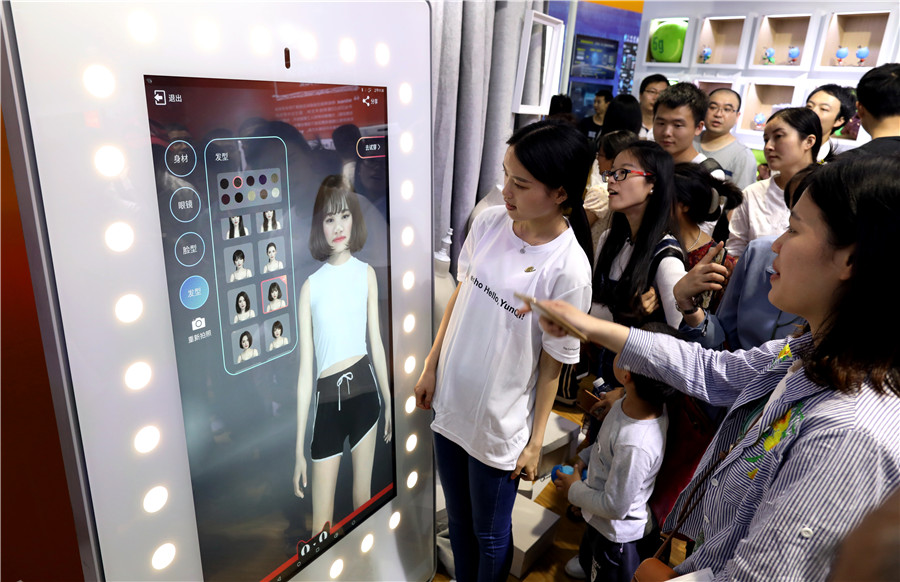
Applying AI to makeup
More fashion brands are applying AI technologies. Cosmetics giant L'Oreal has a smartphone app that allows customers to "try on" lipsticks, eye shadow and eyelash styles. Luxury brands like Burberry give shoppers intelligent advice on which fashion items suit them best.
"AI enhancements will go beyond the traditional areas of machine tasks into creative and customer-interaction processes, blurring the line between technology and creativity," US management consulting firm McKinsey & Company said in a report on fashion trends this year.
Fashion is about design and the customer's emotions and feelings - combining physical materials with human senses. So how can it be read by a machine?
The first step, said Calvin Wong, a professor at Hong Kong Polytechnic University's Institute of Textiles and Clothing, is to teach the machine to analyze a fashion image.
That ensures "the machine understands the fashion world", said Wong, who is leading a team of a dozen researchers that is working with Alibaba Group to enhance the search functions on its Taobao e-commerce platform.
The biggest challenge facing Taobao is the sheer chaos of products that have not been properly tagged, said Jia Menglei, a senior engineer at Alibaba, with customers complaining that it's hard to find what they're looking for.
Li Yuan, 26, and a keen online shopper, said: "There are just tons of items on Taobao. I often have to spend hours on it selecting what I need.
"Sometimes it makes me feel dizzy."
Jia said using a data set of fashion attributes produced by Wong's team will make tagging more exact and predictable, allowing Alibaba to "rebuild the world map of consumer goods".
Understanding images
Apparel comes in innumerable patterns, each with different characteristics and elements that define it as "fashion". The variety of materials, colors, shapes and styles creates skirts, pants, T-shirts, dresses, sweaters and other items that appeal to a range of tastes.
Take a sweater. It can have a puritan collar, a shirt collar, a rib collar - the list goes on. To train a machine to understand a sweater, you need to install a data set of images of all kinds of sweaters, tagged with their design attributes. The AI network, or a single machine trained to have predictive ability, would then recognize a specific type of sweater the next time it sees one.
The data set is most important. It serves as a guideline for the machine's learning process and sets the foundation for all follow-up research.
"It needs to be professional enough to meet the requirements of machine training," Wong said, including complete and precise attributes for each style that may be applied to the basic image.
"For a sweater with a turtleneck, you need to give it a tag both as a sweater and a turtleneck. If it's identified sometimes as a sweater and sometimes as a turtleneck, the machine will be confused."
Wong said the accuracy of searches for clothing images on the internet is only about 50 percent, something he attributes to the lack of sufficient professional data.
The AI system adopted by Alibaba has been trained to recognize more than 500,000 outfits.
The second level of AI application in fashion is to analyze current styles, evaluate their most popular elements, provide recommendations and even predict trends.
Wong said that if a machine has a data set of the latest images of outfits in the fashion world, it could calculate which elements are emerging as popular and may become the trend of the foreseeable future. Then it could offer recommendations for consumers, based on predictive analysis and individual preferences.
The team expects that in the near future AI will be able to collect more data from customers, providing important information about the popularity of certain styles. The data can note the amount of time a customer spends looking at a particular piece of clothing using a "smart mirror" and whether they decide to buy it, along with other aspects of the fashion experience.
Alibaba will combine data from Taobao with that collected in offline shops, aiming to provide an all-around data service for the industry - from fashion design and material selection to storage and logistics.
AI appears set to transform the fashion industry, but is there anything a machine is not likely to master in the near future?
Yes, said Wong, because, in the end, designers are irreplaceable. The core of design is the inspiration, he said, and a machine can only serve as an assistant, at best.