Hometown of Confucius seals own destiny









Links with the ancient philosopher fuel booming tourist industry, economy
Qufu in Shandong province was the hometown of the philosopher Confucius, who lived around 2,500 years ago. This rich cultural history has played a major part in the city's economic development over the past 40 years of reform and opening-up.
"The local cultural industry has developed from a small and disorganized one to a big and high-quality one," said Yue Yaofang, executive deputy head of publicity for Qufu's Party committee.
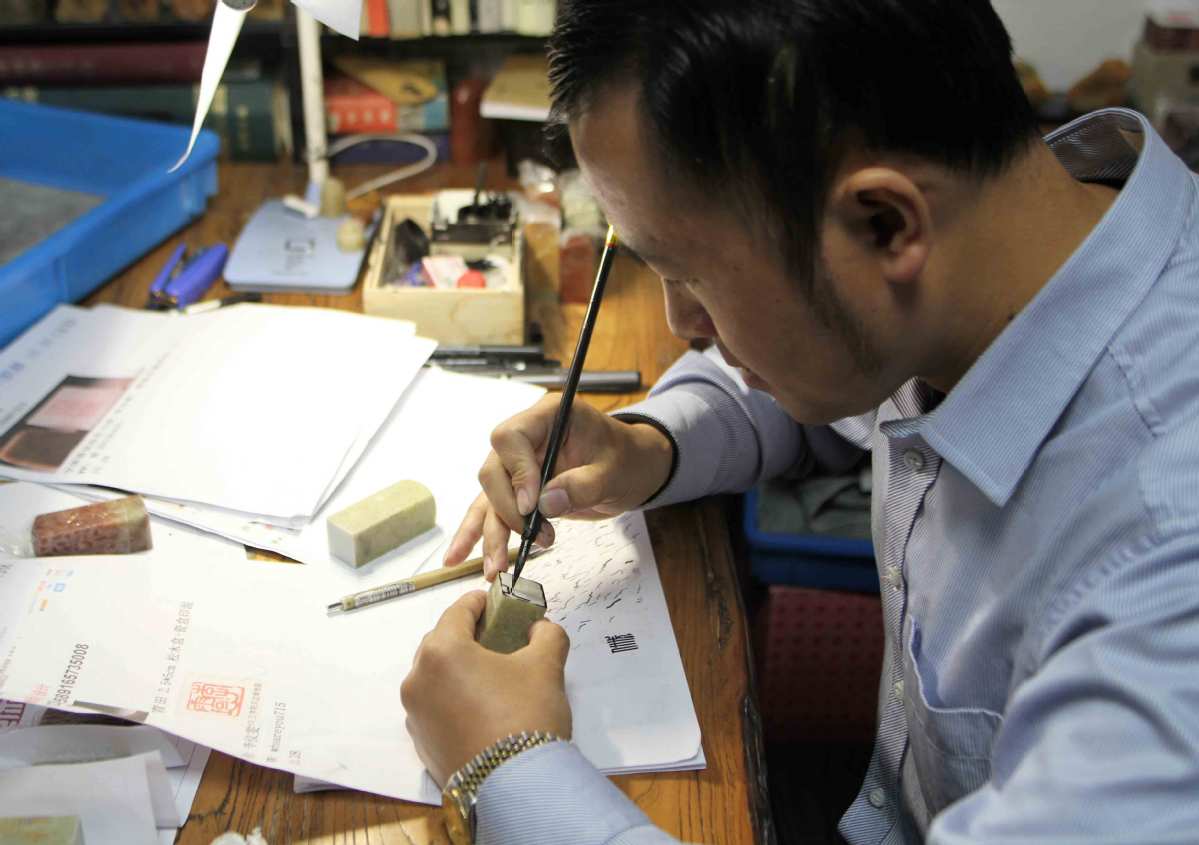
A typical example is its seal industry represented by the Kongfu Seal Pavilion.
Seals are worth much more than artifacts and contain profound cultural connotations. In ancient China, they represented promise and responsibility in a signed contract, and were symbols of social status. The art of Chinese seal-engraving was inscribed in UNESCO's representative list of humanity's intangible cultural heritage in 2009.
In the 1980s, Zhang Kai's father started selling seals at a market stall near the Temple and Cemetery of Confucius and the Kong Family Mansion, collectively known as San Kong. As more and more visitors arrived in San Kong, sales continued to grow.
"The reform and opening-up policy has made people richer, so many of them can travel to Qufu and buy our seals," Zhang said.
When Zhang graduated as a computer major in 2008, he adopted his father's suggestion to sell seals online. Soon, the name Kongfu Seal Pavilion began to spread.
"We had no orders in the first three days. The first order came on the fourth day," he said.
Yet by 2009, the online store was sometimes receiving dozens of orders a day. The following year, Zhang and his father felt unable to keep up with rising demand and started to recruit craftsmen to help.
After seeing the pavilion make a profit, many other villagers also began selling seals. "When that happened, we started to see unfair competition like price wars. So we tried to persuade them to join us and regulate the market in a unified and systematic way," Zhang said.
They formed a Kongfu Pavilion cultural seal-engraving group, with Zhang taking charge. Since then, over 100 families have joined, with membership reaching 800.
The pavilion sells about 20,000 seals a day to customers all over China and in countries including Singapore, Japan and South Korea. Zhang said the annual output value for Kongfu Seal Pavilion has grown from several thousand yuan decades ago to nearly 120 million yuan ($17.5 million) this year.
With culture playing a central role, Qufu's tourism is an important driver for economic development.
"Qufu's tourism started early but developed slowly," said Sun Zaibin, deputy director of the Qufu tourism administration. "Right now, it is developing with good momentum."
In its infancy, the tourism market mainly aimed to draw foreign visitors, and locals used Confucius and Confucianism as main selling points.
In 1984, tour packages began promoting the city as Confucius' hometown, with celebrities invited to promote Qufu's culture and tourism. Four years later saw the China International Confucius Cultural Festival established, and in 1994, San Kong attractions were endorsed by UNESCO as world heritage sites.
As Qufu's cultural and tourism industries developed, companies like San Kong Cultural and Tourist Service began to flourish. The company, established in 1984, started by selling souvenirs at San Kong sites. Today its business also covers back-end services like cleaning and regulating electric cars around San Kong, organizing performances like the Confucius memorial ceremony, study tours, and selling cultural and creative products.
"Our business now is related to the entire tourist chain including food services, accommodation, transportation, sightseeing, shopping and entertainment," said Dong Yajun, the company's deputy general manager. "In the past, we only thought of how to sell things to visitors, but now we're thinking about how to provide visitors with a better cultural experience."
Dong said that decades ago it was not important for employees to be knowledgeable because they just sold souvenirs. But now, in order to provide a better experience, it is important they can explain the cultural connotations behind the products.




- China launches group of internet satellites into orbit
- Former senior official expelled from CPC for serious violations
- Senior political adviser Yang Xiaowei expelled from Party, public office
- Former senior political adviser expelled, dismissed for legal violations
- Guiyang deputy mayor under investigation for discipline violations
- Chinese medical team sets up health education column in PNG newspaper