'Taihu's pearl' shines anew









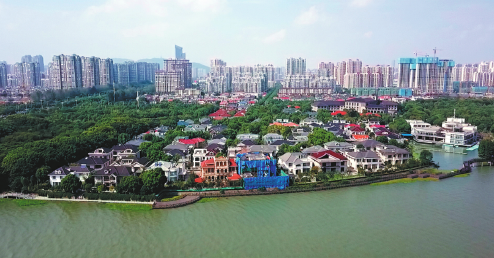
Wuxi is known as 'little Shanghai' because of its village and township enterprises that boomed after the reform and opening-up. But unfettered growth produced a blue-green algae bloom that has since pushed the city toward innovative and green development.
Editor's Note: This is Part 2 of the six-part Yangtze diaries series based on journalist Erik Nilsson's recent 35-day, 2,000-kilometer journey to 11 cities to discover how the Yangtze River Economic Belt has transformed over the 40 years since the reform and opening-up. Scan the code to watch the video.
I recently joined a fishing crew from Jiangsu province's Wuxi to haul up nets on Taihu Lake.
I later underwent a tai chi physical-therapy routine led by a virtual instructor using the internet of things. And I also picked grapes with a local entrepreneur, who abandoned his chemical company for green agriculture over a decade ago.
I discovered how these seemingly disparate experiences are interconnected in the story of Wuxi's rapid development, environmental crisis and recovery, and industrial transformation since the reform and opening-up.
The 3,000-year-old settlement is today known as "little Shanghai" because of its advanced industries and flourishing businesses.
The second-tier city has become a first-class economy. Its GDP exceeded $145 billion-roughly $7 billion more than Hungary's-last year.
Decades ago, rural residents put down their farming tools to start collective, cooperative and individual enterprises. They became leaders on the road from poverty to prosperity.
Many of these startups were based in the city's hinterlands. Some have grown into conglomerates, largely because of their early-mover advantage.
Wuxi's Shuangliang Group, for example, started as a chiller producer in Jiangyin, a county-level city under Wuxi. It was founded by seven retired soldiers, who invested their pensions.
Today, Shuangliang operates with several businesses, including energy production, dockyard services and hotels.
"Before the reform and openingup, we weren't allowed to set up our own companies," vice-president Ma Fulin says.
"And there was a default policy that employers could hire no more than seven workers. The change motivated people who were willing to start companies like Shuangliang."
Ma moved from Beijing to Jiangyin soon after the reform and opening-up in hopes of grasping its emergent opportunities.
"Many people were surprised I'd leave the relatively developed capital to come here," he says.
"It was very rustic then."
He designed machines that capture and harness excess energy from power plants.
"It initially took us three months to make a small machine," Ma says.
"Now, we can manufacture the biggest one in two weeks. They can power a medium-sized city. We're a world leader in this area."
I also visited the headquarters of Fasten Group, which produces steel cables used in over 800 bridges around the world, including many of the planet's largest.
The company-also founded by seven retired soldiers in what was then rural Wuxi-began by making hemp rope for ships plying the Yangtze. It evolved to become one of China's first fiber-optic-cable manufacturers.
Today, it's involved in the creation of international standards for steel cables and develops and produces much of the equipment it uses to manufacture fiber-optic products.
Wuxi has indisputably boomed since the reform and opening-up.
But, as a Chinese saying goes, "The water that carries a ship can also capsize it."