Anti-pollution effort pays off along Yangtze









Economic belt benefits from better coordination of ministries, provinces
Zhang Liangcai used to be a fisherman on Taihu Lake in the 1990s, but now he works as a lake cleaner since the city government of Wuxi, Jiangsu province, started to restore the lake's ecology in 2002.
The environmental campaign accelerated in response to a water crisis in Wuxi caused by pollution in 2007, and a "river chiefs" system was established in which government officials are assigned to protect waterways in their area.
"Now the water is much cleaner, and more birds rest here during the winter migration in recent years," said Zhang, 53.
The system has been spreading across China since 2016, and cross-provincial working procedures were established in November to coordinate joint anti-pollution inspections and water quality monitoring in the cities around Taihu Lake, the country's third-largest freshwater body, located in the lower reaches of the Yangtze River.
"Taihu Lake straddles Jiangsu and Zhejiang provinces, so procedures for cross-provincial communications and cooperation are needed," Wu Wenqing, the director of the Ministry of Water Resources' Taihu Basin Authority, said during the first plenary meeting of the two provinces' river chiefs on Nov 13.
This is just one example of the coordination efforts that have been taking place across ministries and provinces along the Yangtze River for balanced and sustainable development since the outline of the development of the Yangtze River Economic Belt was issued in 2016.
The economic belt, covering 11 provinces and municipalities and accounting for over 40 percent of China's population and GDP, has long been hailed as a major national economic engine.
Wu Xiaohua, deputy head of the Academy of Macroeconomic Research under the National Development and Reform Commission, said the economic belt is vital to China's economy as it has the largest workforce, the biggest industry scale, the strongest regional economy, the largest constellation of complementary industries and its development can greatly boost the neighboring area.
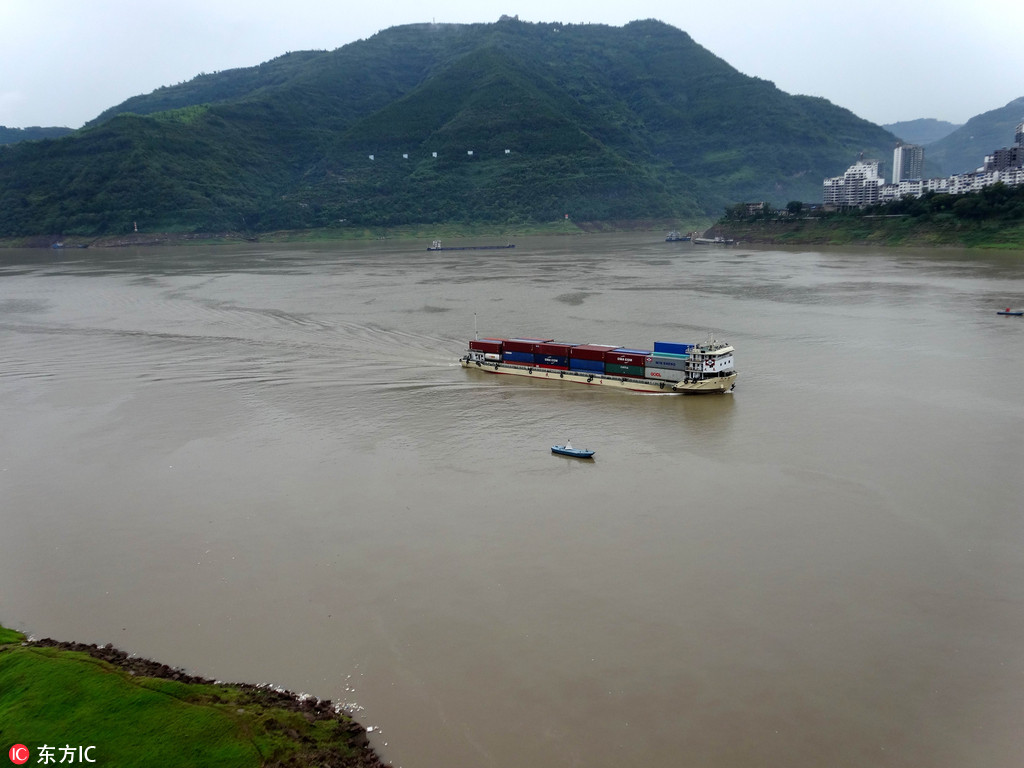
With 2.5 billion metric tons of goods transported annually through the Yangtze, the river is the busiest inland river in the world, Wu said, adding that the "Yangtze is a golden waterway."
In the Central Economic Work Conference in 2014, the government made the construction of the Yangtze River Economic Belt one of the priorities for balanced regional development.
At a meeting on the development of the Yangtze River Economic Belt, held in upstream city of Chongqing in January 2016, President Xi Jinping stressed that provinces and municipalities along the river and relevant State departments should reach agreement on making concerted efforts to build the economic belt with a beautiful environment, smooth traffic and a more coordinated economy and unified market.
Reflecting on Xi's speech, Wu said, "Coordinated development along the Yangtze is challenging as it involves more than a dozen State departments and provinces. There are coordinating mechanisms to strengthen and local protectionism to break."
Improvement has been made over the past years as various parties are working on cooperative mechanisms to break down administrative barriers.
A joint administrative office for Yangtze River Delta region was established in 2018 to formulate a three-year plan regarding the integrated development of Shanghai and neighboring provinces. Similar mechanisms for cities and provinces along Yangtze's midstream hub Wuhan and upstream center Chongqing were also built.
Cheng Changchun, head of the Jiangsu Yangtze River Economic Belt Research Institute, said Xi made it clear that the environment is the top priority in developing the economic belt in his remarks at a meeting to push the development of the initiative in Wuhan in April 2018.
"Regarding environmental protection, all of the Yangtze's tributaries matter, so there is more work to do together," he said.
To that end, the Ministry of Finance, Ministry of Ecology and Environment, Ministry of Water Resources and the National Development and Reform Commission have set aside an 18 billion yuan ($2.62 billion) fund to cover Yangtze River environmental protection and a compensation procedure by 2020 to give economic incentives to local governments.






- First cross-border event debuts at the National Games
- China Focus: National Games enhances coordination under 'one country, two systems'
- China's Fujian aircraft carrier to make regular appearances on high seas: spokesperson
- A decade of dialogues
- HK: a stage for art and cultural dialogue
- Tapping truly unknown wonders