


Immersed in virtual archaeological sites









Students at Northwest University can now use VR to visit and explore ruins and tombs while still in classrooms, Lu Hongyan reports in Xi'an.
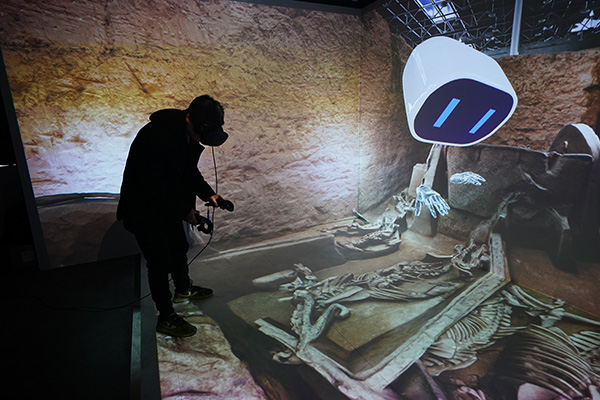
China's first immersive virtual-interactive teaching laboratory for archaeology was recently built by Northwest University in Xi'an, Shaanxi province, in Northwest China.
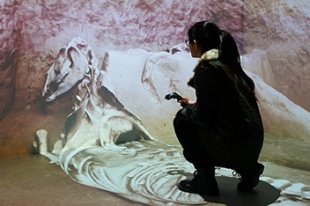
Through virtual reality, students at the university can "visit" archaeological sites while sitting in classrooms.
The laboratory was founded with the support of the Tang Zhongying Foundation.
This is the first archaeological teaching lab in a domestic university that uses VR to reproduce archaeological scenes and provide users with immersive and interactive experiences.
In the VR lab, where excavation sites can be reconstructed, students wearing equipment such as VR helmets and goggles can feel as if they are in a location that is being simulated.
They can observe the features of various ruins and grasp the basic procedures and methods of archaeological investigation and excavation.
Archaeology is a discipline that emphasizes the combination of theory and practice. Practice plays a key role.
However, the opportunities for students to participate in practical training and go to archaeological sites or museums are relatively limited.
The traditional two-dimensional classroom-teaching method of using pictures and words also makes it difficult for students to get intuitive experiences.
With the help of VR equipment, students can have a better grasp of the knowledge in books.
"In the immersive virtual-interactive teaching laboratory of archaeology, we can model the actual data collected from ruins and tombs, allowing students to experience them personally," says Ma Jian, deputy head of the School of Cultural Heritage of Northwest University.
"This can help students intuitively understand the characteristics of the different types of relics, describe the texts and pictures in the books more vividly, and gain a more detailed, more intuitive and three-dimensional understanding of them."