


Creative block









He has remained in the role since then.
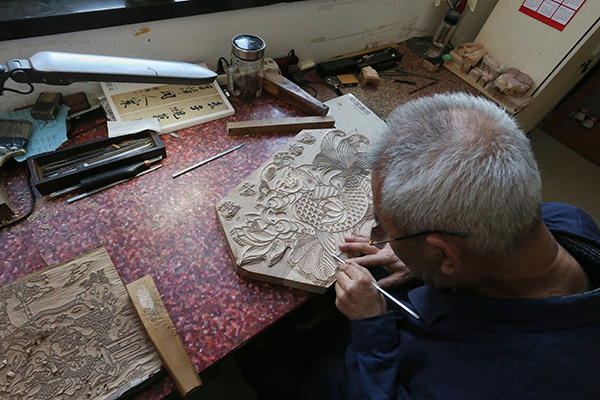
"It was difficult to learn how to accurately carve the lines at first," Wang says. "However, everything is fine with enough practice. There's no shortcut to hone such skills."
Traditional Yangliuqing woodblock printing has four processes: sketching the lines, carving the woodblock plates, printing with water, ink and pigments, and supplementary painting to create the halo effect, especially around human faces.
However, the procedure is highly time-consuming. Since only one color can be dyed at a time, it usually needs four or more plates to print one small picture, let alone bigger ones. Once printed, the picture will be aired for days to let the color dry, before applying the next one.
"No matter how small or large a picture is," Wang says, "we take no less energy."
After all, it is common for Wang to spend months creating one wooden plate, which is made of pear tree. The lumber has to be stored and dried for three years before it can be used.
After the plate is complete, the printing process itself can take up to a month for the picture to be finished and mounted.
Each artisan is in charge of one step in the whole process, a division of labor that is similar to the olden days.
Yangliuqing woodblock prints have abundant themes, which are inspired by literature, folk legends and myths, among others. However, the most recognizable are usually of auspicious symbols for the Chinese New Year.
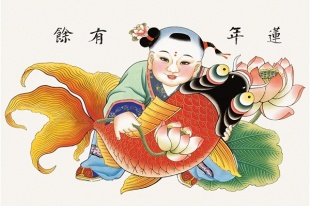
A picture portraying a chubby baby holding a fish (yu) by a lotus (lian) is probably the best known symbol from Yangliuqing. It expresses the Chinese New Year wish, lian nian you yu, which means "there will always be some surplus year after year."
Historical records show that the Yangliuqing town and its surrounding villages were full of picture workshops during the Qing Dynasty (1644-1911).
However, the early 20th century saw the arrival of the modern offset printing technique in China.