A chilled beef-grilling experience awaits









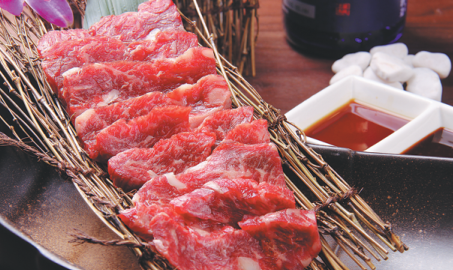
Everybody's tastes are different, especially when it comes to cooking meat. Some people, for instance, like their steak blue and "bloody", while others may prefer to cremate them to within an inch of becoming charcoal. Therefore, for mixed groups, Asian cooking styles like Chinese hotpots and Korean barbecues are great, allowing diners to prepare their food just the way they like it.
However, some styles of cooking, to be properly enjoyed, require rules-which is something Japanese chef Shioyama Shinpei is advocating at his newest restaurant, Gyu Tetsu.
Located in the Maizidian area of Beijing, it's a Japanese-style barbecue beef restaurant with an izakaya, a type of informal pub.
On the back of the menus, Shinpei explains the best way to grill the beef with four golden rules.
The first rule is that the beef is ready to eat when it's cooked medium-well.
Rule two: Cook one side of the beef for 70 percent of the time, then flip it over for the remaining 30 percent of the cooking time.
Number three is not to overload the grill with too much meat at once, and the last-and perhaps most important-rule is: The better the quality of meat, the shorter time it needs to cook.
The catch, however, is that they are all written in Japanese, even when he adds "one more tip, offal should be lightly cooked over a low heat." But then, it's taken him many years to gain such culinary knowledge, it seems somewhat awry that we should get it without having to do a little work, even if it is with the help of a translator app.
Providing high quality chilled, fresh beef, Shinpei hopes his diners can enjoy the delicacy the right way, under the right conditions.
"Nowadays people are constantly checking their phone during mealtime, but to enjoy Japanese barbecue, especially the premium Wagyu beef, they should be focused on grilling it and eating at the right time," says Shinpei.
Russian writer Leo Tolstoy once said that "Art is not a handicraft; it is the transmission of feeling the artist has experienced", likewise, Shinpei thinks when high-quality food meets discerning diners, the depth of experience becomes a meaningful collision of taste and emotion.
Sculptures of a bull's head and a cow stand sentinel at the eatery's entrance and the entire space adopts a traditional and inviting Japanese style, from its walls of dark wood, to its wooden lattice dividers and classic Japanese sunken seats.
Born on the Japanese island of Shikoku, Shinpei started his culinary journey at a ramen restaurant during one summer vacation when he was just 15 years old. He then went on to work in Shinjuku, Tokyo in the restaurant of a renowned izakaya for over 10 years.
In August 2005, when Shinpei first traveled in China, he immediately liked the place and decided to move. Three months later he got a job in Beijing and has remained in the capital for over a decade.
In 2014, Shinpei opened his first Japanese cuisine restaurant in Beijing, and Gyu Tetsu is his eighth culinary venture.
"Each of my restaurants has its own specialty, including udon, ramen, or pub food. In this newest one, I want to focus on Japanese barbecue," he says.
To find the best quality beef, Shinpei and his team searched countless locations before finally choosing chilled, fresh beef delivered directly from a ranch in Shenyang, Northeast China's Liaoning province.
The cattle there are raised under rigorously maintained conditions which is the same as the necessary standards required to be called "Wagyu" beef. That includes a special feeding regimen and strict requirements regarding the location, the amount of sunlight afforded to, ventilation and height of the cowsheds. Specific dietary formulations are also necessary, and the animals can only undertake a small amount of activity in order to ensure the meat they produce is tender.
The chilled meat then has to be stored at temperatures ranging from minus 4 C to 4 C. "Chilled beef is soft, tender and remains closer to its original state, resulting in delicious and juicy meat when cooked," says Shinpei.
Six special sauces are provided to heighten the flavor of the beef, including soy sauce, grapefruit juice with carrot puree and sesame sauce.
At Gyu Tetsu, the act of barbecuing becomes both elegant and environmentally friendly. Every sizzle and flip of the meat is like painting a picture and playing a song, satisfying all the senses, while the charcoal under the grill is made from binchotan, used specially for Japanese barbecue. Binchotan is made of hard Wugang wood, Qinggang wood and Moso bamboo by traditional Japanese charcoal burning methods.
"The burning temperature is over 800 degrees, which instantly seals in the flavor of beef and its juices," Shinpei explains. "It's also smokeless and flameless when burning."
Gyu Tetsu serves not only barbecued meat, but also a variety of side dishes, ramen, sashimi and sukiyaki. The restaurant undergoes a wonderful transformation during every meal-when the charcoal brazier is finally removed, it is instantly transforms into a Japanese izakaya.
At Gyu Tetsu, a wide selection of drinks is provided to accompany each meal-beer, sake, plum wine, highballs, wine and soft drinks are all on the menu.
There are more than 30 varieties of sake, alone. Great for the aficionados, as well as ensuring the perfect pairing with the barbecued meat. Colorful wine cups, personally selected by Shinpei and brought back from Japan, as well as traditional sake pots and masu cups, allow diners to experience Japanese drinking culture.
"Highballs and beer also pair perfectly with Japanese barbecued meat," says Shinpei.