New direction fires up China's porcelain capital









Transition
Though porcelain making has a history of 1,700 years in China, the industry largely remained a manual operation until 1958, when the first mechanized workshop was opened.
Jingdezhen, once an important porcelain export base, saw a drastic decline in profits in the 1990s when inland, State-owned factories lost their edge over their coastal counterparts, which had better equipment, and workshops closed one by one.
Taoxichuan was built on the site of the former Yuzhou Porcelain Factory, one of the closures. Piles of white porcelain plates under the trees next to a grand hotel in Taoxichuan tell the sad story of the once-flourishing State-owned factories.
"This is the last batch of ceramic products made by the Yuzhou Porcelain Factory. Most of them are inferior products," said Wang Songshou, former head of the factory.
In the late 1990s and early 2000s, more than 60,000 technicians and workers left and moved to other porcelain-making areas. As a city that relied on the industry, Jingdezhen fell into recession.
As a result, the city authorities faced a tough decision-continue the tradition of handmade porcelain, or change direction and shift production into construction and bathroom ceramics like the workshops in the coastal areas.
As in many other cities, a large number of obsolete factories and traditional alleys in Jingdezhen were demolished in the first 10 years of the century to accommodate real estate development, a cash cow for local governments.
However, in 2011, the administrators realized that high-rise buildings would not bring lasting prosperity.
"Each alley and chimney is a precious resource that records the city's history," said Liu Zili, general manager of the Jingdezhen Ceramic Culture Tourism Group and former deputy head of the city's Porcelain Industry Development Bureau.
"You will never have another Jingdezhen with a millennium-old culture."
The local government invited planning experts from across the globe to design a path for the city's future. That led to abandoned factories being turned into incubators that attracted capital, information, technology and talent.
Taoxichuan, where 22 old workshops of varying structures and kilns were located, was renovated to become an art zone.
More than 450 million yuan has been invested in Taoxichuan since 2013, turning it into an artists' community that is home to more than 5,000 young people.
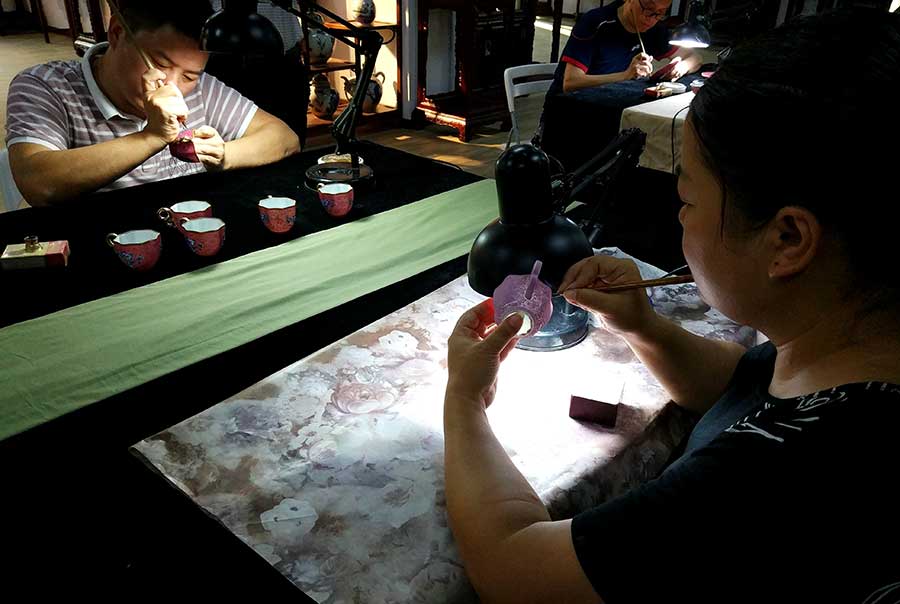
To protect and enhance its unique handmade porcelain industry, the city opened an industrial park named Mingfangyuan in 2015 to house time-honored workshops, both for production and tourism.
Zhu Xiaoping, an eighth-generation inheritor of traditional porcelain manufacture, was one of the first masters to move to a new villa-like workshop from his humble one in the downtown.
Using a formula inherited from his ancestors, Zhu successfully replicated a tough red glaze that was extremely rare even in the ancient royal kilns.
Its refined noble character rapidly became popular among collectors. Now, porcelain bearing the famous glaze is often given as national gifts to foreign leaders.
"Porcelain flourished when China was strong. It went into decline when China was weak," Zhu said. "Thanks to government support, Jingdezhen is flourishing again."
Meanwhile, the city has extended the value chain to the production of fine and special ceramics that can be used in aerospace and electronics manufacturing. In 2017, the value of the city's porcelain industry reached 37.2 billion yuan, eight times the figure 10 years ago and 263 times that in 1978.



- Guangdong urged to drive high-quality development
- Shanghai hosts 6th intl 3E talent fair
- Xi's special envoy attends inauguration of Bolivian president
- Countdown to 15th National Games: On-site warm-up entertains audience
- Eight missing after cargo ship collides with fishing vessel near Shandong
- Investing in people: a worthwhile investment