Relocation provides isolated villagers with better homes and lives










Poverty alleviation efforts in the Tibet autonomous region are accelerating. For example, by the end of last year, 25 counties in cities and prefectures such as Shigatse, Lhokha, Chamdo and Ngari were no longer designated as "impoverished", along with 2,100 villages and 181,000 residents, according to a statement from the regional government last month.
With China on course to build a moderately prosperous society in all respects by the government's target year of 2020, Chamdo, once one of the poorest areas in Tibet, is sparing no efforts to catch up with the rest of the country.
The local urban planning bureau said several key zones have already been mapped out to function as centers for business, trade, high-tech companies and cultural parks.
Construction of the Chamdo section of the Sichuan-Tibet Railway is expected to begin in June, according to Abu, Party secretary of Chamdo.
The link will be Chamdo's first railway line, but it will be the second to connect Tibet with the rest of the country, and Abu, who only uses one name, hopes the completion of the railway will greatly improve travel for residents and the exchange of goods with other provinces.
Over the years, the city has been relocating residents who lived in areas with scant natural resources, poor living conditions or the threat of endemic illnesses. The local government aims to complete the resettlement project and make sure the people are well accommodated by next month.
Tarog, a village that sits beside a national highway on the outskirts of Chamdo, is one of the new government-aided settlements. It is home to 105 households who moved from a remote area near the summit of a mountain.
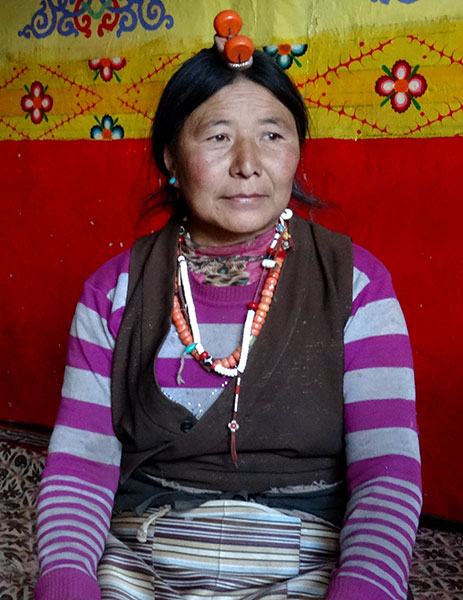
Konchog moved to Tarog village with her family in 2013. The 58-year-old used to live in a cottage made from mud bricks and wood in a village surrounded by snow-capped mountains about 12 kilometers away.
The village had no electricity or water supplies, and it usually took two days to make a return trip to Chamdo on foot if Konchog wanted to see a doctor or purchase home supplies.
Initially, she was unwilling to move because she found the idea of refurbishing a new home too troublesome.
"When I saw our neighbors who had already moved start to live better lives, my husband and I decided to do it. We didn't have the strength to build a house by ourselves, so we are grateful to the government for providing a new home for us," she said.
From the outside, Konchog's old village looks abandoned, but some former residents still return to their old cottages occasionally to tend their yaks or dig a worm-like fungus when it is in season.
They no longer have to rely on their feet to make the trip, as a few automobiles can park in an open space with yaks grazing alongside.
Tashi, 69, a retiree who used to make a living by shepherding yaks and digging the fungus in a poor village higher up the mountain, lives a leisurely life in his two-story house, which has been painted white and red.
His old village also lacked running water and electricity, and it was almost inaccessible by road, so there was no way to send children to school.
In 2012, Tashi moved into his new home and gave up his work as a shepherd, meaning he no longer has to feed the yaks.
The interior of his new house is decorated with knitted blankets, new wooden furniture, a fridge and a big home sound system bought by his son.
With piped water directly connected to the sinks, the big copper vessel that used to store water is now redundant and crammed with unused items.
"Life is changing for the better so rapidly that sometimes I feel that I am living in a dream," he said.